
Embedded payments means a software platform sells payments to its merchants inside its own product, under its own brand, instead of referring them to a bank or processor. For ISVs, PayFacs and the PSPs serving them, it turns software into a payments business. NORBr's white-label infrastructure lets platforms take on branding, commercials and risk step by step.
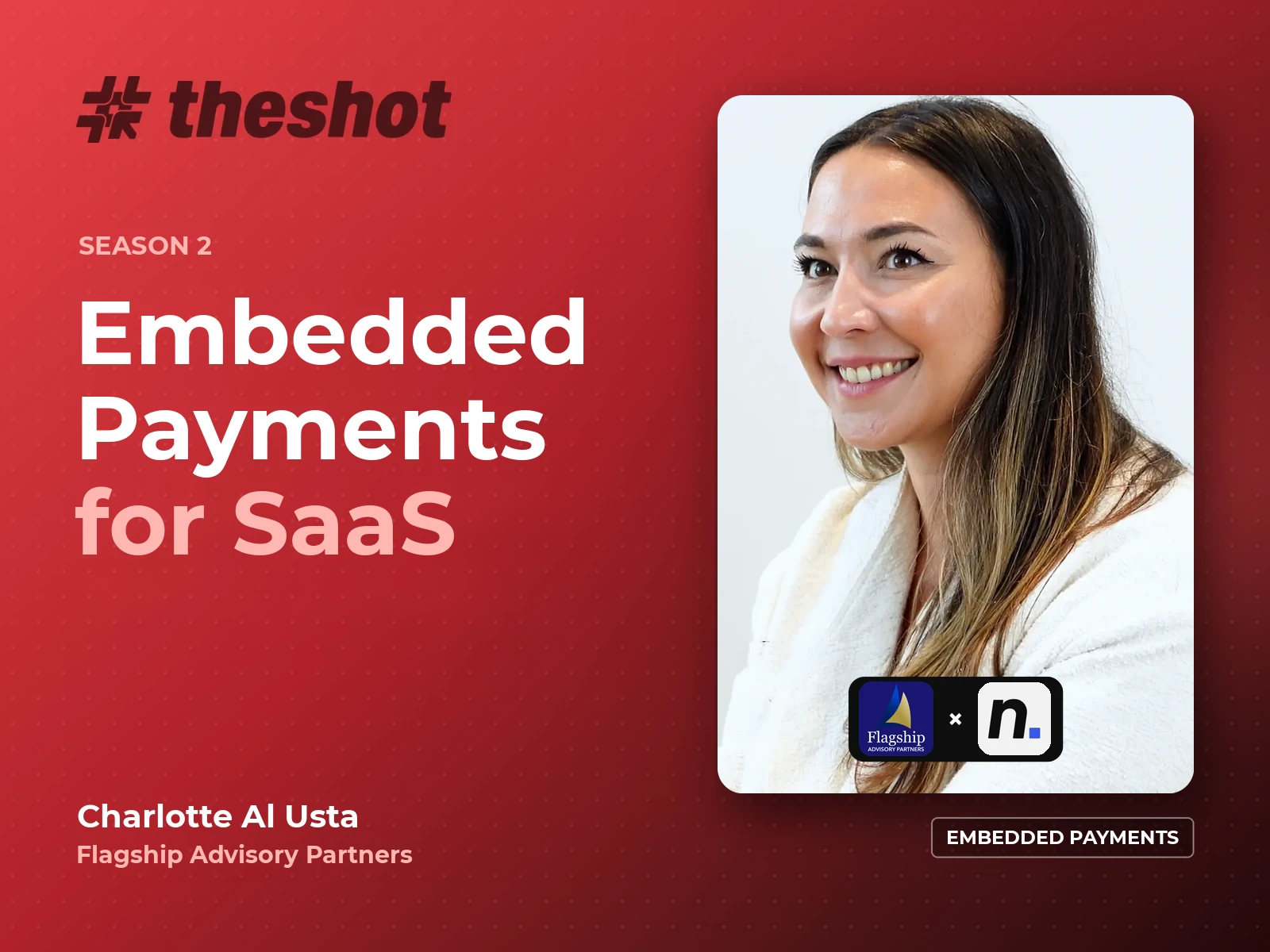
A new restaurant chooses its location, then its stock, then its software, and only then thinks about card payments. Charlotte Al Usta, Principal at Flagship Advisory Partners, starts from that order of purchase to explain why software platforms are in the best position to own the checkout. NORBr invited her to Season 2 of #TheShot to walk through the opportunity, the European gap and the journey from referral partner to PayFac.
This article, updated in October 2026, follows the five episodes of Season 2 and checks the numbers behind them against the latest company filings and Flagship's own research.
Key takeaways on embedded payments for SaaS:
- Small businesses buy software first and payments second, which gives software platforms a distribution advantage.
- For the platforms that went furthest, payments generate most of the revenue.
- Europe is behind the US, which leaves room for platforms that move now.
- Platforms follow a maturity curve, from referral to integrated payments to full PayFac, and lending is the most likely next product.
Why do embedded payments matter so much for SaaS platforms?
Because payments are a follow-on purchase that the software platform is already in the room for. Small businesses want one bundled solution, have little time to compare providers, and tend to keep the first one that works. Charlotte puts the figure at 80% of small businesses going with the first provider they find.
"If you're a software platform and not embedding payments yet, you're leaving a lot of revenue on the table, and risk falling behind competitors who are moving fast in embedded finance." Charlotte Al Usta, Principal, Flagship Advisory Partners, in Episode 1
The latest filings show how far the leaders have gone. Financial technology solutions brought Toast $1.57 billion of its $1.91 billion revenue in the second quarter of 2026, about 82%, according to its Q2 2026 results. Merchant solutions, mostly payments, made up 78% of Shopify's revenue in the same quarter, according to its Q2 2026 release, and transaction fees were 73% of BILL's revenue in its fiscal year 2026. The shares have moved since Charlotte recorded the season, but the point holds: for these companies, software is the entry point and payments are the business.
Why is Europe behind the US on embedded payments?
In the US, most new small businesses already get their payments through their software, not through a bank, an ISO or a processor. Charlotte estimates that Europe and the UK are about five years behind, and sees that delay as an opening rather than a problem, especially for POS-focused platforms.
"Think Lightspeed. Toast. Square. These aren't just platforms, they're the new PSPs." Charlotte Al Usta, in Episode 2
Flagship's latest research explains part of the gap. In Comparing North American and European PayFacs, 2026, published on 7 October 2026, Charlotte and her co-author find that PayFac registrations peaked in 2024 in both regions and have since fallen by 11% in North America and 6% in Europe and the UK, as mergers and the managed PayFac model replace full registration. European ISVs face a heavier regulatory burden, because becoming a PayFac usually means holding a payment institution or e-money licence, which is why most scaled platforms sit in a managed model where a partner carries the licence.
How do SaaS platforms move from referral partner to PayFac?
Step by step. Most platforms start with a referral partnership: they send merchants to a payment provider and earn a small share of the revenue. Once they see the volume, they integrate payments and launch a branded, native offer. Later they add other financial products, and some eventually take full ownership of brand, commercials and risk.
"Everyone wants to be the next Toast or Shopify, but few talk about the journey it takes to get there." Charlotte Al Usta, in Episode 3
Shopify is her example of pacing it right: payments in 2013, then Shopify Capital in 2016, then further products over the following years. Each stage asks for different capabilities from the infrastructure underneath: a referral needs none, an integrated offer needs onboarding and a branded checkout, and a full PayFac needs underwriting, risk monitoring and settlement control.
Which financial products come after payments?
Payments are the starting point of a wider finance layer: lending, payouts, business accounts, FX, card issuing and even insurance. Charlotte's argument in Episode 4 is that banks cannot embed these products at the right moment in a vertical workflow, while software platforms already have the distribution, the data and the timing.
Lending comes first. In Flagship's survey of more than 100 North American SaaS platforms, lending is the product most platforms plan to launch after payments, ahead of card issuing and banking services. Charlotte breaks down the merchant demand in Episode 5: half of merchants want to grow, 20% need to manage cash flow and 30% face unexpected costs.
"You already own the data. You already know the timing. That's your edge." Charlotte Al Usta, in Episode 5
For platforms, the payoff she describes is a higher lifetime value per merchant, lower churn and repeat use within 12 to 18 months.
What should ISVs and the PSPs serving them put in place?
Infrastructure that matches each stage of the journey, without a migration at every step. In practice, that means:
- A branded payment offer: a payment platform with the ISV's own domains, roles and checkout.
- Onboarding inside the software: merchant invitation, KYB and partner applications in one onboarding workflow.
- Licensing handled by a partner: for European platforms that do not want to become a payment institution, payments without the PSP burden.
- Revenue the platform controls: pricing and margin set by the ISV, described in payment revenue.
On NORBr's white-label payment infrastructure, an ISV can start with a managed setup and take on more of the brand, commercials and risk as its volume grows, on the same platform and with the same merchant data. NORBr does not lend to merchants: platforms that add lending connect a specialist partner on top. The embedded payments guide for ISVs and the build versus buy comparison cover the decision in more detail.
Who is Charlotte Al Usta?

Charlotte Al Usta, Principal, Flagship Advisory Partners. Charlotte advises payments, fintech and software companies on strategy at Flagship Advisory Partners, a consultancy specialized in payments and fintech. She writes regularly on embedded payments and PayFac models in Europe and North America, including Flagship's 2026 comparison of North American and European PayFacs. Follow her on LinkedIn and Flagship Advisory Partners on LinkedIn.
The merchant decides on payments once, at the moment it buys its software, so the platform that is not ready at that moment loses the payment for years.
NORBr is the white-label payment infrastructure for PayFacs, PSPs, ISOs and ISVs. Software platforms launch payments under their own brand and grow from managed to fully owned on the same platform.
About #TheShot: a video series sharing clear, unsponsored insights from payment professionals. One expert, one topic, short episodes. Watch Season 2 with Charlotte Al Usta or browse all seasons.