Cards expire.

Payments don't.

Network Tokens replace the card number at scheme level.

Card networks issue Network Tokens to replace the PAN in payment flows. When a card expires or is replaced, the token updates automatically. When a provider doesn't support tokens, NORBr falls back to PAN without interruption. Your merchants see higher authorization rates, lower scheme fees, and no disruption on recurring payments. You give them that infrastructure by selecting a tokenization partner in a contract field. Nothing else changes.

Book a demo
Hero image

Activated in one field. Invisible  in every flow.

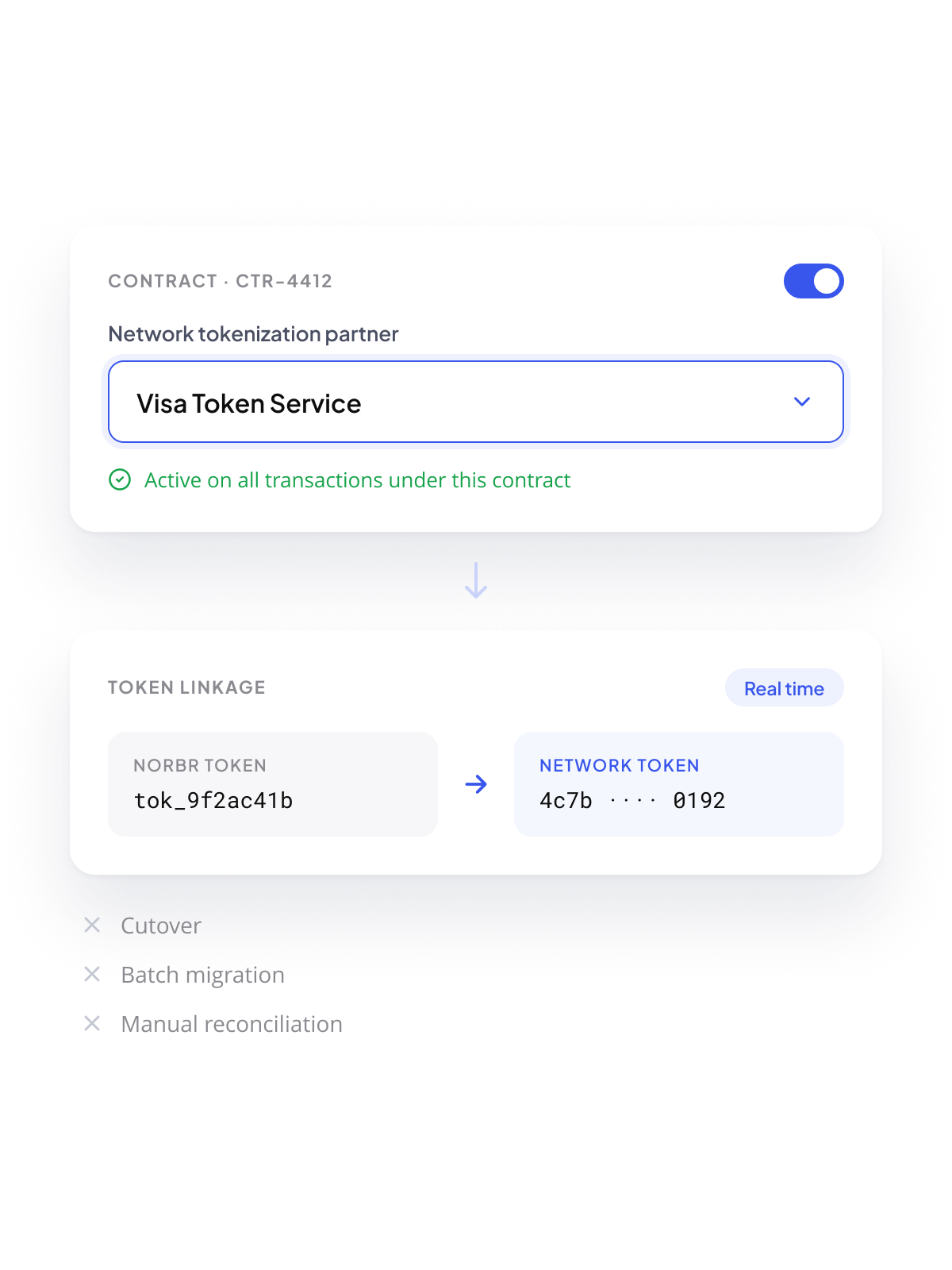
Network Tokenization is configured at contract level. Select a supported tokenization partner in the contract settings. That's the only action required. NORBr automatically links the Network Token to the existing NORBr token for that payment method. No data duplication. No API change. No migration of existing payment data. Merchants keep processing exactly as before, now with token-level performance built in.
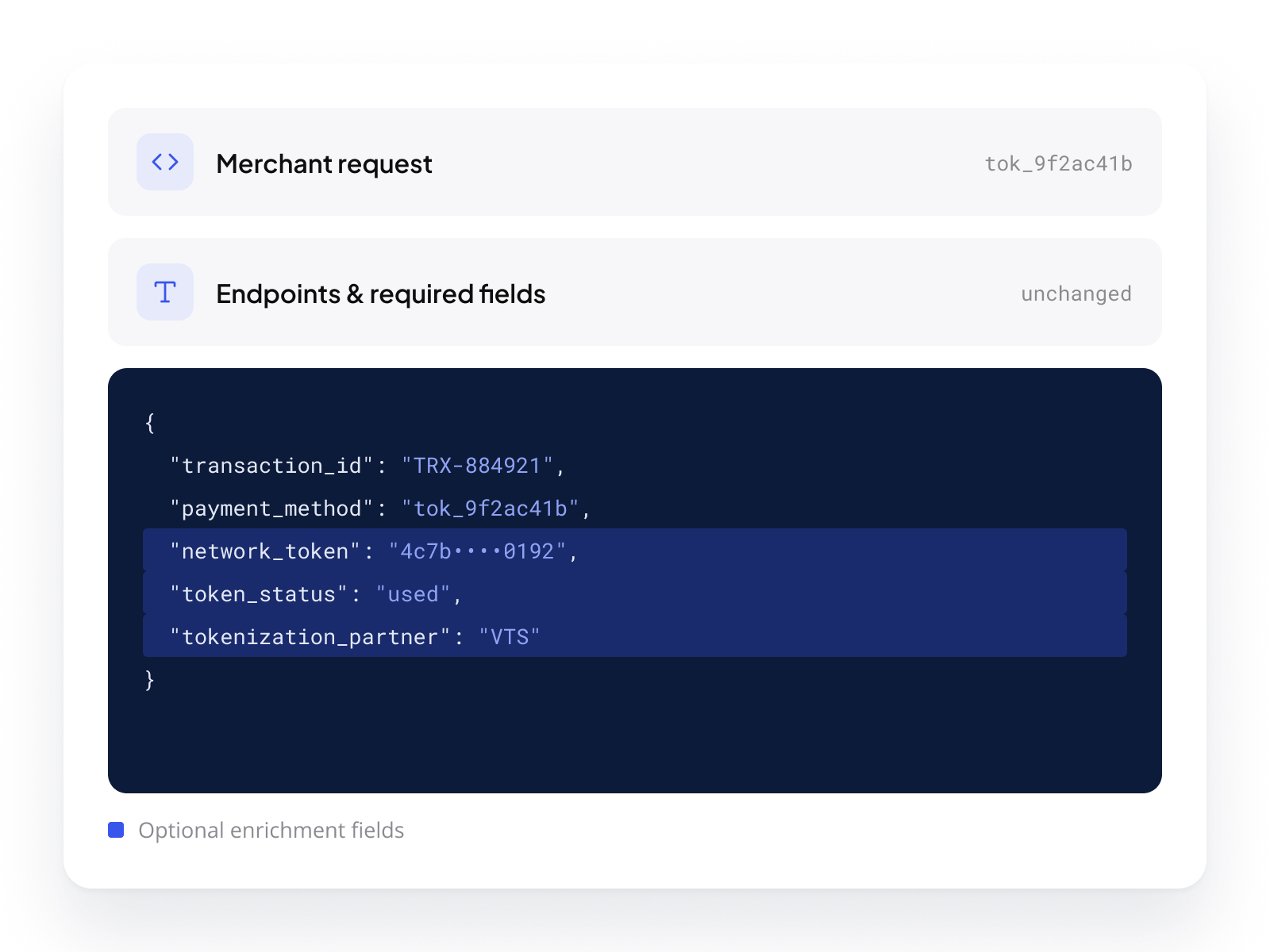
One activation. Full compatibility.
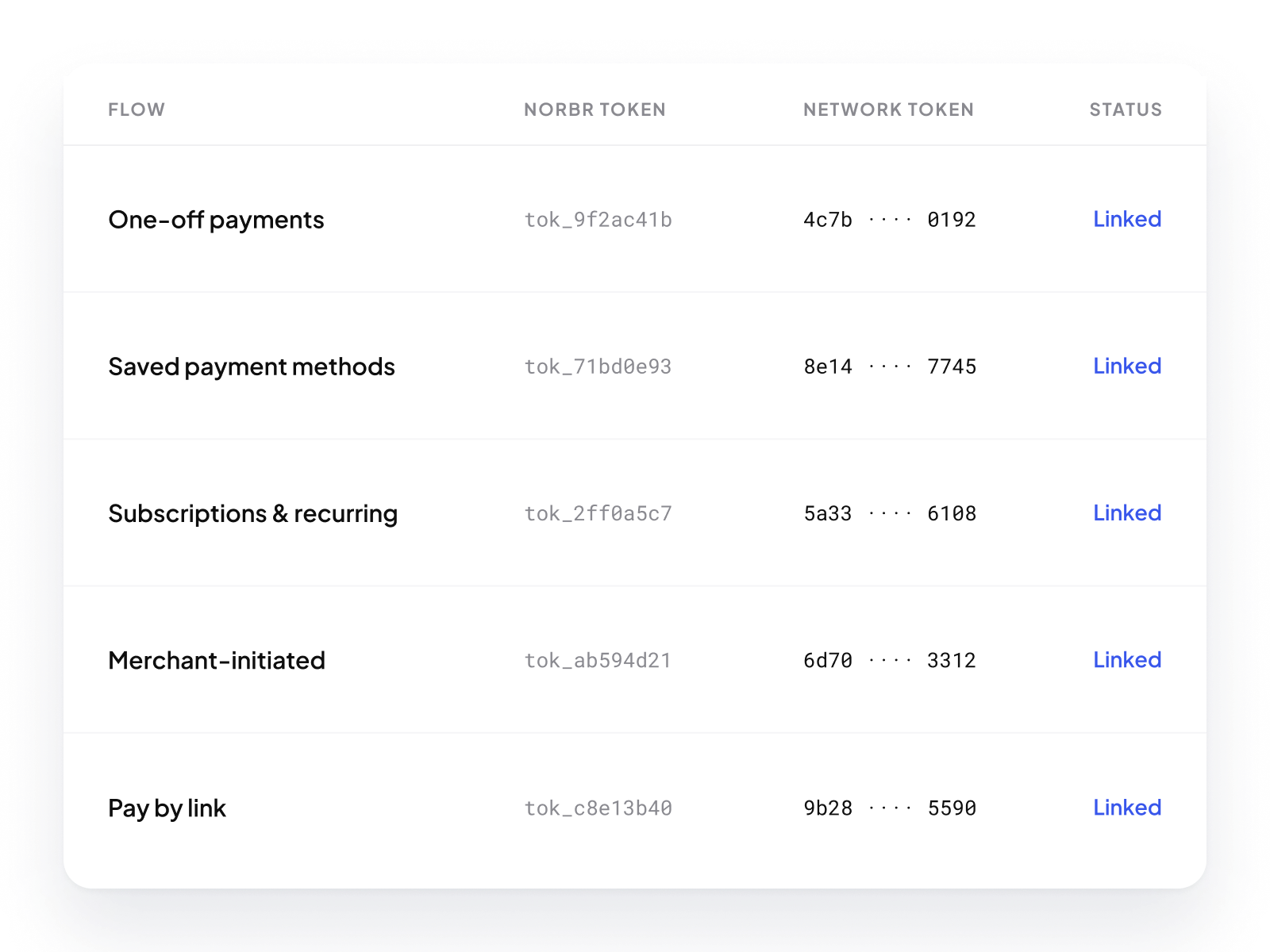
When Network Tokenization is enabled on a contract, it applies to all transactions processed under that contract. Existing NORBr tokens are automatically linked to their corresponding Network Token as soon as one is available. There is no cutover, no batch migration, no manual reconciliation. The linkage happens at the infrastructure level, silently, in real time.
No change for your  merchants' integrations.
Network Tokens do not introduce new fields, new endpoints, or new flows for your merchants' development teams. Token data is available in transaction records and API payloads as optional enrichment fields. Merchants who want to track token usage can. Merchants who don't notice nothing has changed in their integration. The feature is additive, never breaking.
Smart routing. Automatic fallback.
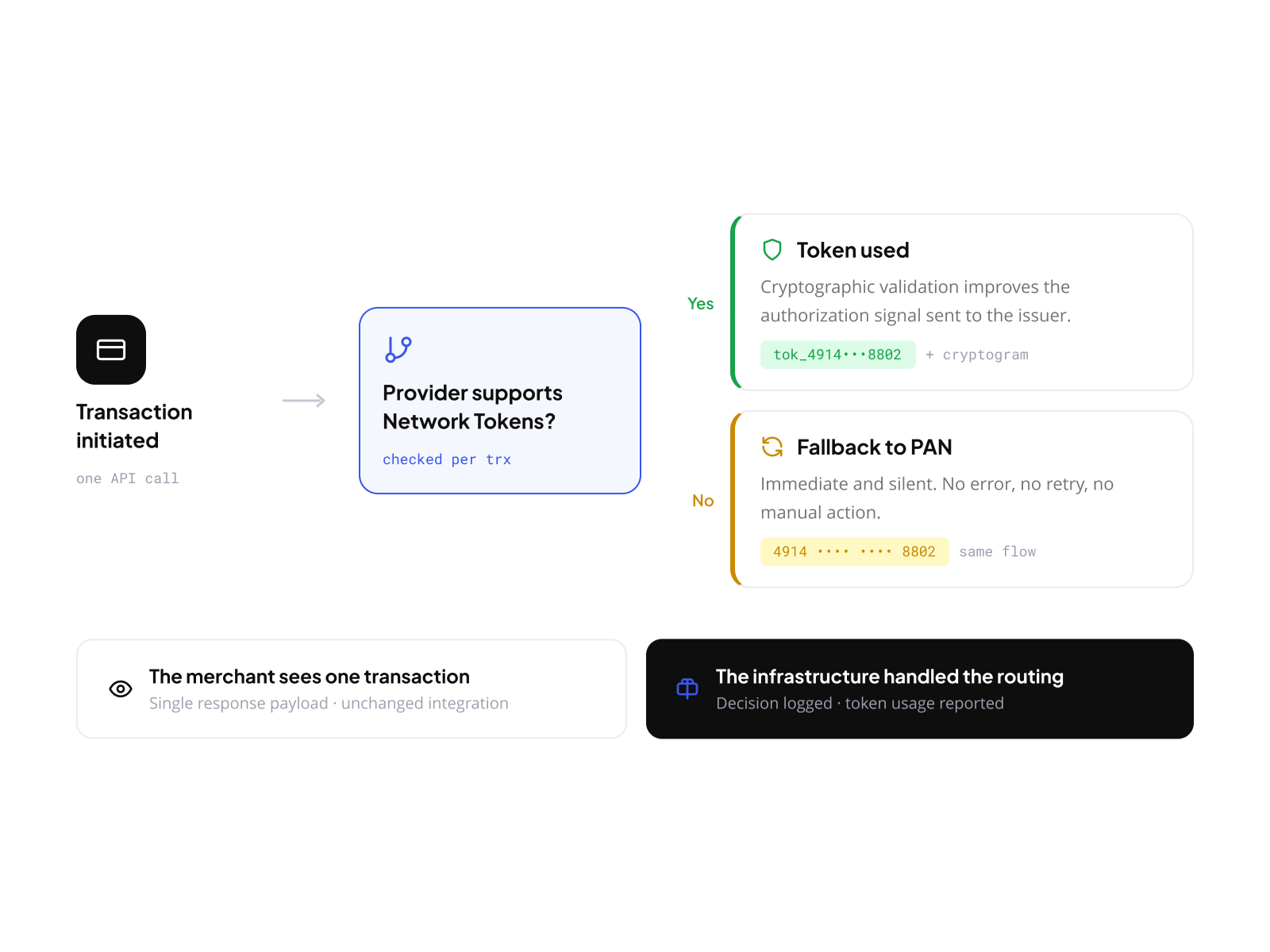
Not every payment provider supports Network Tokens. NORBr handles that automatically. When a transaction is processed, NORBr checks whether the selected provider can handle the Network Token. If it can, the transaction goes through with the token and its cryptogram. If it can't, NORBr falls back to PAN transparently. No error. No failed transaction. No manual configuration required.
Token when possible. PAN when needed.
The routing decision happens at every transaction, in real time. If the provider supports Network Tokens, the token is used and the cryptographic validation improves the authorization signal sent to the issuer. If the provider does not support tokens for this transaction, the fallback to PAN is immediate and silent. The merchant sees one transaction. The infrastructure handled the routing.
Resilience built into the flow.
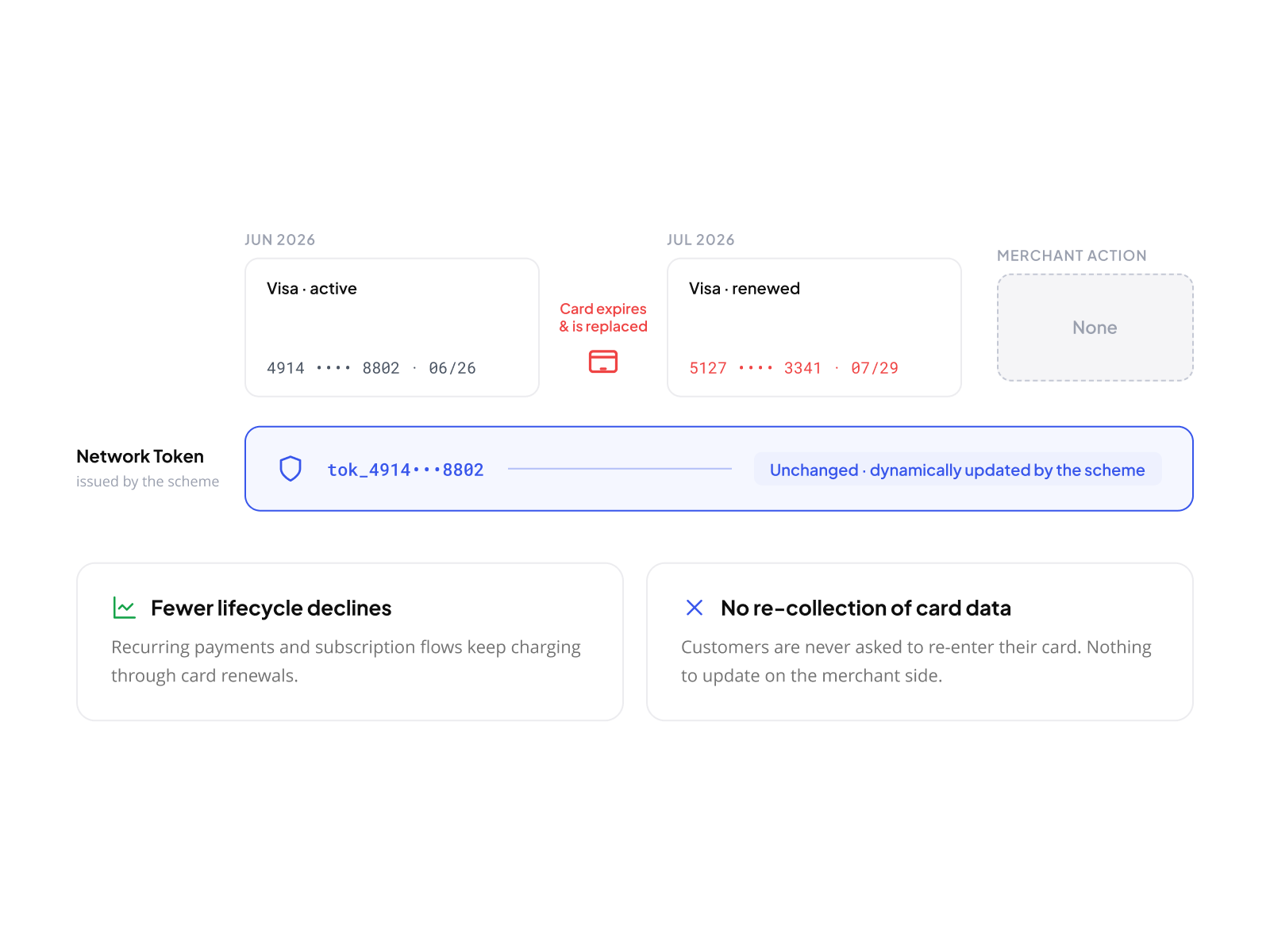
Network Tokens issued by card schemes are dynamically updated when a card expires or is replaced. A token that was valid for a Visa card last month remains valid after the card is renewed, without the merchant needing to update anything. For recurring payments and subscription flows, this means fewer declines driven by card lifecycle events, and no need to re-collect card data from customers.
Measurable benefits. From day one.
Network Tokens improve the payment signal sent to issuers, reduce exposure to card lifecycle changes, and lower the cost of processing. These are not theoretical improvements. They are measurable from the first tokenized transaction, visible in the platform analytics, and attributable to the token layer specifically.
Higher authorization rates. 
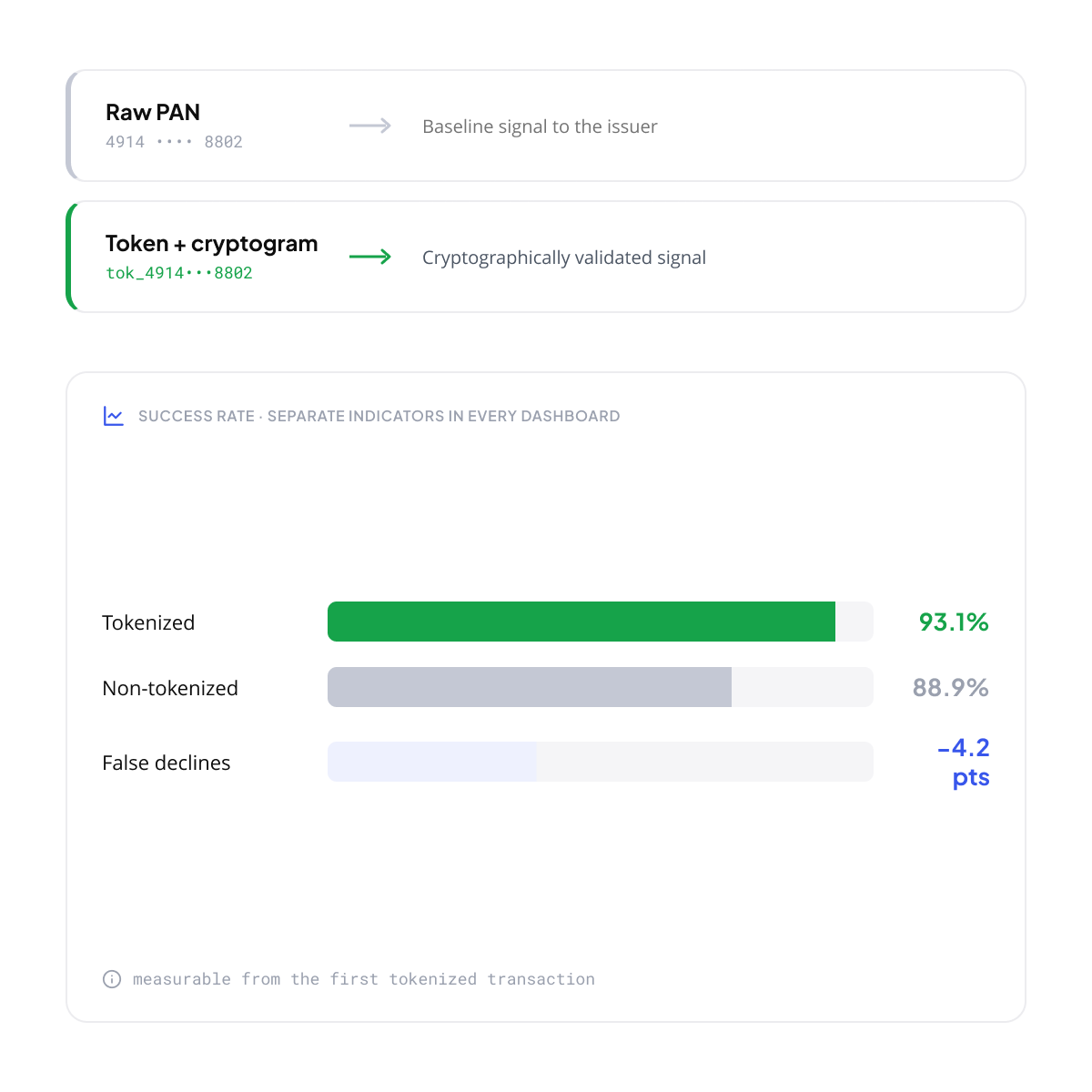
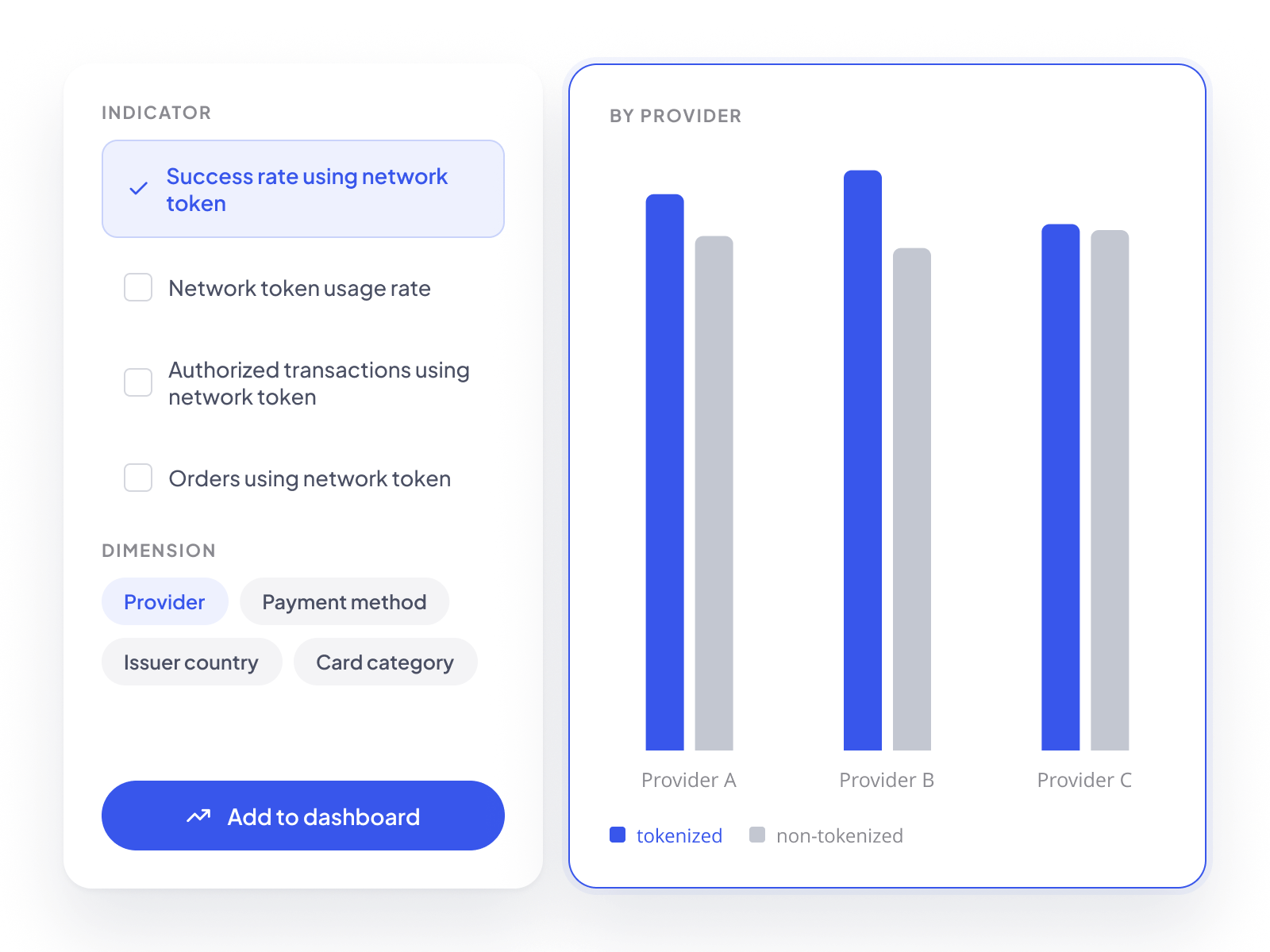
Network Tokens carry a cryptographic validation (cryptogram) that issuers recognize as a stronger signal than a raw PAN. This reduces the rate of false declines and improves the probability of authorization on first attempt. The improvement is measurable directly in the platform: tokenized vs non-tokenized success rates are available as separate indicators in every dashboard and overview.
Card expiry resilience. Recurring payments continuity.
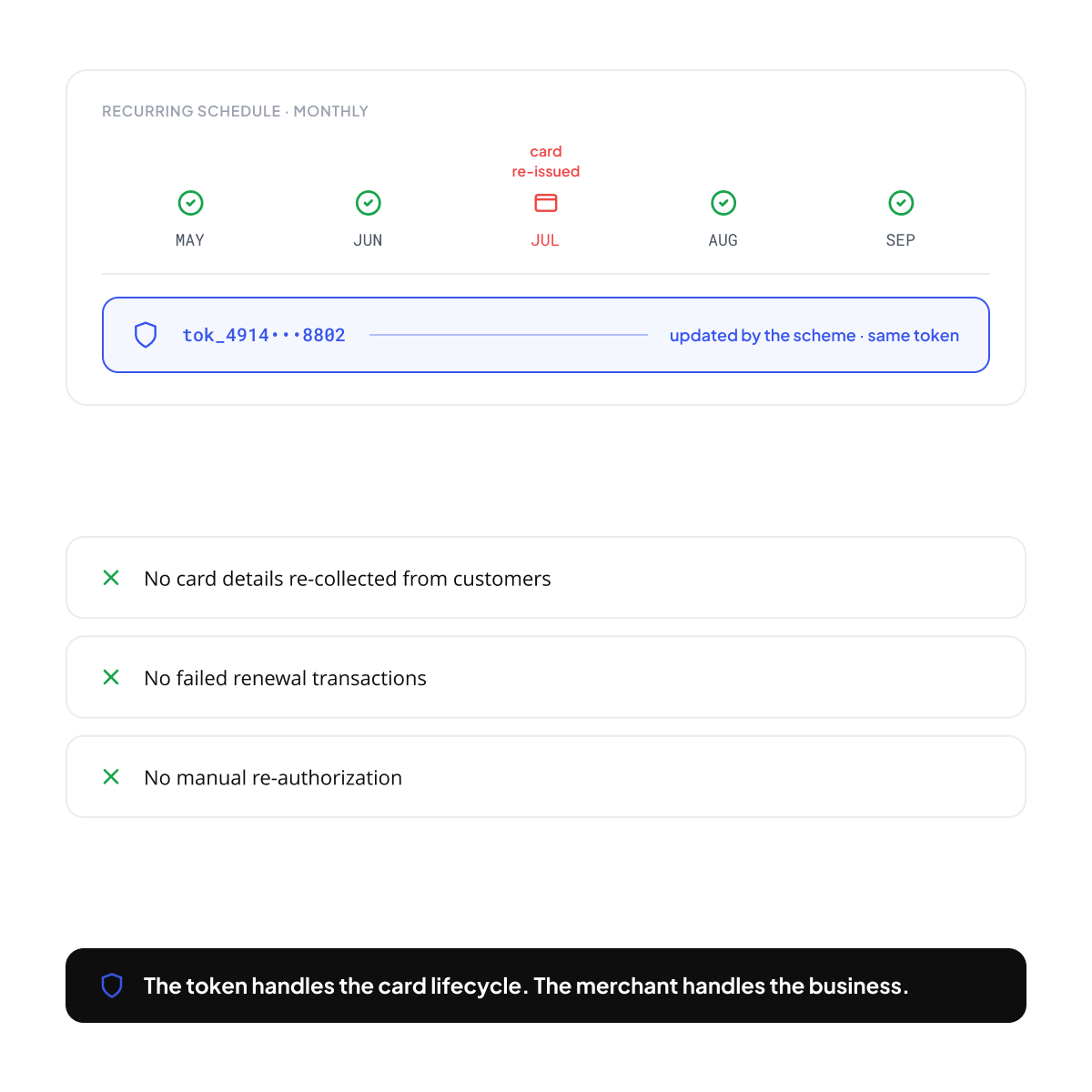
When a card expires, is replaced, or is re-issued, the corresponding Network Token is updated automatically by the scheme. Recurring payments and subscription flows continue without interruption. There is no need to re-collect card details from customers, no failed renewal transactions, no manual re-authorization. The token handles the card lifecycle. The merchant handles the business.
Lower scheme fees. Reduced fraud exposure. 
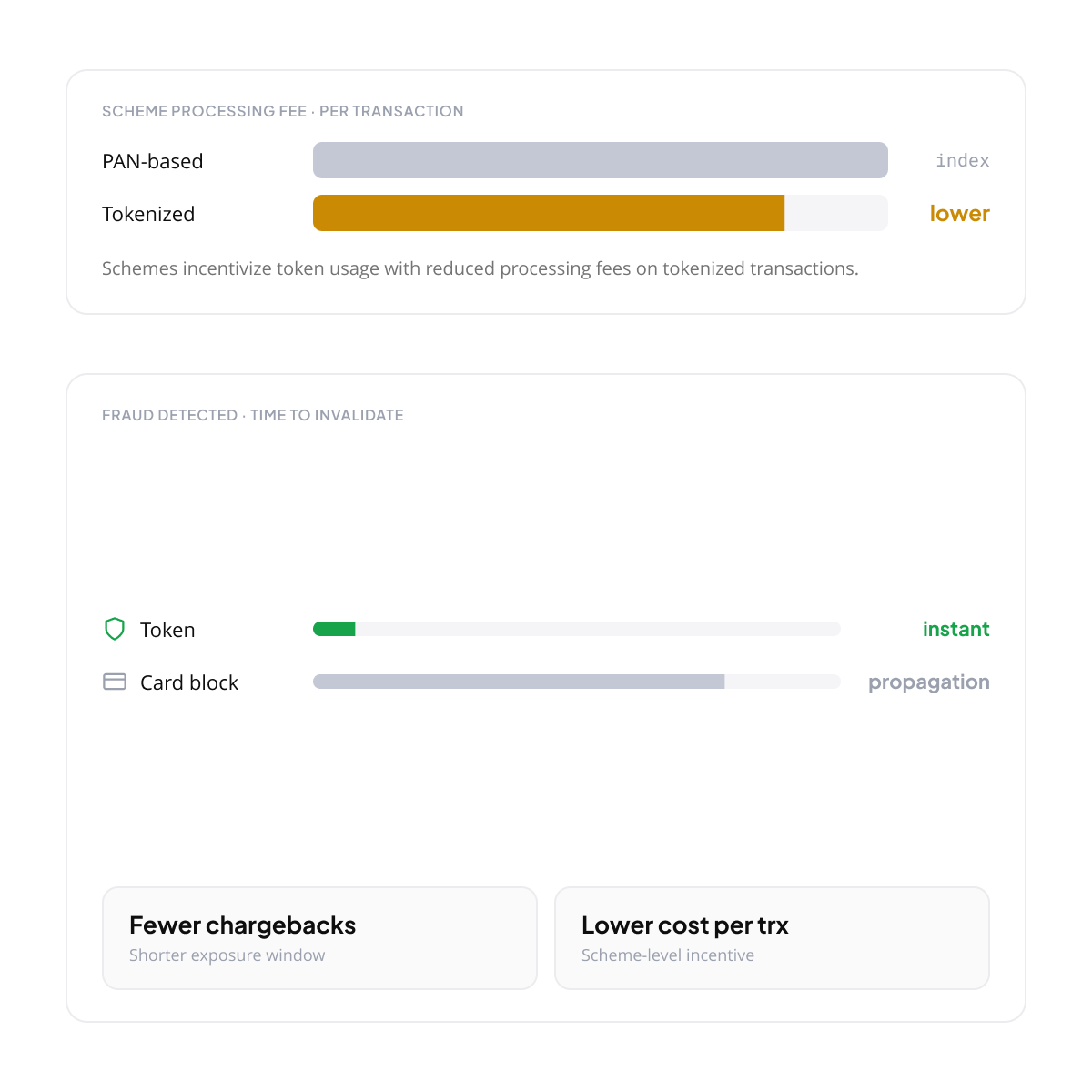
Card schemes incentivize token usage with reduced processing fees on tokenized transactions. In parallel, tokens can be invalidated instantly when fraud is detected, reducing exposure compared to PAN-based flows where blocking a card takes longer to propagate. Fewer chargebacks. Lower cost per transaction.
Tokenized vs non-tokenized.  The numbers are in the platform.
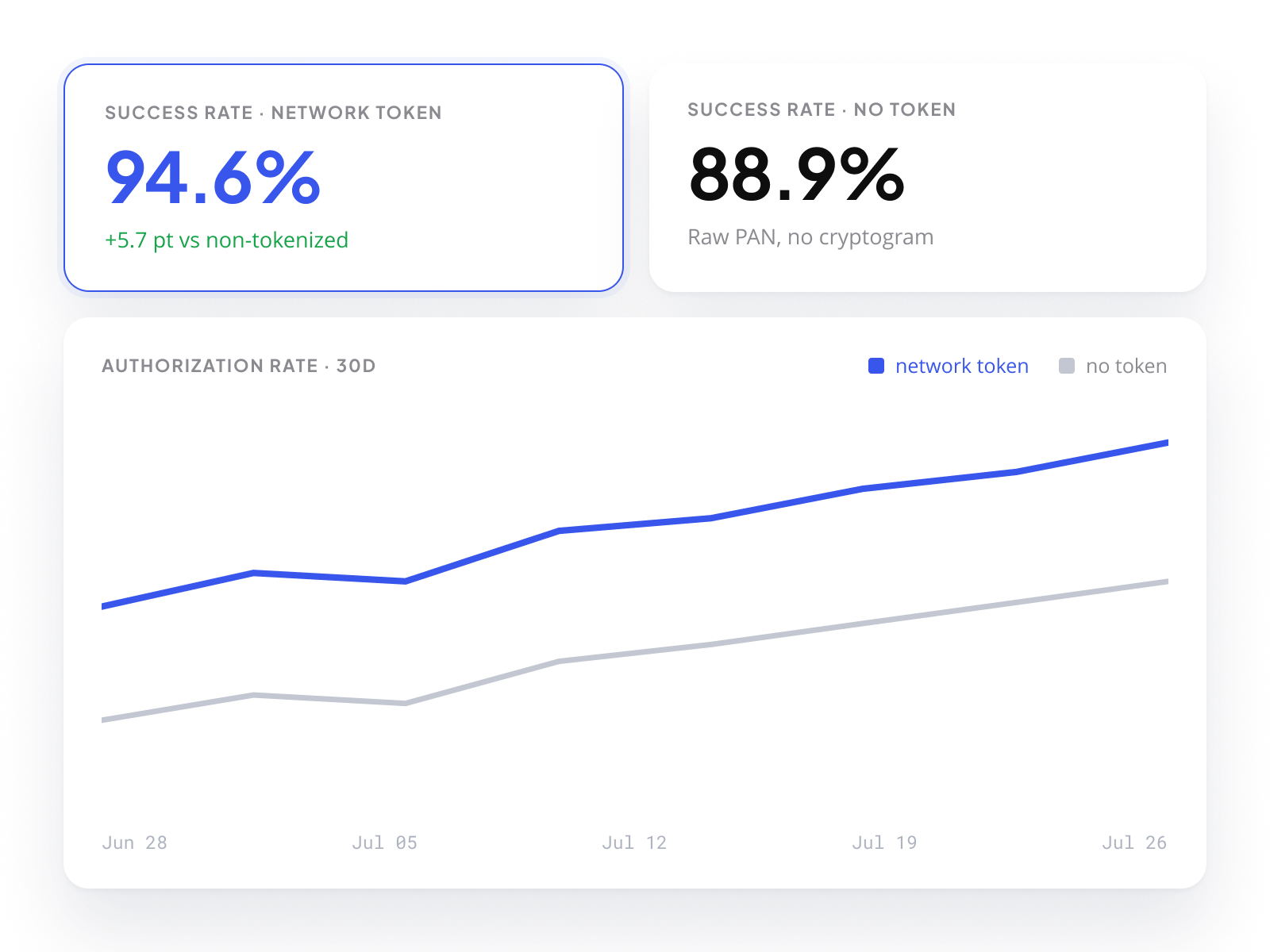
The impact of Network Tokenization is not measured externally. It is visible directly in the platform analytics, using the same dashboards, overviews, and exports your merchants already use. Dedicated indicators and dimensions for Network Token usage are available across every analytical surface. The comparison between tokenized and non-tokenized flows is one widget configuration away.
Higher authorization rates. 
Network Tokens carry a cryptographic validation (cryptogram) that issuers recognize as a stronger signal than a raw PAN. This reduces the rate of false declines and improves the probability of authorization on first attempt. The improvement is measurable directly in the platform: tokenized vs non-tokenized success rates are available as separate indicators in every dashboard and overview.
Dedicated indicators. Built into every dashboard.
Network Token-specific indicators are available alongside standard payment metrics: Network token usage rate, authorized transactions using network token, transaction success rate using network token, orders using network token. Configure a widget with any of these indicators, combine with any dimension (payment method, provider, issuer country, card category) and the performance difference is immediately visible. No custom report. No data export to a BI tool.
Track adoption. Measure impact. Optimize by provider.
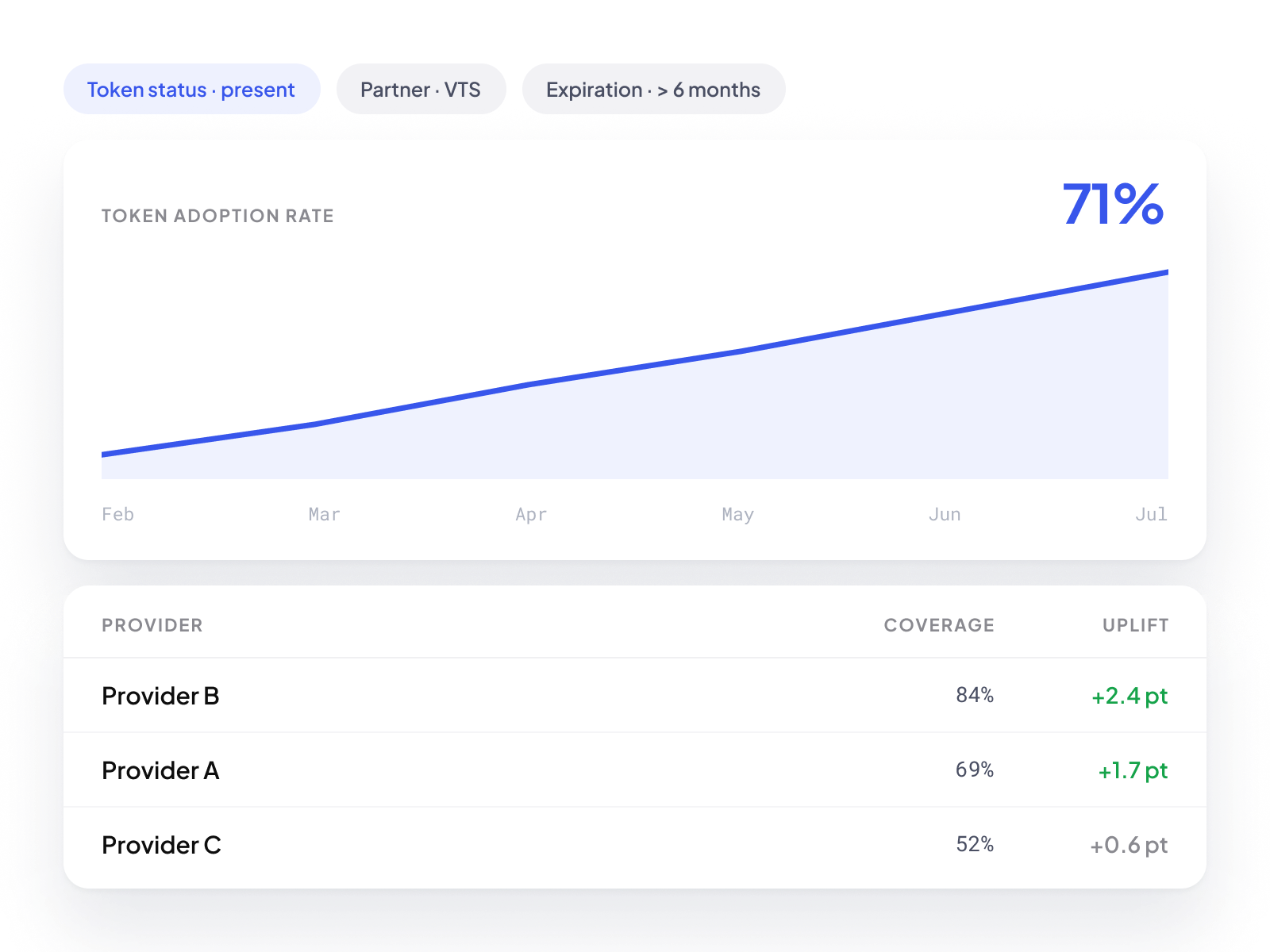
Network Token dimensions allow merchants to filter and segment by token status (token present, token requested, token used), by tokenization partner, and by token expiration data. Use cases: measure token adoption rate over time, compare success rates between tokenized and non-tokenized transactions for the same payment method, identify which providers deliver the best token performance, and track how recurring payment continuity improves as token coverage grows.
Built on NORBr's universal  
token layer.
Network Tokens add the scheme-issued performance layer. Underneath, every payment method your merchants store is already a NORBr Vault token, portable across every provider on their account. Network Tokenization activates on top of that foundation, without migration, without rebuilding the token structure. One Vault. One universal token per payment method. Network Token performance where the provider supports it. PAN fallback where it doesn't. The full token infrastructure is covered in the White-Label Platform section.

Your merchants process more and pay less.

One activation. Zero integration changes. Measurable from day one.

Book a demo