

Payment processing fees are the costs stacked on every card transaction: interchange paid to the issuer, scheme fees paid to the card network, acquirer and processor fees, plus add-ons such as 3DS, tokenization and chargeback fees. For PSPs, PayFacs and ISOs, understanding each layer is what makes blended, interchange plus or tiered pricing to merchants sustainable.
Operators sit between the merchant and the card ecosystem: they pay these fees upstream and set what merchants pay downstream. This article, updated in October 2026, explains who charges what in a card transaction, the main fee types, the hidden fees to watch in acquiring contracts, how network tokens and 3DS change costs, how to price merchants, what a transaction costs end to end, and how infrastructure helps operators control these costs.
Who are the parties in a card transaction and who charges what?
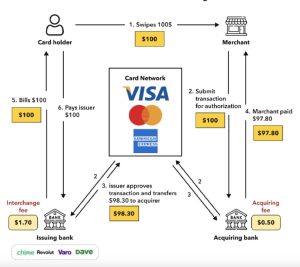
Every card payment involves at least five parties, and most of them charge for their part:
- The cardholder, who pays with a card issued by their bank.
- The issuer, the cardholder's bank, which receives interchange.
- The card network, such as Visa, Mastercard or a local card scheme, which charges scheme fees.
- The acquirer and processor, which process and settle the payment and charge their own fees.
- The PSP, PayFac or ISO, which provides the service to the merchant and sets the merchant's price.
The merchant pays a single price, the merchant service charge, and the operator's margin is what remains after every upstream fee.
What are the main types of payment processing fees?
Four layers make up most of the cost:
- Interchange: paid by the acquirer to the issuer, set by the networks and, in some regions, capped by law. In the European Economic Area, the Interchange Fee Regulation caps consumer interchange at 0.2 percent of the transaction value for debit cards and 0.3 percent for credit cards. Rates elsewhere are published by Visa and Mastercard by region.
- Scheme fees: charged by the network for using its rails, usually a small percentage plus per-transaction and access fees.
- Processor fees: charged for the technology that handles authorization, clearing and settlement, often per transaction plus monthly fees.
- Acquirer fees: charged by the acquiring bank for the merchant account, settlement and risk, including setup and chargeback fees.
Which hidden fees should operators watch in their acquiring contracts?
The ones that do not appear in the headline rate. Cross-border and currency conversion fees apply when the card and the acquirer are in different countries. Chargeback fees apply per dispute, on top of the lost transaction. Administrative fees cover statements, compliance programs and account maintenance.
Retries can cost too: card networks charge fees when a declined transaction is retried too often with the same card, as under Visa's excessive reattempts rule, which applies after 15 retries in 30 days. For an operator, each of these fees either reduces its margin or has to be passed on to merchants, so they belong in every contract review.
How do network tokens and 3DS change the cost of a transaction?
Network tokens, issued by the card schemes, stay valid when a card is renewed and carry a cryptogram for each transaction, which tends to raise authorization rates and reduce fraud. Some schemes also apply lower interchange or fees for tokenized card-not-present transactions, though programs vary by region and card type.
3D Secure adds a per-authentication fee but shifts fraud liability to the issuer when the cardholder is authenticated. The right balance is rule-based: apply 3DS where the risk or the regulation requires it, and use exemptions elsewhere. The network tokenization page and the tokenization article explain how operators manage tokens across providers.
Blended, interchange plus or tiered: how should a PSP or PayFac price merchants?
- Blended: one rate for all transactions. Simple for merchants, but the operator carries the risk when expensive cards dominate the mix.
- Interchange plus (or interchange plus plus): the merchant pays actual interchange and scheme fees plus the operator's fixed markup. Transparent and fair, but statements are more complex.
- Tiered: transactions grouped into qualified, mid-qualified and non-qualified tiers. Easy to sell, but harder to predict and often perceived as opaque.
Many operators combine them: blended pricing for small merchants, interchange plus for larger ones. The payment revenue page shows how operators set pricing per merchant on NORBr.
What does a $100 transaction cost end to end?
An illustrative example, with assumed rates that vary by region, card type and contract, for a $100 card-not-present payment priced as interchange plus:
- Interchange: 1.4% + $0.10 = $1.50
- Scheme fees: 0.14% = $0.14
- Processor fee: $0.10
- Acquirer markup: 0.2% = $0.20
- Network token fee: $0.05
- 3DS fee: $0.05
Total: about $2.04, or roughly 2 percent of the transaction. The operator's own margin comes on top, which is why every upstream basis point matters.
How does a white-label payment infrastructure help operators control processing costs?
By giving the operator choices it does not have with a single acquirer. Routing sends each transaction to the provider with the best cost and approval rate for that card and market, local acquiring avoids cross-border fees, and network tokens and 3DS rules are applied consistently across providers.
On the back-office side, reconciliation and settlement matches every fee reported by every provider with the transactions behind it, so unexpected charges surface quickly. The A2A payments article covers a lower-cost alternative to cards.



































_%2520a%2520game%2520changer%2520for%2520digital%2520transactions_-Cover.webp)
