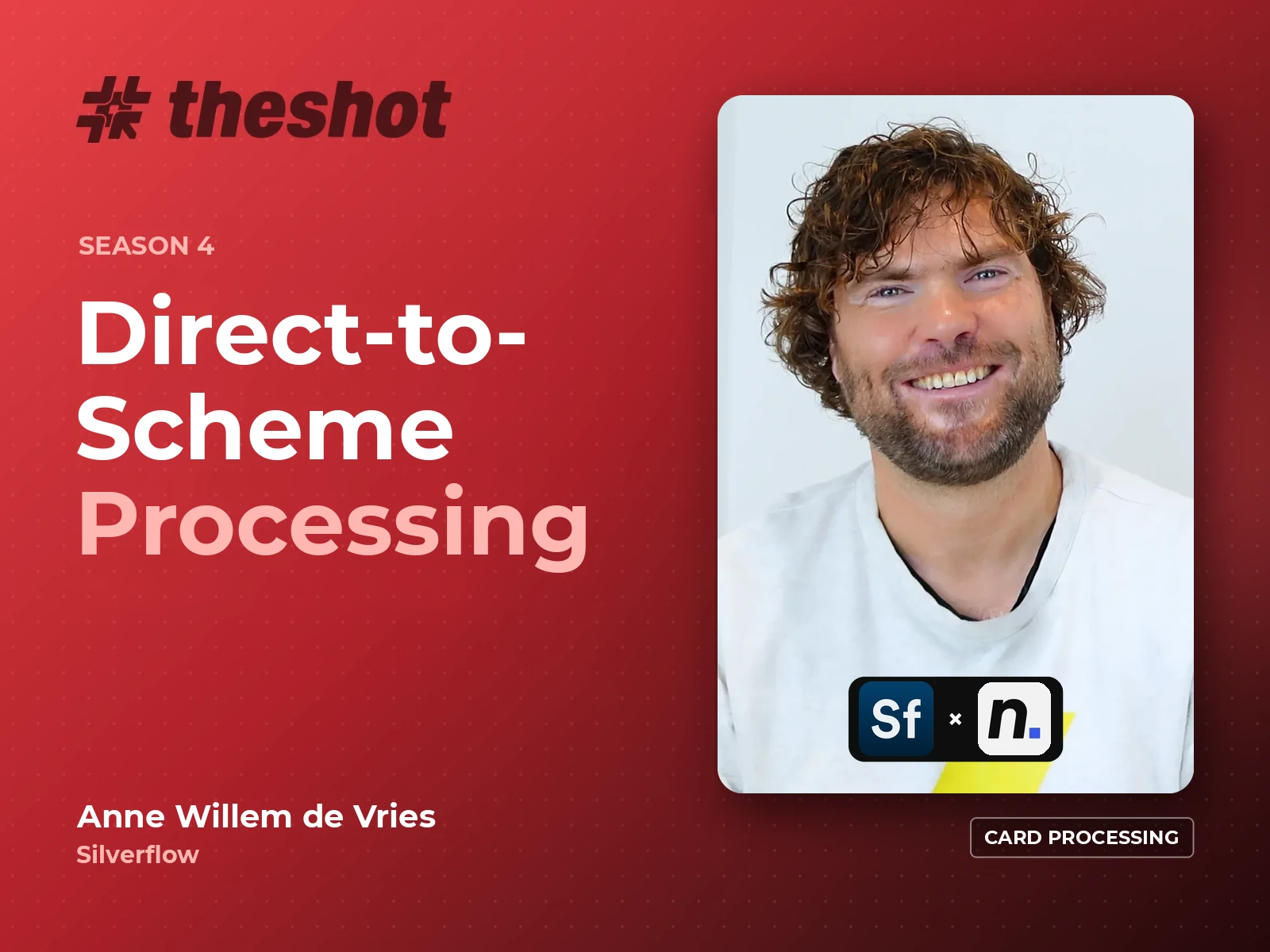

Direct-to-scheme processing connects a card acquirer, PSP or large merchant straight to Visa, Mastercard and the other networks, removing intermediate processing layers. For PSPs, PayFacs and acquirers, it means more control over messages, uptime, scheme features and raw payment data. NORBr's white-label payment infrastructure brings that data together across every acquirer and processor an operator connects.
Between a shopper's click and the issuer's answer, a card payment can cross a gateway, an acquiring processor and a card network before it reaches the issuing bank, and each layer adds its own cost, delay and version of the data. Anne Willem de Vries, Co-Founder and CEO of Silverflow, a cloud-native card processing platform, asks what changes when some of those layers are removed. He walks through it in Season 4 of #TheShot.
This article, updated in October 2026, follows the five episodes of Season 4 and adds the scheme release calendar and the regulatory scrutiny of scheme fees that make the topic more pressing in 2026.
Key takeaways on direct-to-scheme processing:
- Even enterprises with highly optimized checkouts still depend on PSPs and acquirers to process card payments.
- Every layer between the merchant and the network adds its own handling of data, uptime and service levels, and its own cost.
- Scheme changes cascade through each layer in turn, which delays new features and compliance updates.
- A direct connection gives access to decline codes, BIN data, interchange and scheme fees at the source.
Why do enterprises with their own checkout still rely on PSPs and acquirers?
Because building the checkout is not the same as processing the payment. Large merchants invest heavily in getting users to the basket: search, ads, social campaigns, then a checkout that speaks the shopper's language and shows the right payment methods. Behind that page, card transactions still go through PSPs and acquirers.
"Even with optimized checkouts, merchants still depend on PSPs and acquirers in the background to process those card transactions." Anne Willem de Vries, Co-Founder and CEO, Silverflow, in Episode 1
The same holds one level up for PSPs, PayFacs and ISOs: their merchants see the operator's checkout, but the operator itself depends on the processing chain of each acquirer it uses.
What happens to a card payment after the shopper clicks pay?
In Episode 2, Anne Willem traces the path. The transaction goes from the merchant to a gateway, which connects to one or more acquiring processors. The processor forwards it into the card network, such as Visa, Mastercard or American Express, which routes it to the issuing bank. The issuer approves or declines, and the answer travels back the same way.
Direct-to-scheme processing shortens that path by connecting to the networks without some of the intermediaries. In Silverflow's model, the processing platform does not become the acquirer: the bank or payment company keeps its scheme licence and uses the platform for processing. Deutsche Bank, for example, kept its role as acquirer when it moved its card processing to Silverflow in 2025. The model is gaining volume: Silverflow reported in October 2026 that it processes $40 billion a year, around 2 million transactions a day.
How does a direct connection lower costs and increase control?
Every layer handles data, uptime and service levels in its own way. A service level agreement can set targets for each one, but the merchant or PSP is not in control of how messages are formatted, where data is stored or how the system performs.
"By connecting directly to the card networks, you reduce complexity. You gain control over how you send messages, where data is stored, system uptime, and performance. And of course, each layer adds cost, so fewer vendors means more savings." Anne Willem de Vries, in Episode 3
Scheme fees are the other half of the cost question, and regulators have noticed. The UK Payment Systems Regulator found that scheme and processing fees rose by more than 25% in real terms between 2017 and 2023, costing UK businesses at least £170 million a year. Its final remedies, published in July 2026, require Visa and Mastercard to follow pricing governance rules from the end of November 2026 and to make fees more transparent from the end of July 2027. In the EU, the Interchange Fee Regulation caps consumer interchange at 0.2% for debit and 0.3% for credit, but scheme fees sit outside the caps, and large European retailers asked the Commission in 2026 to curb them.
Why do scheme changes reach merchants so slowly?
Because each layer implements them in sequence. When Visa or Mastercard introduces a new feature or a compliance change, the processor, then the acquirer, then the gateway and any platform above it must each build and certify it before the merchant can use it.
"That can mean 6 to 12 months before an enterprise merchant can activate it. But with direct scheme processing, you can begin implementation as soon as the networks launch it." Anne Willem de Vries, in Episode 4
The volume of change is steady. The schemes ship most updates in two releases a year, in spring and autumn, and the autumn 2026 release alone brings new Mastercard fees in Europe on preauthorizations that are not cleared or reversed within 30 days, from 1 October 2026, and on acquirer exemption indicators, from 12 October 2026. A PSP that learns about such a change through three layers has less time to adapt its merchants' flows before it starts costing them.
What payment data does a direct scheme connection give access to?
The data as the network produced it, before any layer has interpreted, reduced or reformatted it. In Episode 5, Anne Willem lists what that includes: the original decline codes, BIN data such as card type, issuing bank and region, and cost data such as exchange rates, scheme fees and interchange.
"If you want to optimize and compete, this level of access is no longer optional. It's a strategic edge." Anne Willem de Vries, in Episode 5
That data feeds every decision an operator makes for its merchants: which acquirer to route to, which BIN ranges to treat differently, which fees to challenge. Sandra Mianda's article on BIN configuration shows what goes wrong when that data arrives incomplete.
What does direct-to-scheme mean for PSPs, PayFacs and ISOs?
Few operators will connect to every network themselves, but all of them face the same problem the series describes: data and features that arrive late and transformed through each provider they use. The practical response has three parts:
- Normalize data across providers: decline codes, BIN attributes and fees in one format, whatever acquirer processed the payment.
- Read the full fee stack: interchange, scheme fees and markup itemized per transaction, as in reconciliation and settlement.
- Keep the choice of rail: connect several acquirers and processors, including direct processing partners where they fit, and route between them with routing rules.
NORBr does not connect operators directly to Visa or Mastercard and is not a card processor. It sits above the acquirers and processors an operator chooses, through one payment network, and absorbs scheme programs such as account funding transactions and Rapid Dispute Resolution in Scheme Ready. The guide to card networks and local schemes and the guide to payment processing fees cover the rest of the chain.
Who is Anne Willem de Vries?

Anne Willem de Vries, Co-Founder and CEO, Silverflow. Anne Willem co-founded Silverflow, an Amsterdam-based, cloud-native card processing platform that gives acquiring banks, payment companies and commerce platforms a single connection to the card networks. Before Silverflow, he worked on the card payments side of Adyen. Follow Silverflow on LinkedIn.
Every layer between a payment and the network keeps a small part of the margin and a large part of the information.
NORBr is the white-label payment infrastructure for PayFacs, PSPs, ISOs and ISVs. Operators connect acquirers and processors once and read the same payment and fee data across all of them.
About #TheShot: a video series sharing clear, unsponsored insights from payment professionals. One expert, one topic, short episodes. Watch Season 4 with Anne Willem de Vries or browse all seasons.