

Payment fallback routing automatically resends a declined or failed transaction to an alternative acquirer or PSP instead of returning the error to the shopper. For PayFacs, PSPs, ISOs and ISVs running a white-label payment infrastructure, it means their merchants recover otherwise lost sales without any manual retry, under the operator's own brand.
Even with good routing, some payments fail for reasons that have nothing to do with the customer. This article, updated in October 2026, explains what payment fallback routing is, why transactions fail after a correct first route, how a fallback engine decides what to do with each failure, how fallback differs from retries and smart routing, what it changes for merchants, and how operators can offer it under their brand.
What is payment fallback routing?
Fallback routing is a rule that says what happens when a payment attempt fails: try again on the same provider, send the payment to another provider, or stop and return the decline. It runs within the same checkout session, so the customer simply sees the payment succeed, or fail only once all reasonable options are exhausted.
It requires at least two providers able to process the same payment and a way to reuse the payment credentials with both, which is why fallback depends on universal or network tokens. The tokenization article explains that link.
Why do transactions fail after a correct initial routing?
Because many failures come from the route, not the card. A provider may be unavailable or slow, an acquirer may reject a transaction for technical or configuration reasons, a currency or card type may not be supported on that contract, or an issuer may respond differently to a domestic and a cross-border acquirer.
Others come from the cardholder or the issuer: insufficient funds, a stolen card, a suspected fraud or a closed account. Telling these two families apart is what makes fallback useful rather than risky. The payment routing article covers how the first route is chosen.
How does a fallback engine decide where to reroute a failed transaction?
From the return code. Each provider's decline and error codes are mapped to a normalized set, and each code is tied to an action: retry on the same provider for transient issues, reroute to another provider for structural ones, or do nothing when retrying is pointless or forbidden.
On NORBr, that mapping is an editable table in the payment resilience settings. Codes governed by scheme rules are pre-configured and locked, others can be customized per merchant, and the operator sees every merchant's fallback configuration and recovery rate in one place.
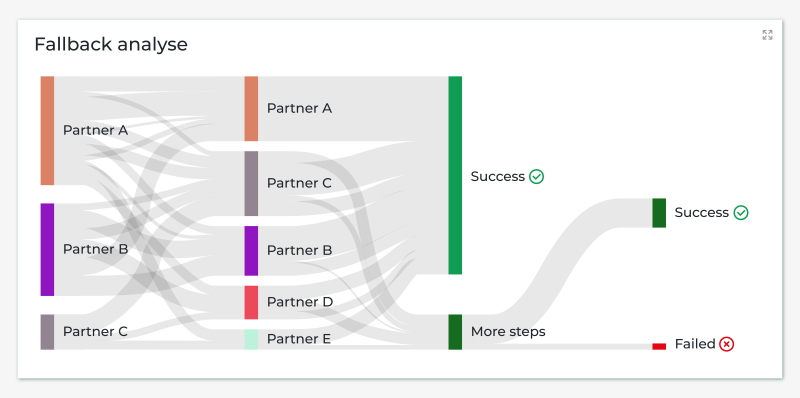
What is the difference between fallback, retry and smart routing?
- Routing chooses the first provider for a payment, based on rules such as country, card type, amount or channel.
- Fallback sends a failed payment to a different provider, in the same session.
- Retry tries again, on the same or another provider, immediately for transient errors or later for recurring payments, within scheme limits on repeated attempts.
Hard declines, such as a lost or stolen card, should never be retried: card schemes charge fees for excessive reattempts, as described in the payment processing fees guide.
What does fallback routing change for a PSP's or PayFac's merchants?
Fewer lost sales from failures that were never the customer's fault, without any action from the merchant or the customer. Outages at one provider stop being outages for the merchant, and the merchant does not need its own development team to handle multi-provider retries.
For the operator, recovered transactions are recovered revenue on its own margin, and fallback becomes a feature it can show in its offer, with recovery rates visible per merchant.
How can an operator offer fallback routing under its own brand?
By running merchants on infrastructure where fallback is part of the platform, not a custom project. On NORBr, operators connect several acquirers and PSPs from the global payment network, merchants set their routing and fallback rules from a console under the operator's brand, and return code mappings and SCA rules are configured without code.
The payment revenue page shows how recovered volume turns into revenue for the operator.



































_%2520a%2520game%2520changer%2520for%2520digital%2520transactions_-Cover.webp)
