Extend your stack

on demand.

Without rebuilding it every time.

Need a new PSP for the Argentine market? It's probably already there.  A risk provider your CFO insists on? Same. A network tokenization partner you didn't even know you'd need next quarter? We'll add it. NORBr keeps a working network of providers, acquirers, authentication, risk and network tokenization partners. You activate. You request. We deliver.

Book a demo
Hero image
Connectors you don't have to build.
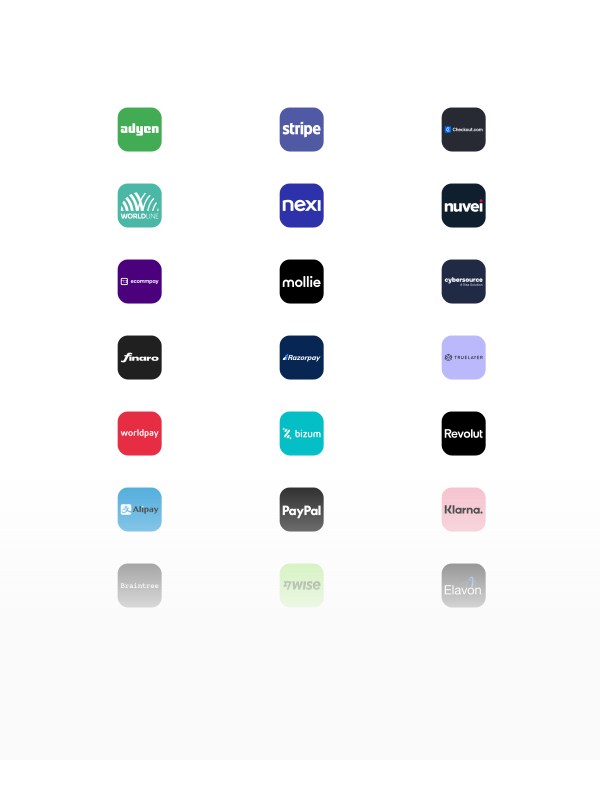
Launch a new market on Monday. Add a local method on Wednesday. Switch acquirer on Friday. Every move is a connector you don't have to build. We've already done the integration work, the certifications and the maintenance. You pick what you activate and when. The catalog keeps growing on demand.
50+
live providers
and growing on demand.
200+
payment methods
and growing on demand.
190+
countries covered
and growing on demand.
6 types
PSPs, acquirers, payout, risk, payment methods, 3DS
and growing on demand.
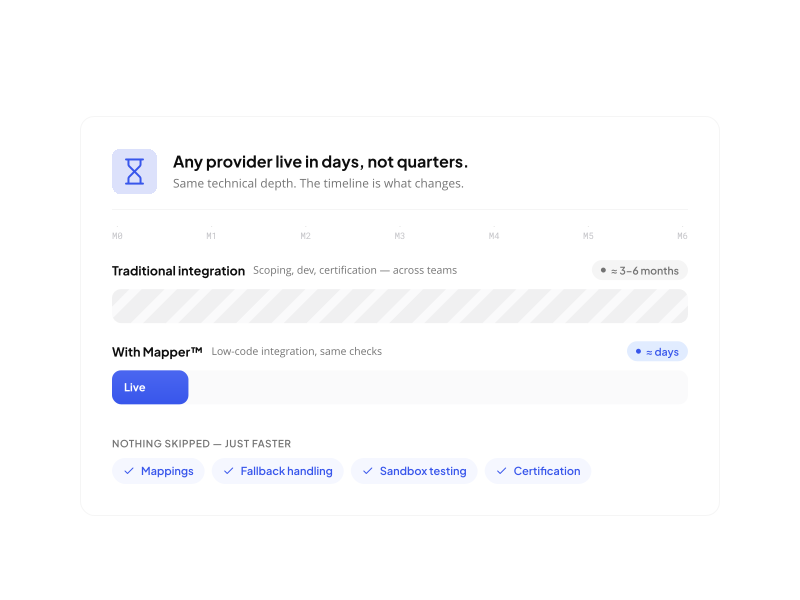
Any provider live in days, not quarters
Not in the catalog yet? Tell us. We connect it. Mapper™, our internal low-code integration tool, gets most new providers live in days. Not the quarters traditional integrations take. And once a provider is in, it's in for the whole network.
Built for speed, not corner-cutting
Mapper™ accelerates the integration without skipping the technical depth. Mappings, fallback handling, sandbox testing and certification all happen. They just happen faster. The trade-off you don't make: speed against quality.
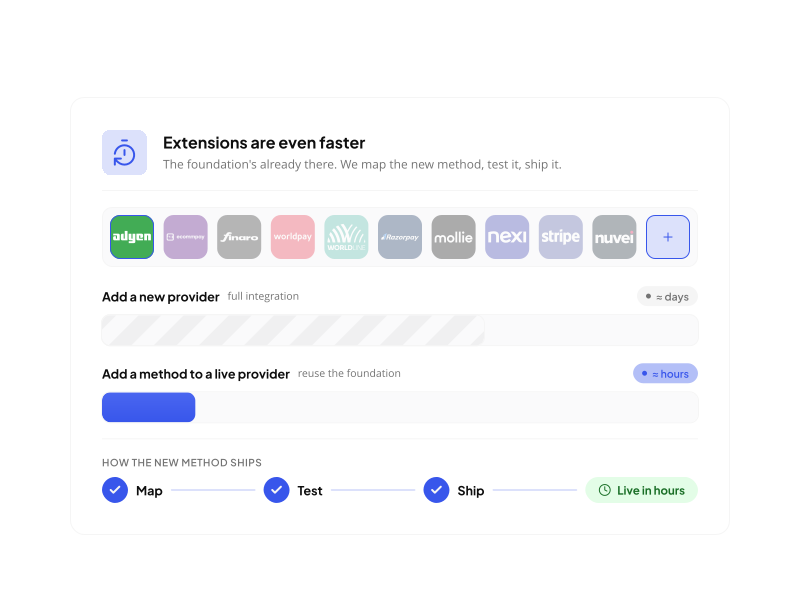
Extensions are even faster
Already running a provider with one method? Adding another takes hours, not days. The foundation's already there. We map the new method, test it, ship it.
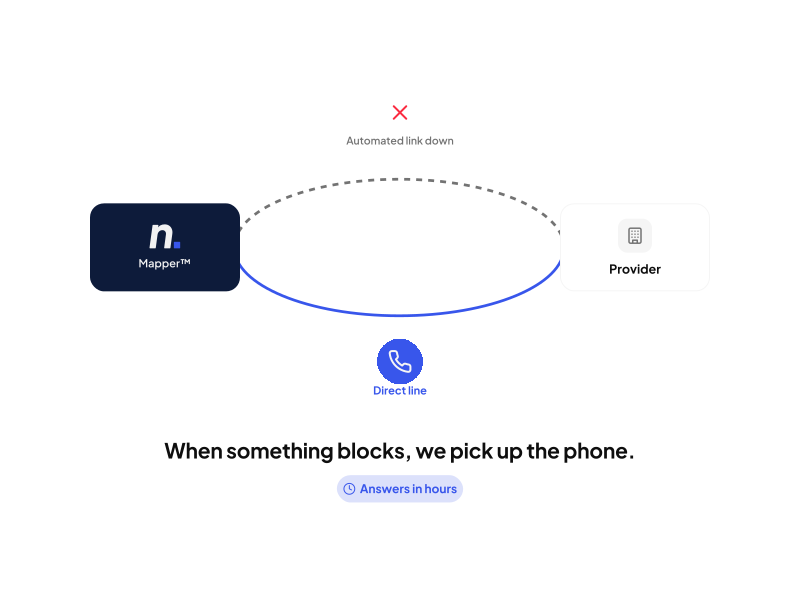
When something blocks, we pick up the phone
Speed has conditions. The provider's sandbox needs to be reachable. Their API documentation needs to be current. But when something is off, we talk to our contacts at the provider every week. We know who to reach, and we get answers in hours. That's the part of the integration timeline you can't out source to documentation. Payment methods are then activated per merchant directly in Payment Stack & Activation.

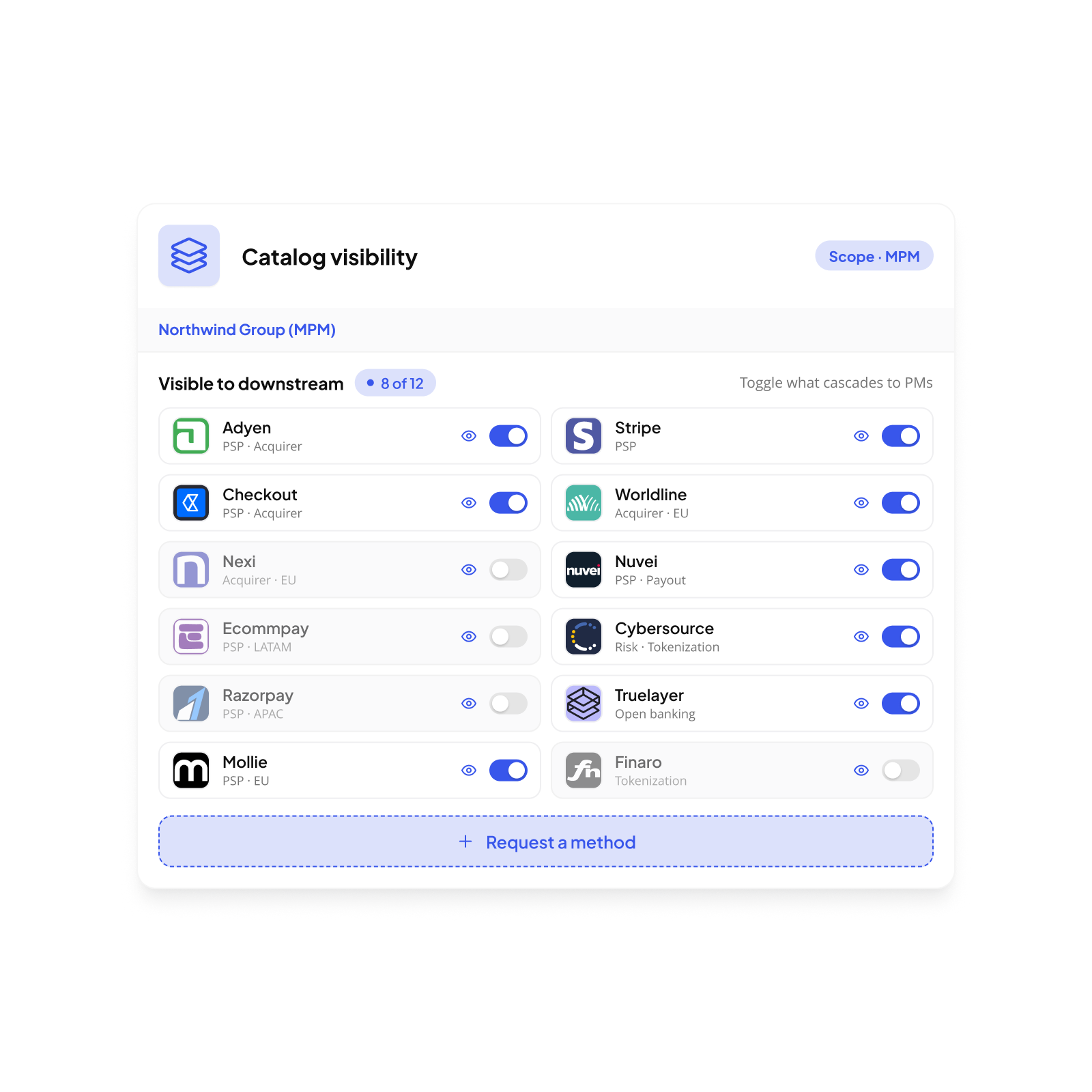
Control what your downstream actually sees.

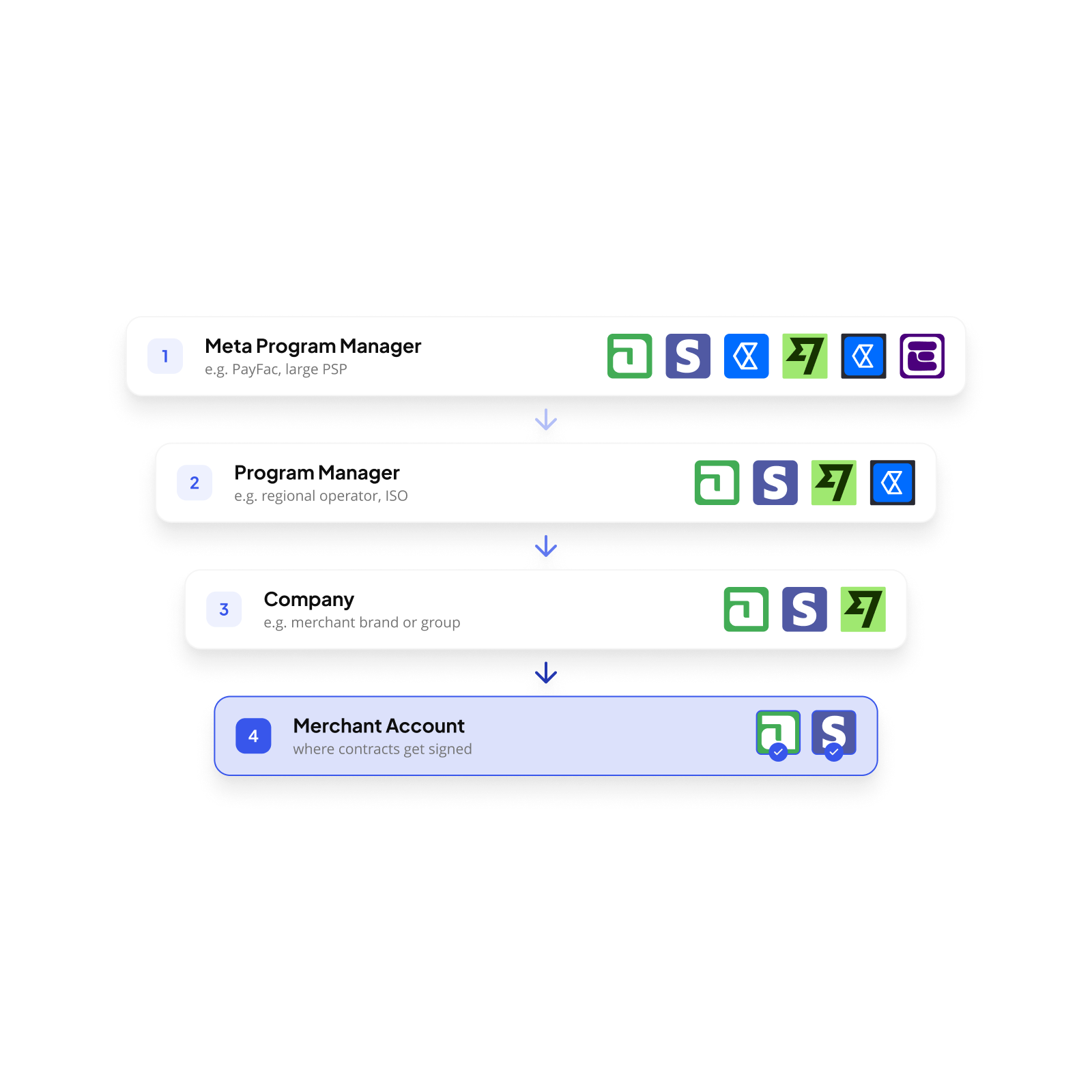
The full NORBr catalog doesn't reach everyone by default. If you run a payment platform as a PSP, an ISO, a PayFac or an ISV, you decide which providers cascade down to your downstream partners. Each level of your structure curates the catalog further before the next level sees it. Four layers of control, all in your hands.

Pick what your partners see
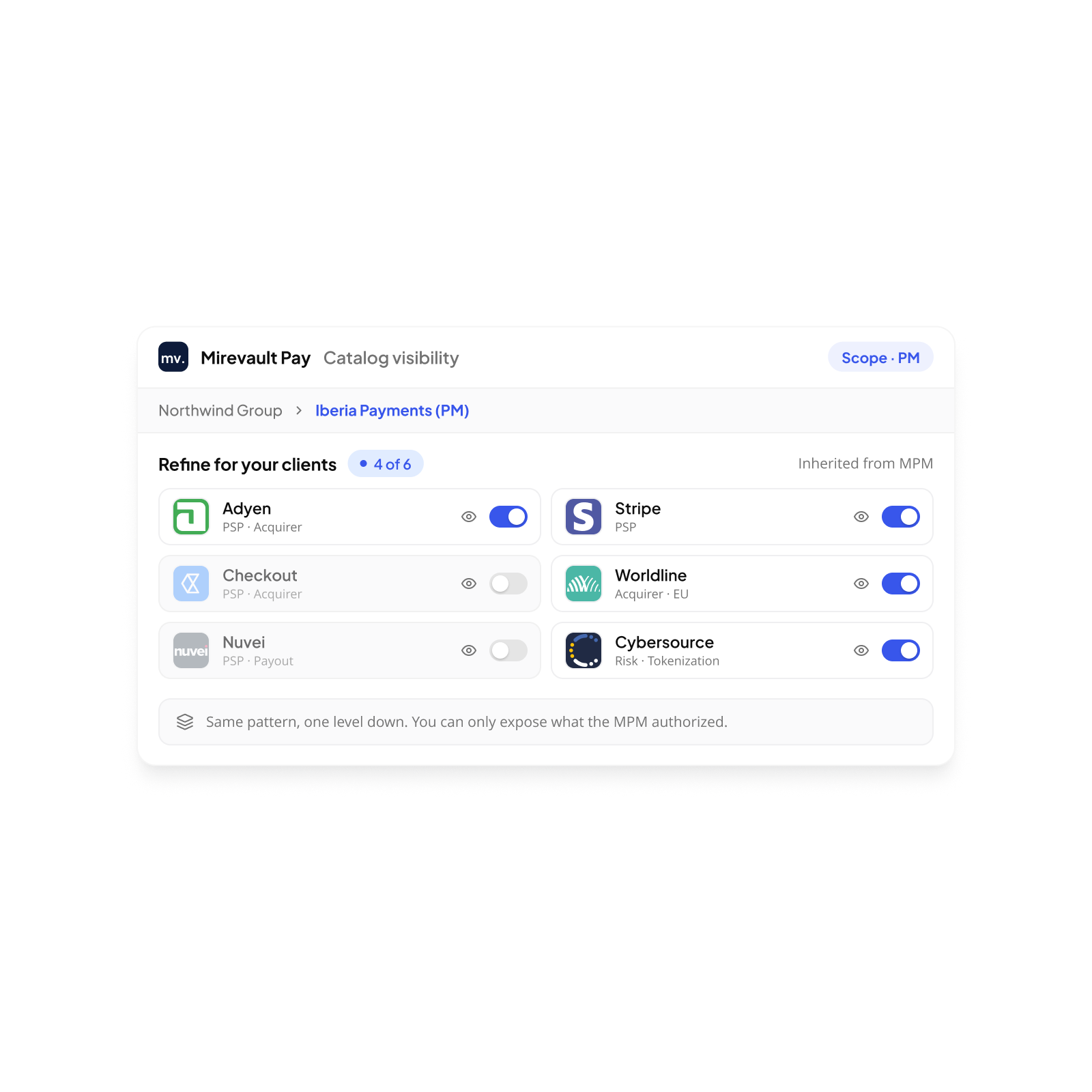
If you sit at the top of your structure, what NORBr calls a Meta Program Manager, you decide which providers from the network are visible to the partners you operate. A cards-only business won't be shown crypto rails. A regional player won't be shown providers irrelevant to its geography. The catalog you expose downstream is the one you've designed.
Each partner refines further
Your direct partners, what NORBr calls Program Managers, receive the catalog you've authorized. They curate it again for their own clients. They promote a provider, restrict another, and shape what their commercial offer actually looks like on the ground. Same logic as your own curation, one level down.
Contracts get created at the ground level
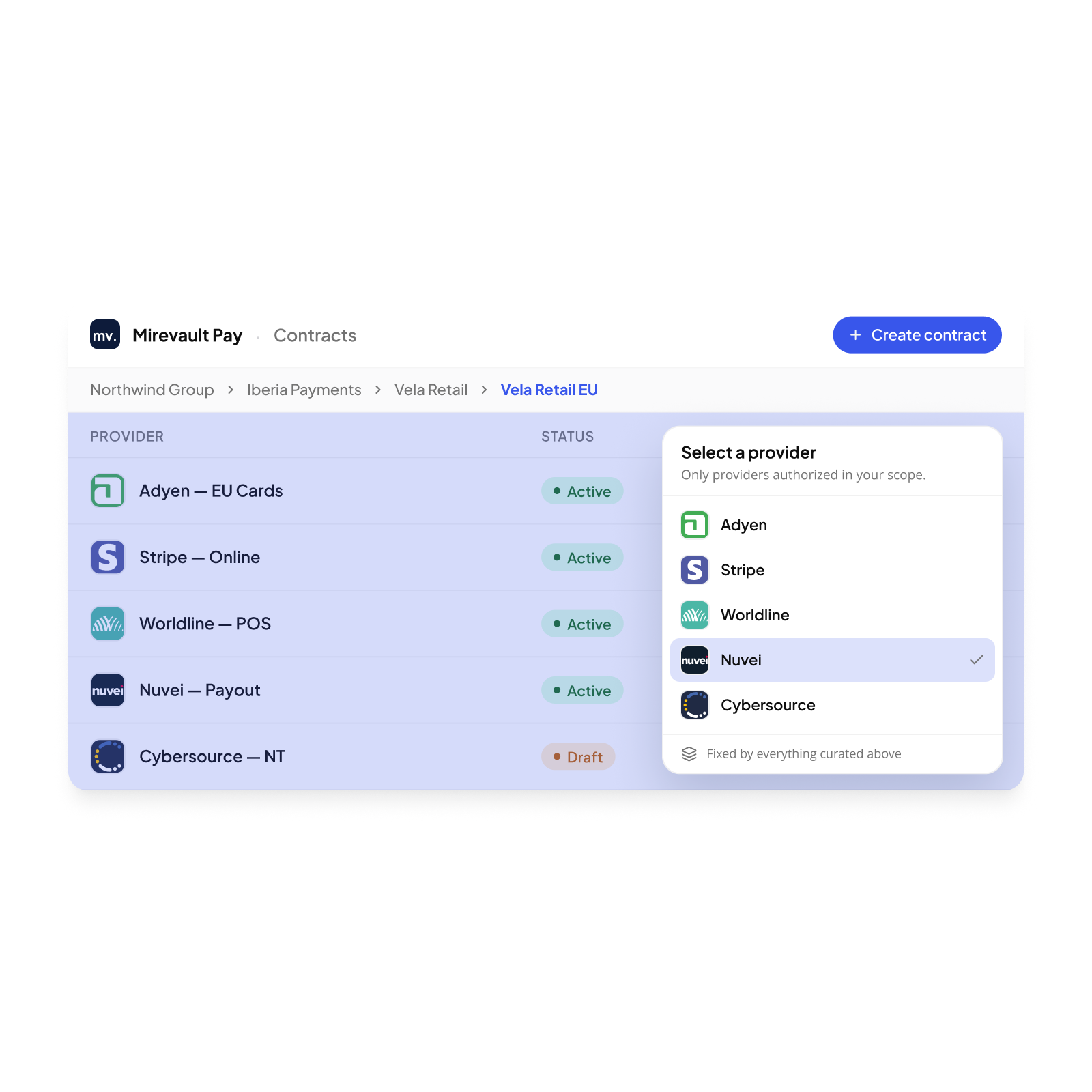
Each of your partners manages one or several merchant clients, what NORBr calls Companies. Each Company runs one or several payment activities through Merchant Accounts. That's where the actual payment contracts get created: provider credentials, payment methods, currencies. The list of providers a Merchant Account can contract with is fixed by everything curated above.
Cascade decisions are reversible
Changed your mind? Hiding a provider doesn't break the contracts already using it. It just stops new ones from being created on it. Re-expose it later and it's available again right away. Curation is a control layer, not a destructive one.
Infrastructure for ambitious operators.
Provider-agnostic. Audit-ready, always.
icône

Annual certification

PCI DSS AOC issued after independent QSA audit every year.

icône

Provider independence

Your stack works with any provider, today and tomorrow.

icône

Modular by design

Activate what you need. Grow into the rest. No infrastructure tax.

icône

Proven at scale

Deployed for global operators across retail, e-commerce and recurring flows.

Extend your coverage, stay invisible.
Some of the most established payment service providers and acquirers use NORBr. Not because they need a payment platform. They already have one. They use NORBr because their own product, however good, has limits their merchants are starting to feel. A method they can't ship fast enough. A geography their acquirer doesn't cover. A sub-client (a PayFac, an ISO) they want to serve without rebuilding everything. NORBr fills those gaps. Quietly.
Ship the methods your roadmap can't reach this quarter
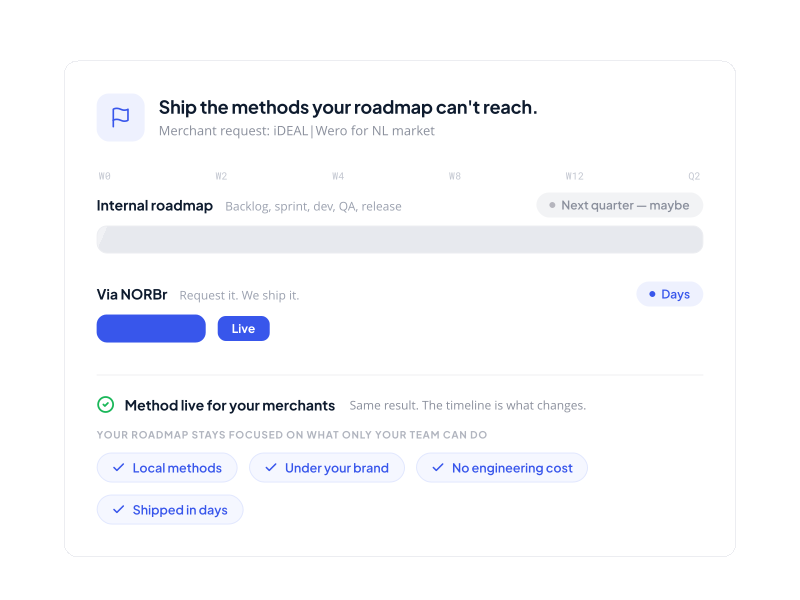
Your engineering team has a roadmap. Your product team has priorities. Neither of them can ship the local method your merchants in market X have been asking for. Not in this cycle. Not in the next one either. NORBr ships it in days, plugs it into your stack, and your merchants see it as part of your product. Your roadmap stays focused on what only your team can do.
Serve your sub-clients without rebuilding your platform
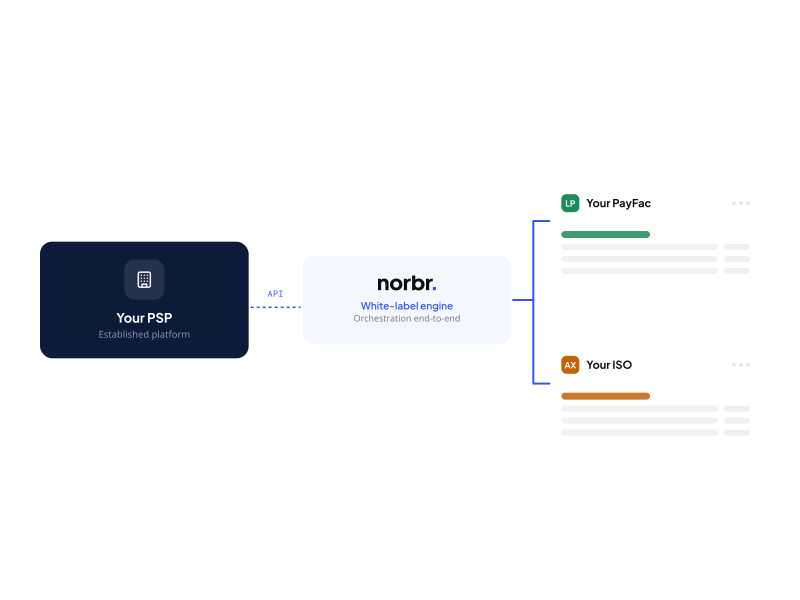
Your platform was built for your direct merchants. Now you're signing PayFacs and ISOs who need their own dashboard, their own merchant onboarding, their own monitoring. You don't want to build that. NORBr already has it. We plug onto your APIs as a technical partner, expose a white-label console to your sub-clients, and handle the orchestration end-to-end. They see your brand. You don't build a second product.
Add coverage where you don't have a license
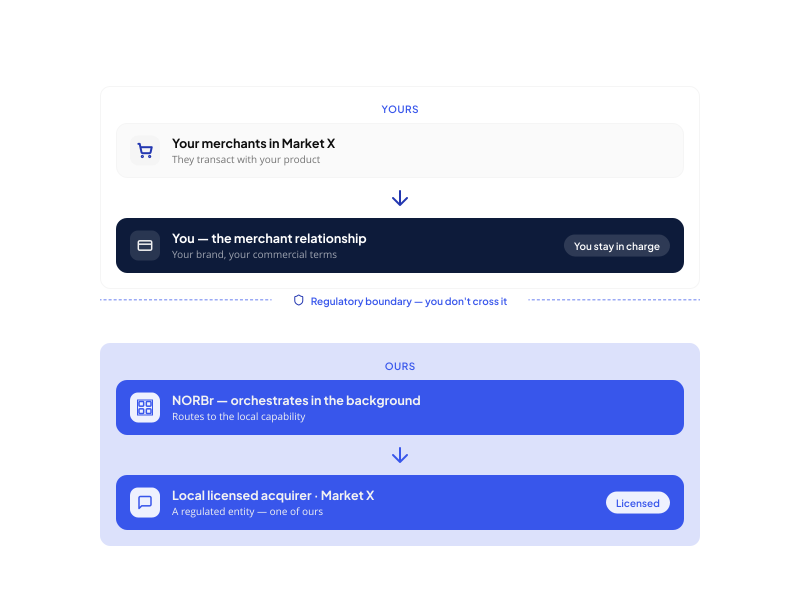
Some markets need a local acquirer you don't operate in. Some methods need partnerships you haven't signed. Going through NORBr means activating the local capability without becoming the local entity. You stay in charge of the merchant relationship. The acquirer in the background is one of ours. Your merchants get the coverage. You don't get the regulatory overhead.
A partnership that protects your positioning
We don't name our clients. We don't case-study them. We don't put their logo on slides. Every white-label arrangement is bound by the same discretion principle as the rest of the product.

Your operational dependencies are yours. They're not ours to disclose.

Missing a provider?  
It won't be missing for long.

Request it. Mapper™ integrates it. Your merchants see it as part of your product.

Book a demo