

Building a payment infrastructure means designing, developing and maintaining your own processing connections, routing, compliance and administration layers. Buying means running those layers on a white-label payment infrastructure. For PayFacs, PSPs, ISOs and ISVs, the decision comes down to upfront investment, time to market, compliance scope and the ongoing cost of keeping the platform current.
Every operator that wants to own its payment offer eventually faces this choice. This article, updated in October 2026, explains what a payment infrastructure includes, why operators are modernizing, what building in-house really involves, how long each path takes, the hidden costs of building, what buying a white-label infrastructure provides, and which option fits which type of operator.
What does a payment infrastructure platform include?
More than a connection to an acquirer. A complete platform for a PayFac, PSP, ISO or ISV includes:
- Provider connections and routing: acquirers, payment methods and risk tools, with rules that send each transaction to the right provider and fall back when one fails.
- Fraud and authentication: risk scoring, 3DS and SCA rules.
- Compliance: PCI DSS, GDPR and local regulations, plus the audits that go with them.
- Administration tools: user and merchant account management, onboarding, contracts, logs, billing and payouts, used by program managers.
- Merchant-facing tools: checkout, a merchant console, reporting and reconciliation.
Each layer has to work with the others and keep working as providers, schemes and regulations change.
Why do PayFacs and PSPs need to modernize their payment infrastructure?
Because many payment stacks were designed for one acquirer, one market and card payments only. Adding a provider, a local method or a new country means custom development each time, and data stays split across portals that do not reconcile with each other.
Modern infrastructure is cloud-native and API-first: providers are connected once and activated by configuration, data is normalized across partners, and new features reach every merchant at once. The question for an operator is not whether to modernize, but whether to build that infrastructure itself or run on one that already exists.
What does it cost to build a payment infrastructure in-house?
Building requires a dedicated team of payment engineers, security and compliance specialists and product managers, before the first merchant goes live. Development covers every provider integration and certification, the administration and merchant tools, and the infrastructure to host them securely.
Compliance adds its own budget: a PCI DSS Level 1 assessment, penetration tests, audits and the controls to pass them, renewed every year. And large projects carry real delivery risk: in BCG's study on payments modernization in European banking (May 2026), about 20 percent of banks had stopped or abandoned at least one payments modernization project. The PCI DSS guide for PayFacs details the compliance scope.
How long does it take to build versus buy?
Building a complete platform typically takes well over a year: design, integrations, certifications, testing and a pilot before revenue starts. Each additional acquirer or payment method then becomes its own project.
Buying shortens that path to configuration and integration of the operator's own systems, often a matter of weeks to a few months depending on scope. Providers already connected to the infrastructure are activated rather than integrated. The time-to-market page shows what changes for a launch.
What are the hidden costs of building: maintenance, technical debt and revenue loss?
The build is only the beginning. Providers change their APIs, schemes update their rules, PCI DSS releases new versions, and every change has to be implemented, tested and certified again. Over the life of a platform, maintenance usually outweighs the initial development.
Technical debt accumulates as features are added under time pressure, slowing every later change. And while the platform is being built or reworked, the operator is not onboarding merchants or launching in new markets, revenue that competitors on ready infrastructure are already collecting. The traditional vs embedded payments article covers the same trade-off for software platforms.
What do you get when you buy a white-label payment infrastructure?
The layers above, already built, certified and maintained, under the operator's own brand. The operator configures its structure, providers, pricing and rules, and keeps its merchant relationships and margins, while the infrastructure provider handles integrations, updates and compliance of the platform.
Partnerships are increasingly how the industry expects to win: in KPMG's payment modernization survey (February 2026) of 500 banks and 500 retailers, 51 percent of banks said the future winners in payments will be those with the best ecosystems and partnerships. On NORBr, the Payment Platform Builder sets up that structure, from program managers to merchant accounts.
Build or buy: which option fits which type of operator?
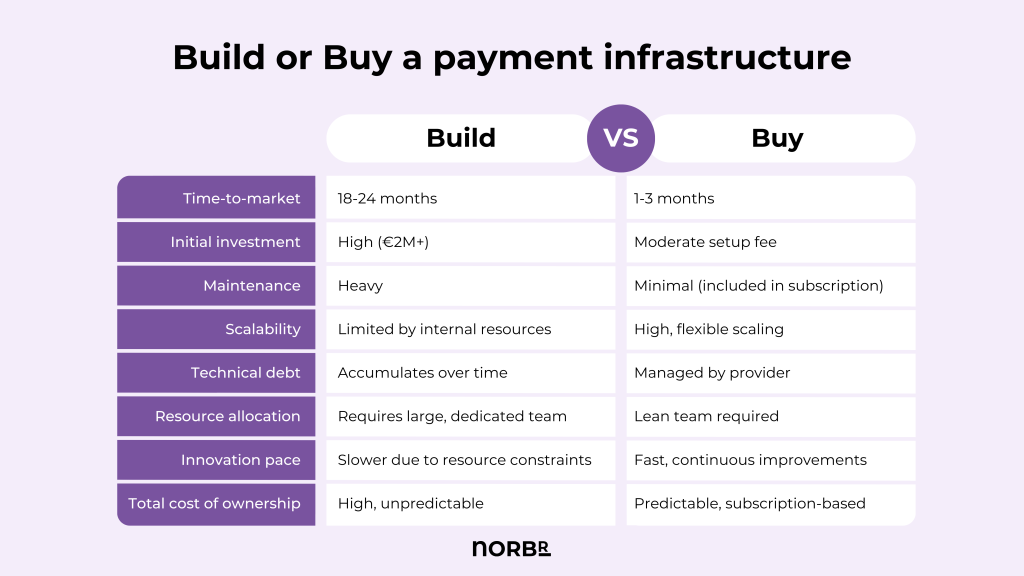
- Build fits operators whose payment technology is the product itself, with the budget, team and time to own every layer for the long term.
- Buy fits PayFacs, PSPs, ISOs and ISVs whose value lies in their merchants, their vertical or their markets, and who need to launch, expand and add providers quickly.
- Hybrid fits operators that keep proprietary components, such as risk models or a specific checkout, and run them on top of a white-label infrastructure.
The build vs buy page compares both paths in detail, and the ISV and ISO infrastructure article explains what software vendors and sales organizations need.



































_%2520a%2520game%2520changer%2520for%2520digital%2520transactions_-Cover.webp)
