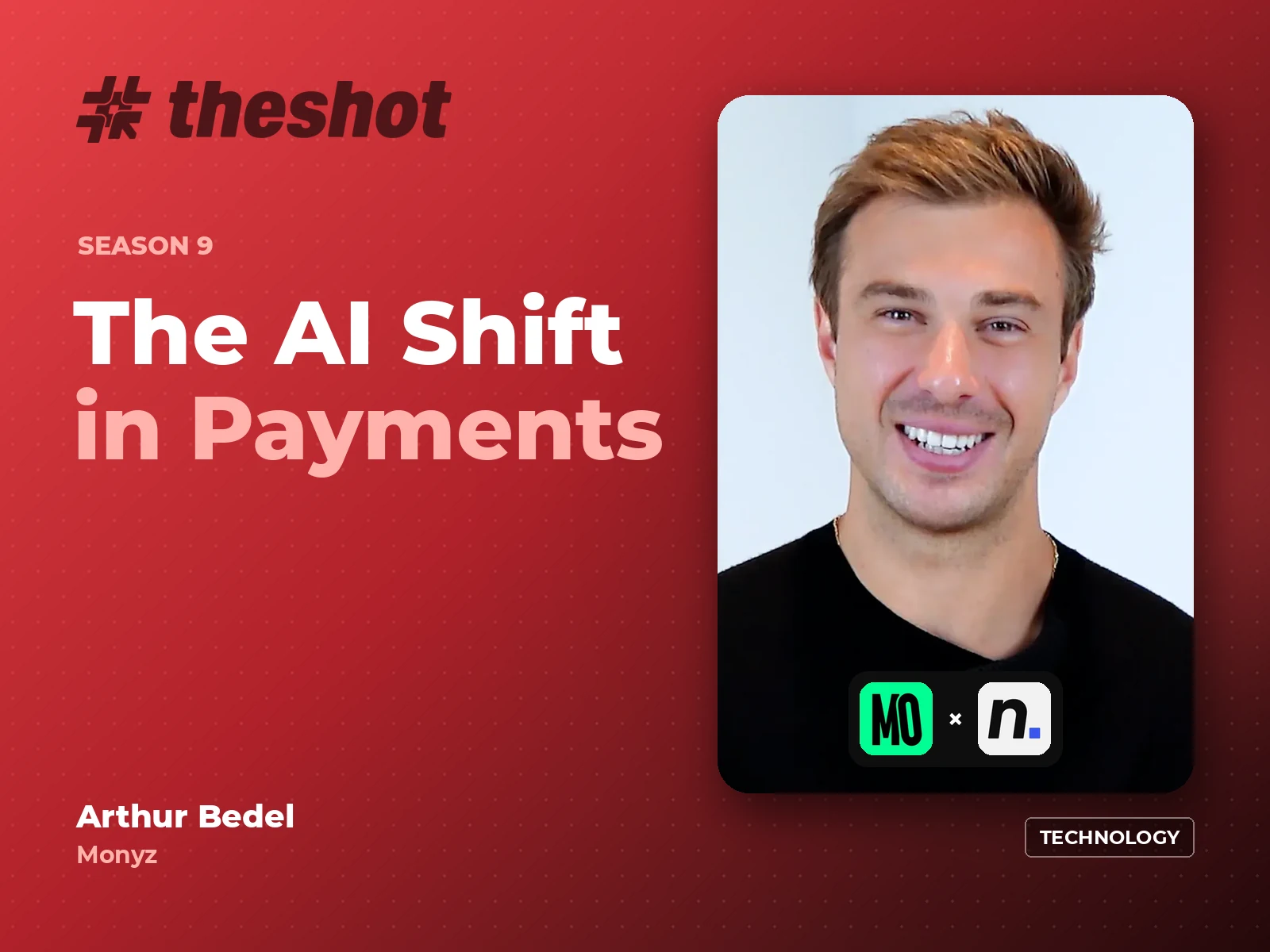

AI changes payments in two ways. Agentic commerce lets software agents buy for people and pay other agents, which demands proof of intent and new rails for tiny payments. Intelligence replaces hand-built decision trees in acceptance, fraud and chargebacks. For PSPs, PayFacs, ISOs and ISVs, both land in the transaction record that NORBr's white-label payment infrastructure keeps across providers.
Most of the conversation about AI in payments is about agents buying flights. Arthur Bedel, Founder of Monyz, thinks the bigger change is less visible: getting a transaction accepted is still largely manual work. NORBr invited him to Season 9 of #TheShot to separate the two shifts, because both land in the infrastructure that PSPs, PayFacs, ISOs and ISVs run for their merchants.
This article, published in October 2026, follows the four episodes of Season 9 and maps them against what card networks, wallets and regulators have launched up to October 2026, then lists what operators should put in place now.
Key takeaways on AI in payments:
- A payment is a data stream between two ledgers. AI changes who sends the instruction and how the decision to accept it is made.
- When an agent pays, more context must travel with the transaction to prove what the person wanted.
- Liability for an agent's mistake is not settled, and the evidence is scattered unless it stays on the payment record.
- For agent-to-agent payments, Arthur expects blockchain rails to win on speed, smart contracts and cost.
- In acceptance, an agentic workforce will replace decision trees that are never fully mapped.
What are the two shifts AI brings to payments?
The first is agentic commerce: an AI agent makes a purchase for a human, or for another agent. The second is intelligence applied to the processes that already exist, from routing and retries to fraud screening and chargebacks.
"When you look at payments, it's money moving. It's a data stream that says money should be moving from one ledger to another. How it's being moved changes. But our ability to understand how we can make a transaction be accepted, that is where AI actually takes most of the place. A lot of it is manual, has been manual." Arthur Bedel, Founder, Monyz, in Episode 1
Arthur also names a second disruptive force, stablecoins and digital wallets. It meets agentic commerce when agents pay other agents, covered below, and it is the main subject of Season 6 with Jordan Lawrence.
How does a payment work when an AI agent pays?
The agent receives a request, for example a trip to Roatán in Honduras on a given airline and in a given kind of hotel, then books and pays on a travel site. No human clicks "pay". The mechanisms built to confirm that a human is present, such as 3-D Secure challenges, no longer fit the flow.
"You have to change the rules behind this transaction, to make sure that the payment is actually what the human wanted. There's more context being provided. It's the first time in ages that the networks, but also financial solutions, are really redefining commerce as we know it today." Arthur Bedel, in Episode 2
The foundations were laid in 2025: Mastercard's Agent Pay and its agentic tokens, Visa's Trusted Agent Protocol for signed agent identity, and Google's Agent Payments Protocol (AP2), which records the user's instructions as signed mandates and was transferred to the FIDO Alliance in April 2026.
Since September 2026, the industry has moved to shared frameworks. EMVCo published a draft framework built around Intent Services, a shared layer where participants register and retrieve the intent a consumer has authorized. Ant International, Mastercard and Visa started work on interoperable Know Your Agent (KYA), which binds each agent to a verified operator. Mastercard is testing a score that estimates whether an agent initiated a transaction, American Express issues a Proof of Intent Token before the agent gets a credential, and Shopify opened checkout to browser-based agents. Volume follows: Stripe reported that agentic purchases made with its Link wallet rose 38x in the month to late September 2026.
In Europe, PSD2 strong customer authentication still applies per payment, so agent flows rely on existing exemptions, such as low-value payments under €30 within cumulative limits, or payees the consumer has added to a trusted list. NORBr's Season 3 with Sandra Mianda explains how 3-D Secure and delegated authentication work today, the baseline these frameworks build on.
Who carries the liability when an AI agent buys the wrong thing?
Nobody has settled it yet. Speaking at Sibos in September 2026, Federal Reserve Governor Christopher Waller put the question plainly: "Who is on the hook if an agent makes the wrong purchase?" As of October 2026, neither Visa nor Mastercard has introduced a chargeback reason code specific to agent purchases, so a contested agent purchase goes through the same flow as any other.
The evidence is split: proof of intent with the scheme or agent platform, the authorization with the acquirer, the chargeback in that acquirer's portal. A PSP with several acquirers can end up defending a chargeback without the record that shows the consumer approved the purchase. Pre-chargeback alerts help only if the transaction they match carries the agent data.
Merchants expect their payment partners to close the gap. In a Teneo survey for American Express of 502 US business leaders at companies that accept online payments, 86% said they will need at least moderate support from payment providers and partners to prepare for agentic commerce.
Why would agent-to-agent payments run on blockchain?
Because card rails were not designed for the payments agents will make to each other. Arthur's argument in Episode 3 rests on three properties: blockchain settlement is fast, smart contracts execute as soon as a condition is met, and the cost per transaction is low.
Agents will pay for an API call or a dataset, in amounts Arthur calls nano transactions, where a fixed card fee exceeds the purchase. x402, a standard started by Coinbase that revives the HTTP 402 "Payment Required" status code for stablecoin payments between machines, is one answer. According to Allium's September 2026 stablecoin report, x402 carried 29 million transfers in August 2026, averaging about six cents each. The raw counts need care: TRM Labs estimates that only a small share of that activity is agents actually buying something, the rest being tests and scripts.
"In only a few months, we're actually going to have more agents than we'll have humans. We haven't created yet the infrastructure for this type of AI to actually be able to transact." Arthur Bedel, in Episode 3
Analysts put the horizon further out: Gartner predicts that people, companies and governments will have created more than 10 billion autonomous agents by the end of 2030.
Why do good transactions still get declined, and what is an agentic workforce?
Because the logic that accepts or refuses them is a decision tree written by people, and no decision tree covers every context. If it did, every good transaction would be accepted. Decline codes compound the problem: they tell the merchant little about why the issuer refused, so teams retry inside a black box. The cost is measurable: PYMNTS Intelligence research with PayPal (August 2026) estimates that US merchants lose about $157 billion a year to false declines.
Arthur's answer in Episode 4 is an agentic workforce: AI agents that work like team members, each with one job, such as improving acceptance for one company, reducing fraud, managing chargebacks or adjusting the checkout in real time.
"It's not a decision tree that's being hidden, that people keep tweaking, retrying some transactions without actually knowing what's happening because there's a black box. It's finally mapping out how a transaction should actually be accepted." Arthur Bedel, in Episode 4
For a payment operator, the value moves to the data the agent can see across every provider, and to the actions it is allowed to take.
What should PSPs, PayFacs and ISVs put in place now?
The data layer can be prepared before scheme rules are final:
- Agent data on the transaction: agent identifiers, token type and intent references on the same record as the authorization.
- Portable credentials: network tokens and universal tokens usable across acquirers.
- Chargeback evidence: the intent reference retrievable when a chargeback for an agent purchase arrives.
- Routing and retry policies: which acquirer handles agent-initiated payments, set in routing rules and payment resilience settings.
- A second rail: stablecoin settlement assessed for machine payments before merchants ask.
On NORBr, authorization results, 3-D Secure outcomes, network token data, refunds, pre-chargeback alerts and chargebacks from every connected provider attach to one unified record per payment, which is also the data an acceptance agent needs. NORBr does not issue agentic tokens, register or verify agents, or decide who carries liability for an agent's mistake: schemes, issuers and KYA providers do that. NORBr keeps what they produce attached to the payment it belongs to.
NORBr's articles on AI and fraud for PSPs and PayFacs, payment fallback routing and the challenge of payment routing go further on each piece.
Who is Arthur Bedel?

Arthur Bedel, Founder, Monyz. Arthur founded Monyz, a fintech accelerator launched in New York in 2026 that helps fintechs turn attention into revenue, and advises companies redefining how financial institutions and payment companies operate. Before that, he held roles at payment companies including VGS, Nuvei and BizPay, and before payments he was a professional tennis player. Follow him on LinkedIn and Monyz on LinkedIn.
Agents will make payments simpler for the people who send them, and harder for the systems that accept them. The operators that hold the full transaction record are the ones that can prove what an agent was told, and teach it to say yes.
NORBr is the white-label payment infrastructure for PayFacs, PSPs, ISOs and ISVs. Every transaction from every provider lands in one record, which operators route, retry and report on under their own brand.
About #TheShot: a video series sharing clear, unsponsored insights from payment professionals. One expert, one topic, short episodes. Watch Season 9 with Arthur Bedel or browse all seasons.