Scheme rules,

already handled.

Scheme rules belong in the infrastructure,  not on your roadmap.

Visa and Mastercard impose transaction indicators, routing qualifications, and dispute programs that change regularly. Getting them wrong means penalties, fee reclassifications, and chargebacks that could have been avoided. NORBr embeds these requirements directly into the payment flow. The right indicators are sent automatically. The right programs are activated by configuration. Your merchants process correctly. You don't build compliance infrastructure. It's already there.

Book a demo
Hero image

AFT. Move money the way  the schemes expect.

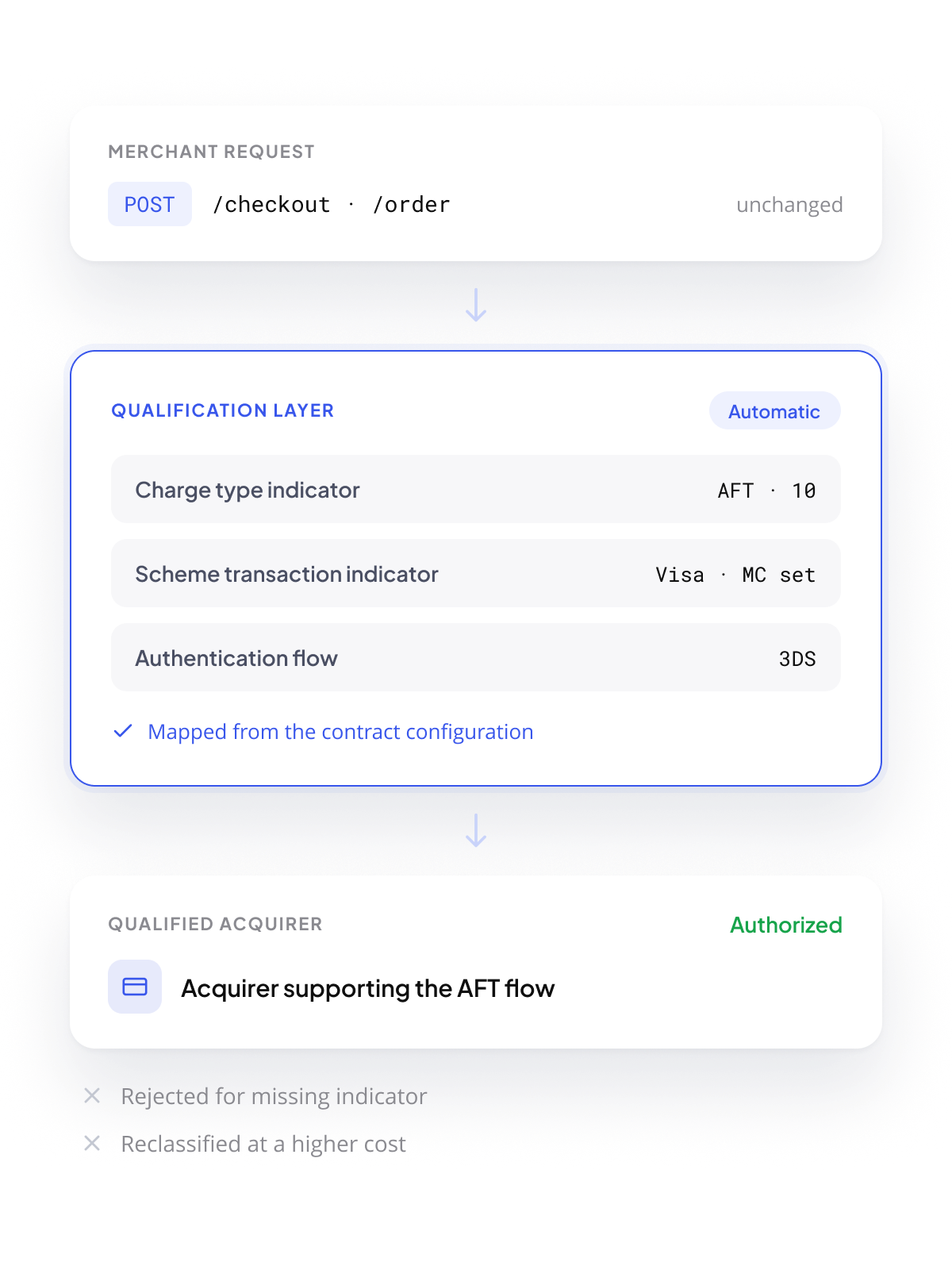
Account Funding Transactions are not standard payment flows. They move funds from a customer's card to a destination account, and card schemes require specific transaction indicators, charge type qualifications, and routing configurations to process them correctly. Without the right qualification, a transaction is either rejected, reclassified, or processed at a higher cost. NORBr handles the qualification automatically.
Built for money movement use cases. 
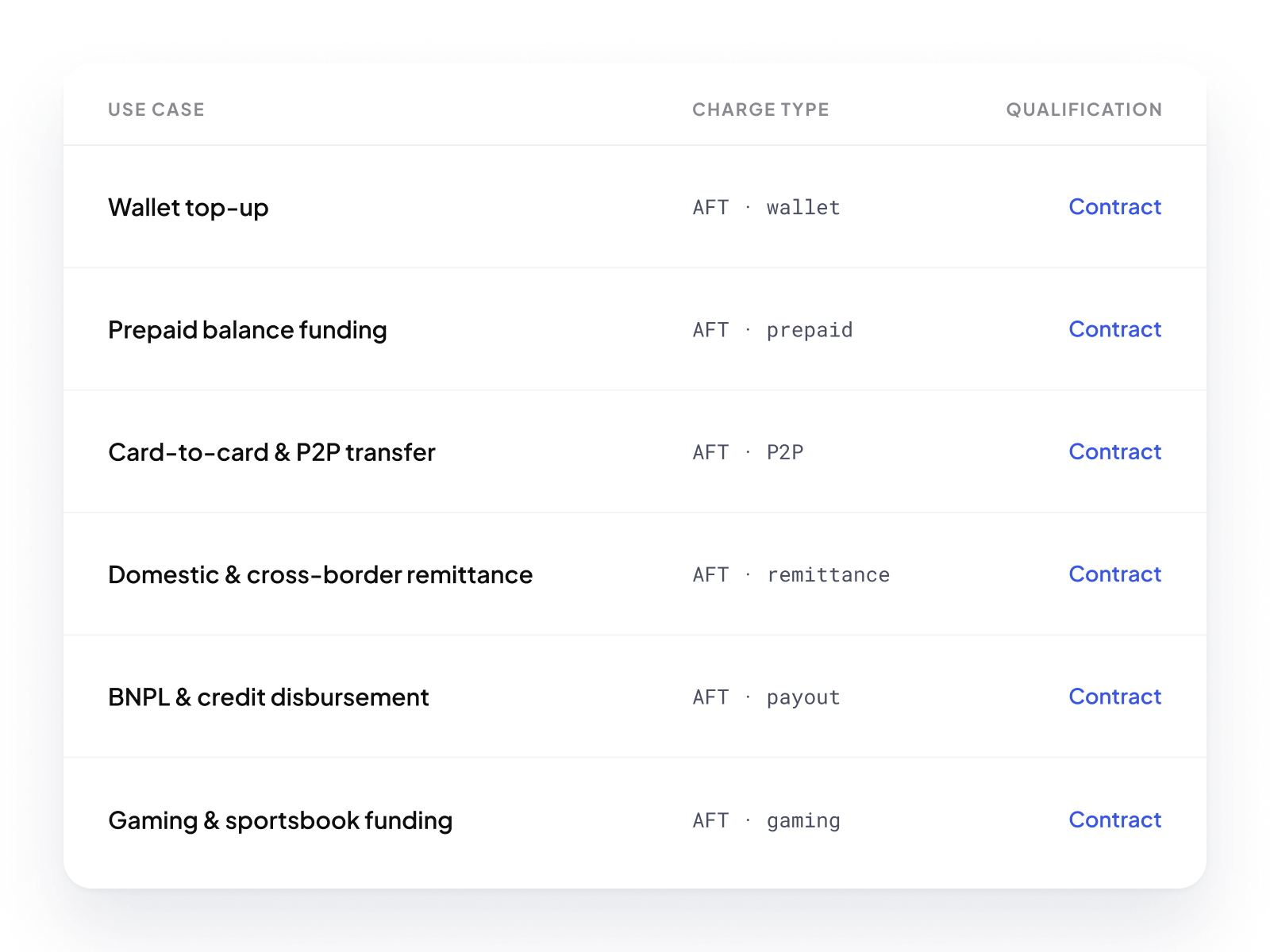
AFT covers the full range of card-funded account loading and money movement scenarios your merchants operate. Wallet top-ups and prepaid balance funding. Card-to-card transfers and P2P payments. Domestic and cross-border remittance. BNPL and credit disbursements to destination cards. Gaming and sportsbook wallet funding. Each use case carries its own charge type indicator. NORBr maps the transaction to the right qualification at the contract level, so the correct indicator reaches the acquirer on every transaction.
Qualified routing. 3DS and non-3DS.
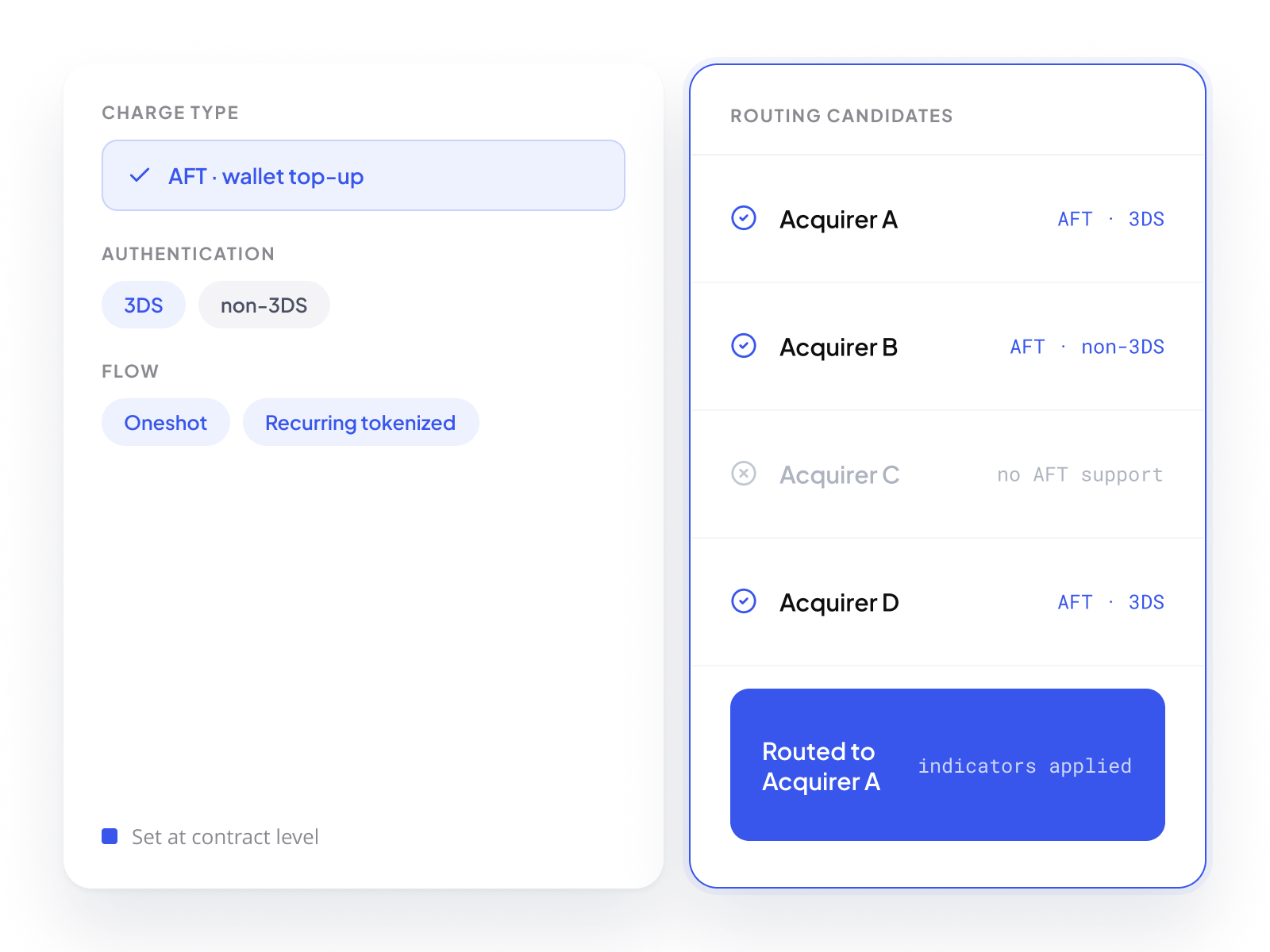
AFT transactions route to acquirers that support the AFT flow. NORBr applies the correct routing rules for each charge type, the correct Visa and Mastercard transaction indicators, and the correct 3DS or non-3DS flow based on the merchant's configuration. Oneshot transactions and recurring tokenized AFT flows are both supported. The merchant sends a standard checkout and order request. The qualification layer handles everything between that request and the acquirer.
RDR. Disputes resolved before they become chargebacks.
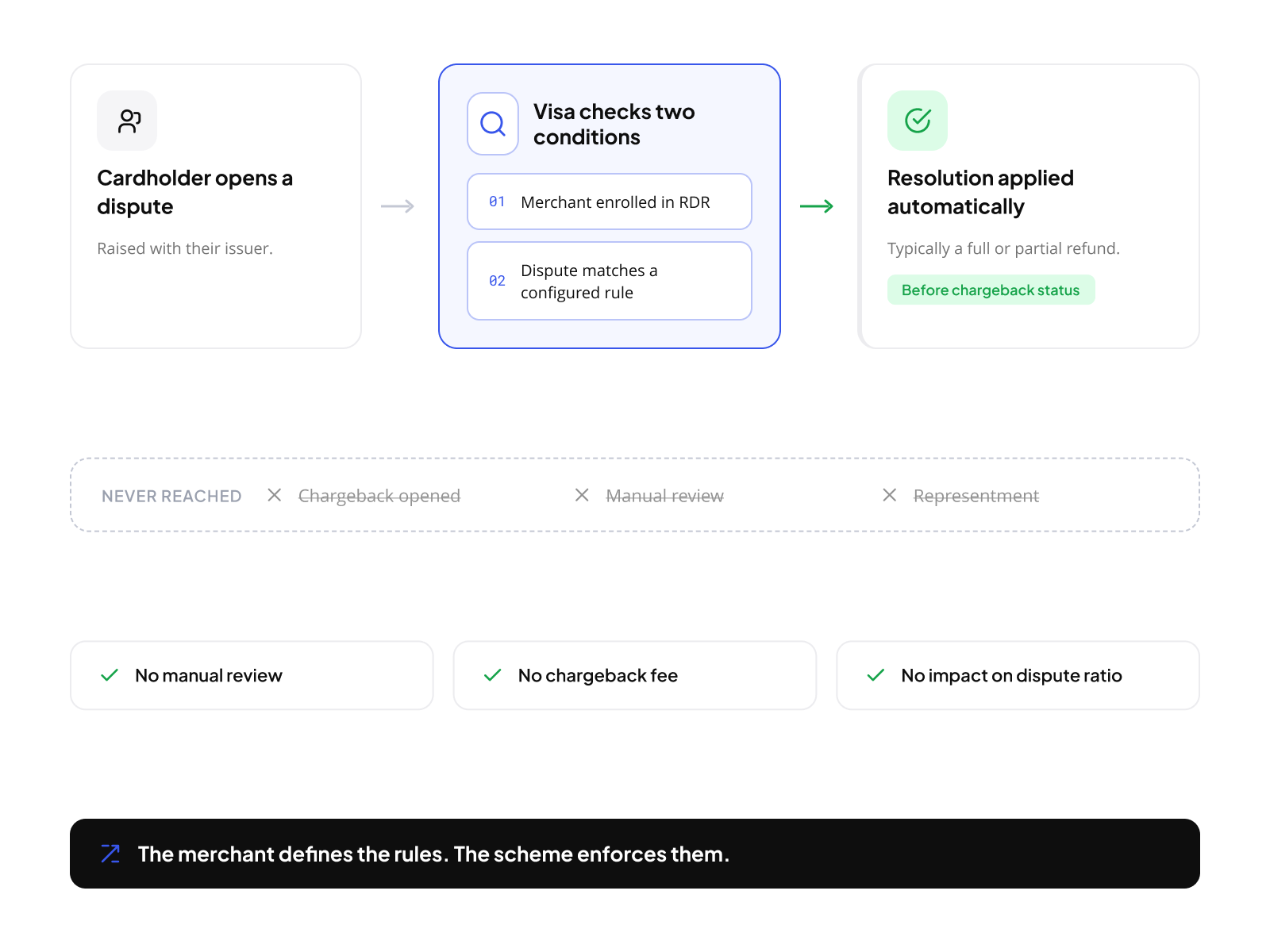
Visa's Rapid Dispute Resolution program enables merchants to resolve eligible customer disputes automatically, before they reach chargeback status. The merchant configures resolution rules. When a dispute matches, Visa applies the resolution directly. The customer's claim is resolved. The chargeback never registers. The merchant's dispute ratio stays clean.
How RDR works
When a cardholder initiates a dispute with their issuer, Visa checks whether the merchant has enrolled in RDR and whether the dispute matches a configured resolution rule. If it does, the resolution is applied automatically, typically a full or partial refund, before the dispute reaches chargeback status. No manual review. No chargeback fee. No impact on the merchant's dispute ratio. The merchant defines the rules. The scheme enforces them.
On the NORBr roadmap. Built into the platform.
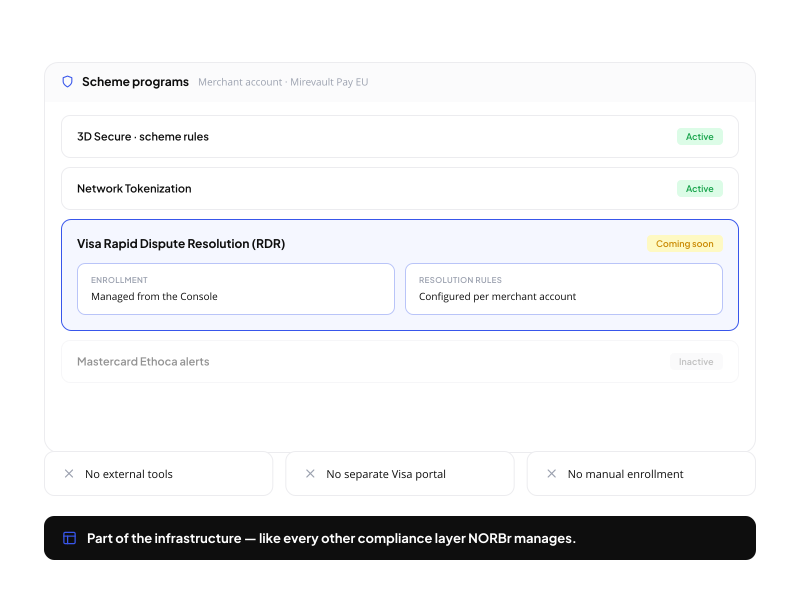
RDR support is currently in development at NORBr. When available, enrollment and rule configuration will be managed directly from the Console, at Merchant Account level, consistent with every other scheme program on the platform. Operators and their merchants will not need external tools, separate Visa portals, or manual enrollment processes. The program will be part of the infrastructure, like every other compliance layer NORBr manages. Updates will be communicated directly.
Scheme programs. In the platform. Not on your roadmap.
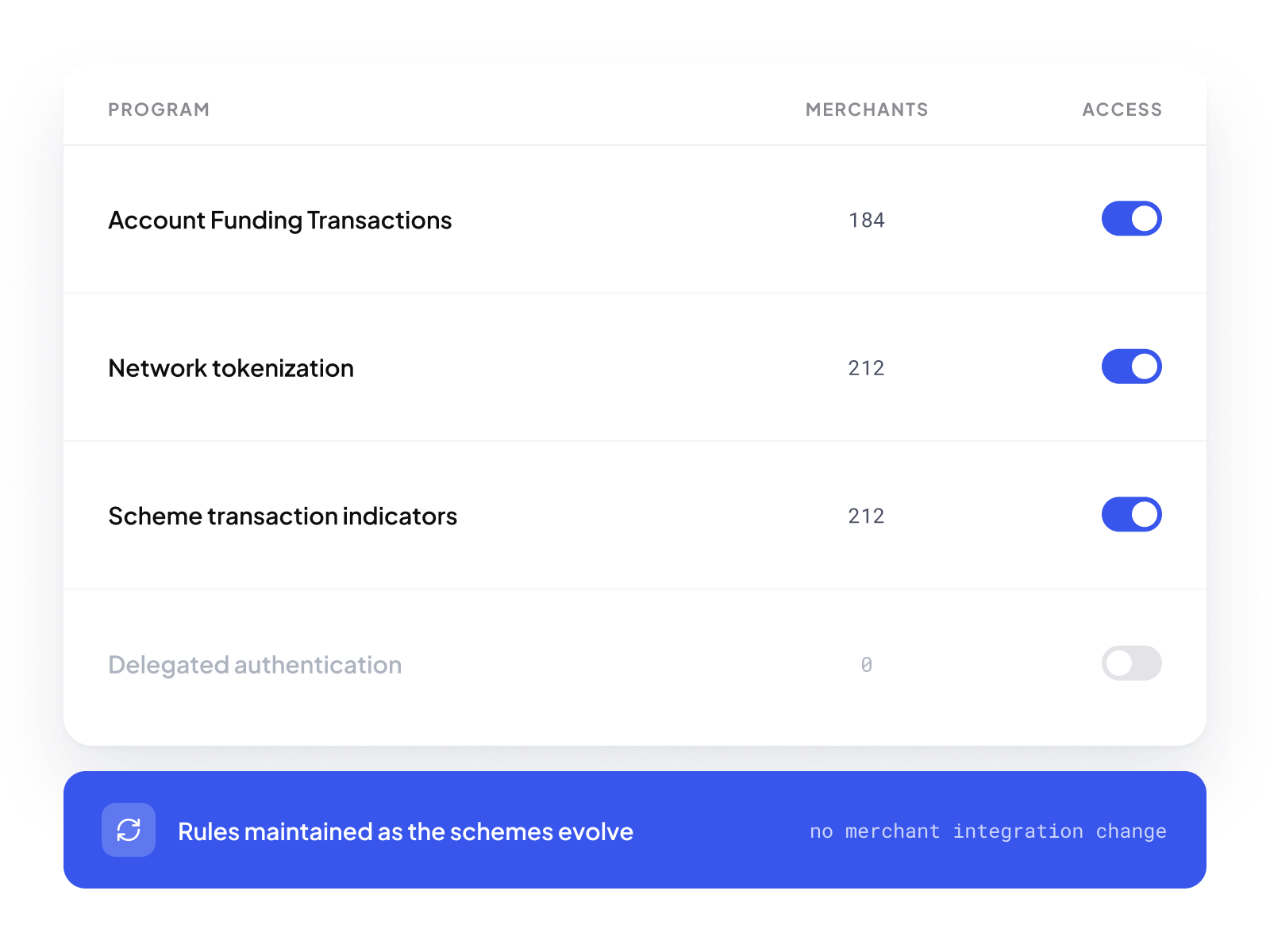
Visa and Mastercard continuously evolve their programs, transaction indicators, and routing qualifications to improve network performance and payment quality. Each evolution creates new capabilities for merchants who implement them correctly. The operators who build on NORBr give their merchants access to those capabilities through configuration, without absorbing the implementation work individually. It is handled at infrastructure level, embedded in the platform, and updated without requiring integration changes from merchants.
Your merchants process correctly. Without knowing why.
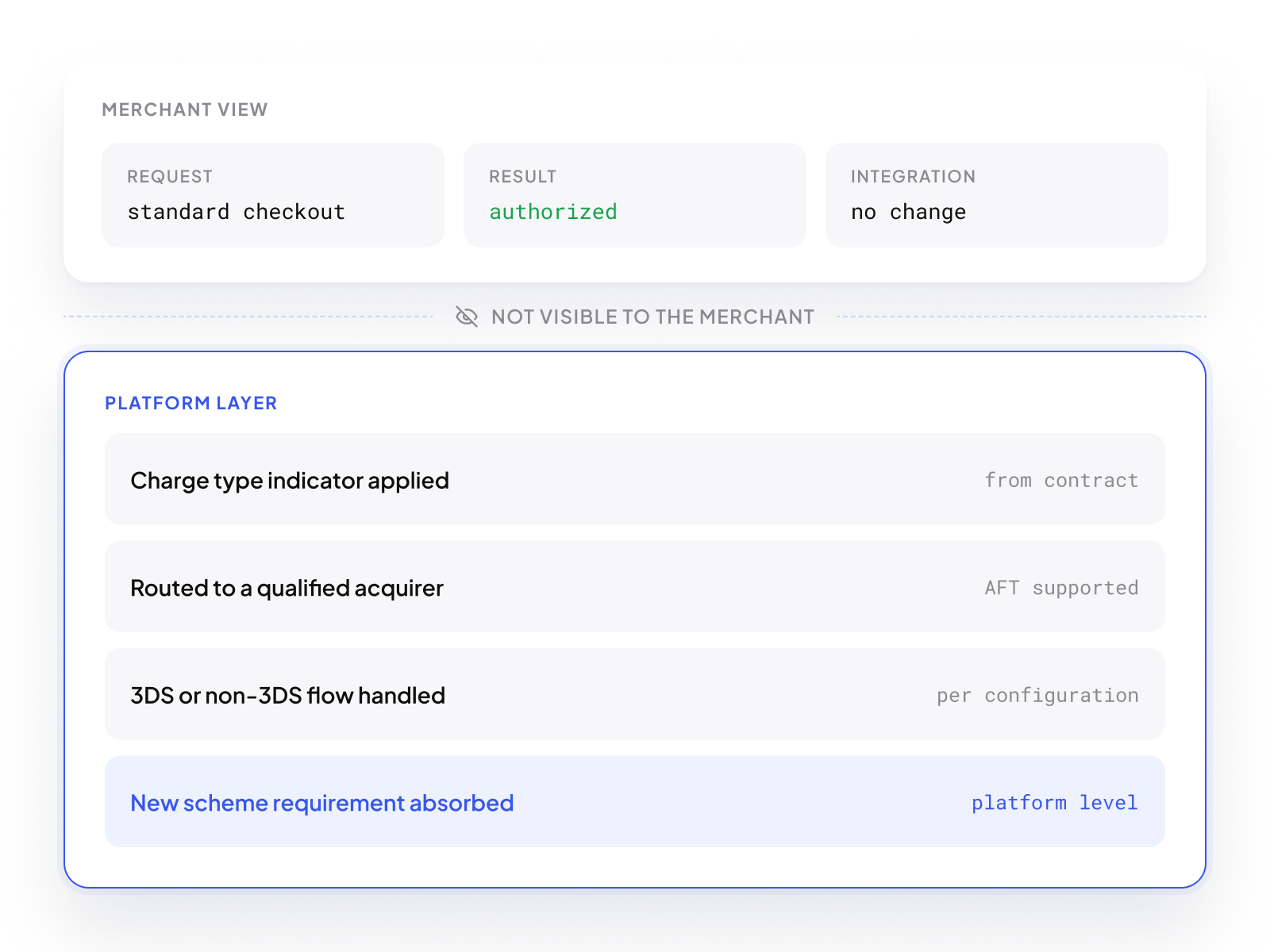
A merchant processing AFT transactions sends a standard request. The platform applies the correct charge type indicator, routes to a qualified acquirer, and handles the 3DS or non-3DS flow based on contract configuration. The merchant never sees the qualification layer. They see authorized transactions. When a new scheme requirement applies to a flow their contract covers, it is absorbed at platform level. Their integration does not change.
Compliance as infrastructure. Not as overhead.
For operators running networks of dozens or hundreds of merchants, scheme compliance is not a merchant problem to solve individually. It is an infrastructure capability to provide at scale. NORBr builds the scheme program support, maintains it as rules evolve, and makes it available to every merchant on the network through configuration. You define which programs your merchants access. The platform does the rest.

Your merchants process correctly. Every scheme. Every program. Every update.

Compliance built into the infrastructure. Not added to the roadmap.

Book a demo