
Stablecoins are tokens pegged one to one to a currency such as the US dollar and settled on a blockchain, so value moves around the clock at a predictable price. For PSPs, PayFacs, ISOs and ISVs, they are one more rail for cross-border B2B payments, treasury, payouts and escrow, which NORBr's white-label infrastructure adds next to cards and bank transfers.
A cargo ship loaded with sugar in Ghana, bound for Brazil, can sit in port for days because the last payment has not cleared through correspondent banks. Jordan Lawrence, CEO and Co-Founder of Damisa, puts a price on that wait: around $280,000 a day for the vessel, while a stablecoin transfer settles in minutes.
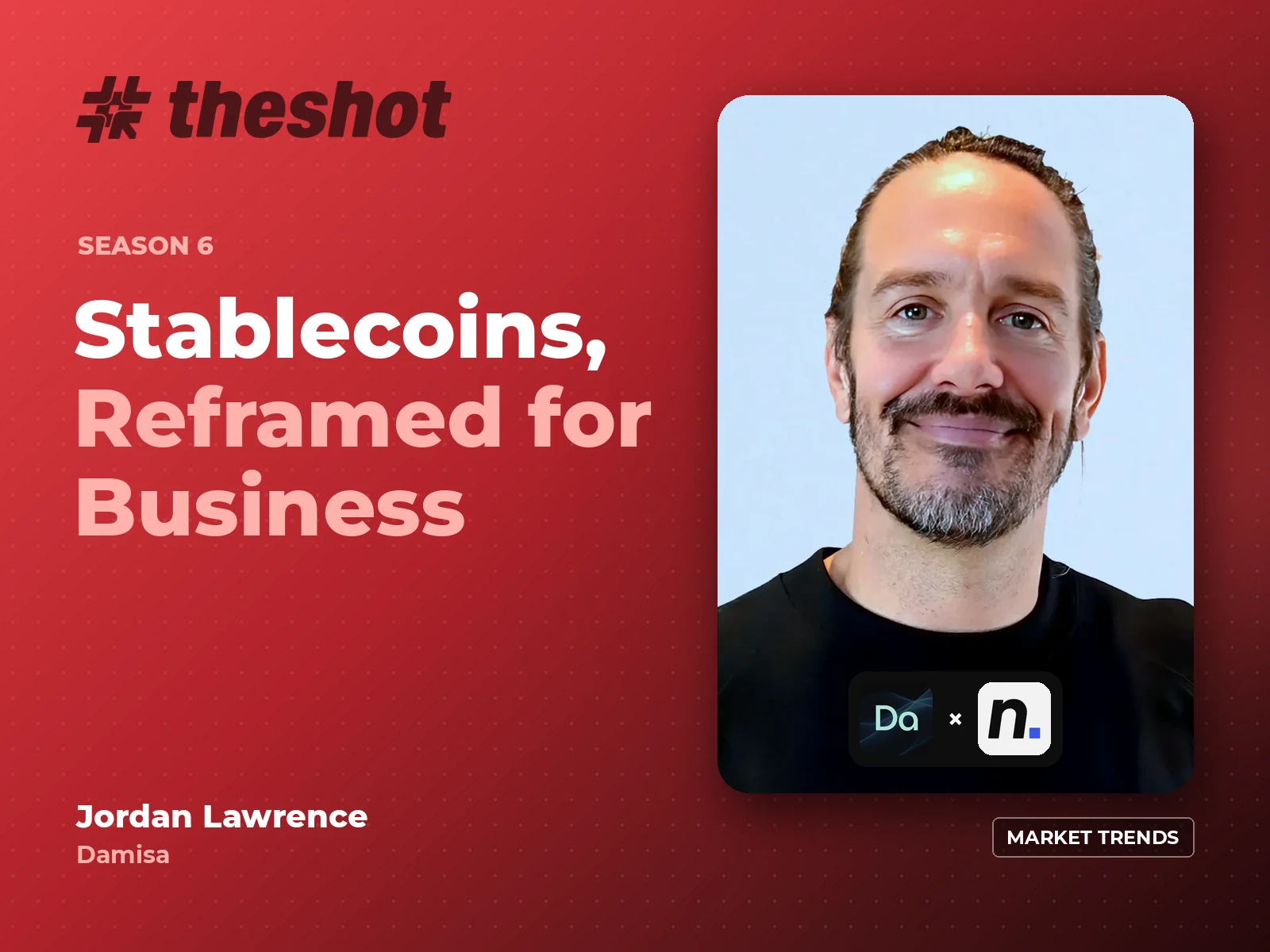
NORBr invited Jordan to Season 6 of #TheShot to unpack stablecoins for the PSPs, PayFacs, ISOs and ISVs that run payments for merchants. For them, stablecoins are not a new asset class to speculate on. They are one more set of rails to connect next to cards and bank transfers, and the question is where those rails solve a problem their merchants already have. This article, updated in October 2026, follows the three episodes of Season 6 and adds the regulatory and market context around them.
Key takeaways on stablecoins for business:
- A stablecoin is backed one to one by a reserve currency, which makes it usable for payments where Bitcoin's price swings are not.
- The strongest use cases today are B2B: cross-border settlement, treasury and FX, payouts and escrow.
- Regulation now exists on both sides of the Atlantic, with MiCA in the EU and the GENIUS Act in the US.
- The likely model is hybrid: existing fiat rails, with stablecoin infrastructure plugged in where it removes delay or cost.
What makes a stablecoin different from Bitcoin for payments?
A stablecoin holds a fixed value against a reference currency because the issuer keeps reserves that back each token one to one. Bitcoin floats against the dollar and was not built for the transaction volumes of a payment network. That stability is what makes stablecoins usable for pricing, invoicing and settlement.
"When Satoshi Nakamoto first wrote the white paper of Bitcoin, it was designed as a payment method. Things have moved on, and Bitcoin cannot handle all the transactions that need to happen per second in the payment space. A stablecoin is backed one to one to a G3 currency. If you have a US dollar stablecoin like USDT or USDC, it is always pegged to the US dollar." Jordan Lawrence, CEO and Co-Founder, Damisa, in Episode 1
The market has grown into a settlement layer of real size. According to the Stablecoin Beat August 2026 market report, total stablecoin supply stood at about $304 billion at the end of August 2026, with USDT and USDC together accounting for roughly 85% of it. Jordan's point is that much of this demand did not come from crypto traders. Businesses in countries with volatile currencies already hold dollar stablecoins to protect their treasury, and in some markets consumers pay with them in shops.
Why are B2B cross-border payments the underserved use case?
Consumer payments are well served by cards, wallets and instant payment schemes. B2B payments across borders still run largely on correspondent banking, where a transfer passes through several banks, each with its own cut-off times, compliance checks and fees.
Swift has improved the network leg: in 2023 it reported that 89% of transactions reach the recipient bank within an hour. The same release notes that only about 60% of wholesale payments reach the customer's account in that time, because of delays at the beneficiary leg: regulatory controls, batch processing and the opening hours of local market infrastructure. Those delays concentrate in the corridors where Swift works least well, which are also the corridors Jordan describes.
"Countries where SWIFT works really well, Singapore, London, New York, it's fine. But in markets where SWIFT doesn't work well, stablecoins are a massive use case." Jordan Lawrence, in Episode 2
Cost follows the same pattern. The World Bank's Remittance Prices Worldwide report put the global average cost of sending $200 at 6.49% in the first quarter of 2025, more than twice the 3% target set by the UN Sustainable Development Goals for 2030. Remittances are a consumer flow, but they run on the same correspondent chains as small B2B transfers.
How does programmable escrow replace a bank guarantee?
In international trade, an exporter does not want to ship goods and hope to be paid, and an importer does not want to pay for goods that never arrive. The traditional answer is a bank guarantee or a letter of credit, which Jordan estimates at 7 to 8% of the transaction value, plus days of paperwork.
A stablecoin escrow works on a simpler mechanism. The seller issues an invoice, the buyer pays into an escrow wallet, the goods are shipped, and the funds are released once delivery is confirmed, either in stablecoins or converted back to local currency. The release condition is written into a smart contract: if the confirmation arrives, the payment executes. Jordan sees the same model applying to real estate transactions and to gig economy platforms that pay creators in many countries.
Escrow also answers a question card payments solved long ago. A card transaction carries chargeback rights for the cardholder. A stablecoin transfer is final. Escrow puts a protection step back between payment and delivery, without a bank in the middle.
What regulation now applies to stablecoins in the EU and the US?
Both large markets now have a dedicated framework. In the EU, the rules of the Markets in Crypto-Assets Regulation (MiCA) on asset-referenced tokens and e-money tokens have applied since 30 June 2024, as the European Banking Authority recalls. A euro or dollar stablecoin offered in the EU is treated as an e-money token, and its issuer must be authorized as a credit institution or an e-money institution.
In the US, the GENIUS Act was signed into law on 18 July 2025 as Public Law 119-27. According to the Congressional Research Service, issuers must hold at least one dollar of permitted reserves, such as cash, insured deposits and short-dated Treasury bills, for every dollar of stablecoins issued, and publish periodic reports on reserve composition examined by registered accounting firms. Implementation is still under way: the Comptroller of the Currency said in August 2026 that the OCC would have a final rule out by November, and the Act takes effect on 18 January 2027 at the latest, or 120 days after the final rules if they come sooner.
Not everyone sees stablecoins as money in the full sense. In its Annual Economic Report 2025, the Bank for International Settlements argued that stablecoins fail three tests of a monetary system: singleness, elasticity and integrity, and that they may play a subsidiary role if adequately regulated. For a payment operator, that debate matters less than the practical point: regulated issuers and licensed on- and off-ramps now exist, which is what makes stablecoin flows connectable.
Will stablecoins replace fiat rails or run alongside them?
They will run alongside them. Jordan's own conclusion is hybrid: keep the fiat rails that work, and plug stablecoin infrastructure on top for four uses, pay-ins, payouts, escrow, and treasury including FX.
"The future is a combination of both: using existing fiat rails and plugging stablecoin infrastructure on top." Jordan Lawrence, in Episode 3
That is also why banks and PSPs move carefully. Most rely on fiat rails, often SWIFT, and Jordan notes that large institutions take time to innovate. Many PSPs are partnering with stablecoin issuers and infrastructure providers rather than building the stack themselves. The card networks are moving the same way: Mastercard completed its acquisition of BVNK, a stablecoin payments infrastructure provider, in August 2026, and Visa reported in September 2026 that its stablecoin settlement had passed a $20 billion annualized run rate, up more than 15 times in a year.
What should PSPs and PayFacs prepare for?
For an operator, a stablecoin rail is an integration like any other: an issuer or on- and off-ramp partner, a settlement flow, reconciliation, compliance checks and reporting. The work is in connecting it to the rest of the stack, so that a merchant paid in USDC sees the same transaction record, the same reconciliation and the same reporting as a merchant paid by card.
On NORBr's white-label payment infrastructure, new providers and payment methods are added by integration rather than by rebuilding the platform. NORBr builds those integrations on request with its Mapper tool, and every flow lands in the same payment network, routing rules and analytics. An operator can therefore add a stablecoin partner for the merchants and corridors that need it, without changing what every other merchant on the platform runs. Jordan spoke to NORBr before, on variable recurring payments for PayFacs, and the account-to-account payments guide covers the other rail he knows well. Payments between AI agents, the next use case for stablecoin rails, are covered in AI in payments: agentic commerce and the acceptance problem.
Who is Jordan Lawrence?

Jordan Lawrence, CEO and Co-Founder, Damisa. Jordan co-founded Damisa after helping build the open banking payment network Volt, where he was Chief Growth Officer, as FinTech Futures reported at the launch. Damisa is a UK-based payments company that combines stablecoins and fiat to move money across borders, with smart wallets, automated escrow and instant cross-border settlement, and a focus on emerging markets, logistics, real estate and travel. Follow him on LinkedIn and Damisa on LinkedIn.
A stablecoin does not make a payment faster by itself. The rail it replaces does: a transfer that once waited for three banks to open now waits for a smart contract to see a delivery confirmation.
NORBr is the white-label payment infrastructure for PayFacs, PSPs, ISOs and ISVs. New payment partners and rails are integrated on request and run under the operator's brand, next to the cards and bank transfers its merchants already use.
About #TheShot: a video series sharing clear, unsponsored insights from payment professionals. One expert, one topic, short episodes. Watch Season 6 with Jordan Lawrence or browse all seasons.