Every payment,

one record.

One payment, 300+ structured fields, every one a filter.

Every payment your merchants process becomes one unified record: Checkout, Order, Transaction, and Finance, linked end to end. The same structure holds whichever provider processed it, whichever method the customer chose, online or in-store. Your merchants read it, act on it, and segment it, all from one place.

Book a demo
Hero image

The four objects of every payment.

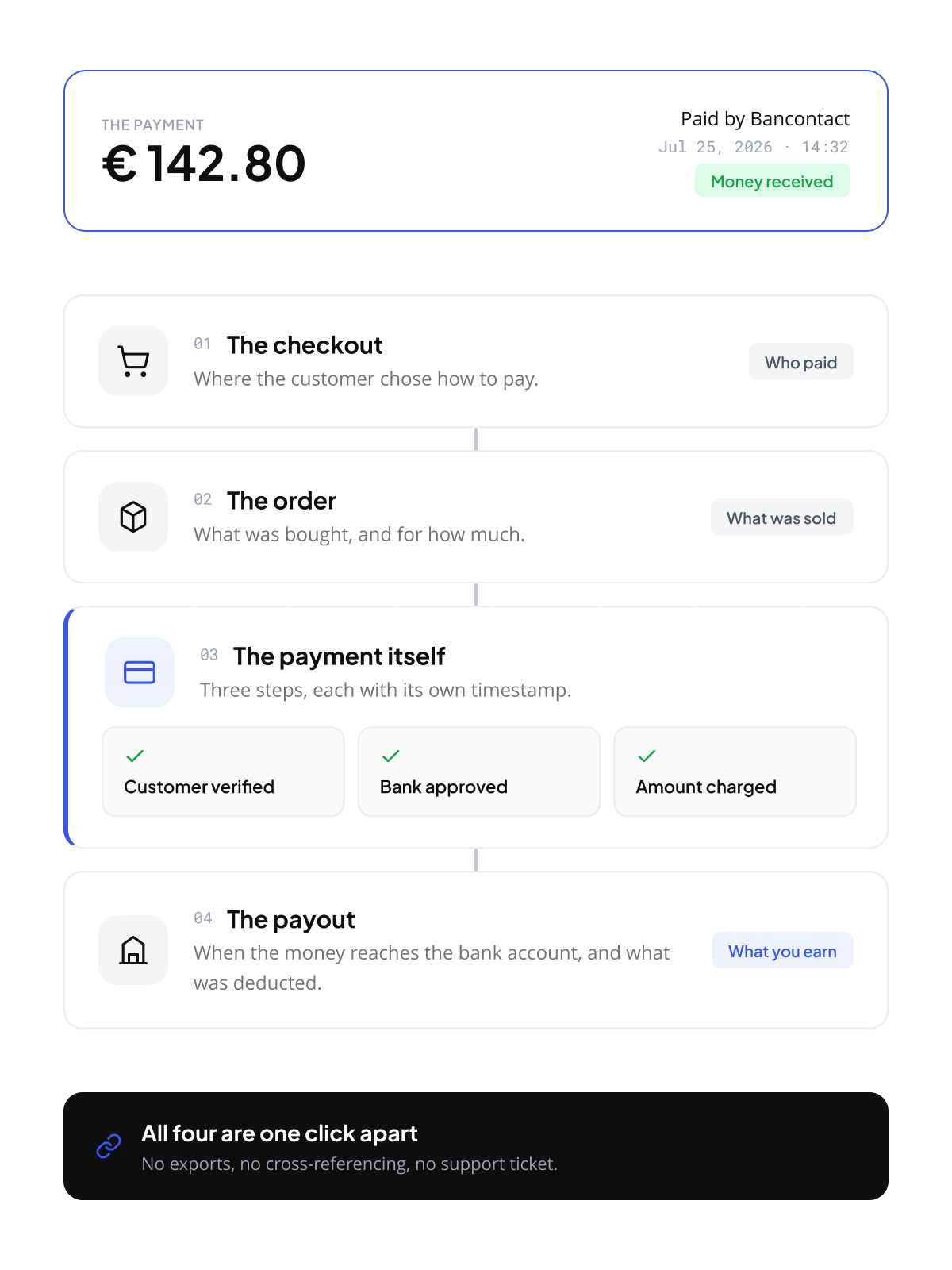
A payment is not a single status. It moves through four linked objects: the Checkout your customer opens, the Order your merchant submits, the Transaction that executes the payment, and the Finance record that reconciles it. Every field is captured at every step, from the session identifier to the interchange fee. More than three hundred data fields describe a single payment, all linked, all queryable. Your merchants analyze, export, act,
and reconcile from one structured source.
From session to settlement.
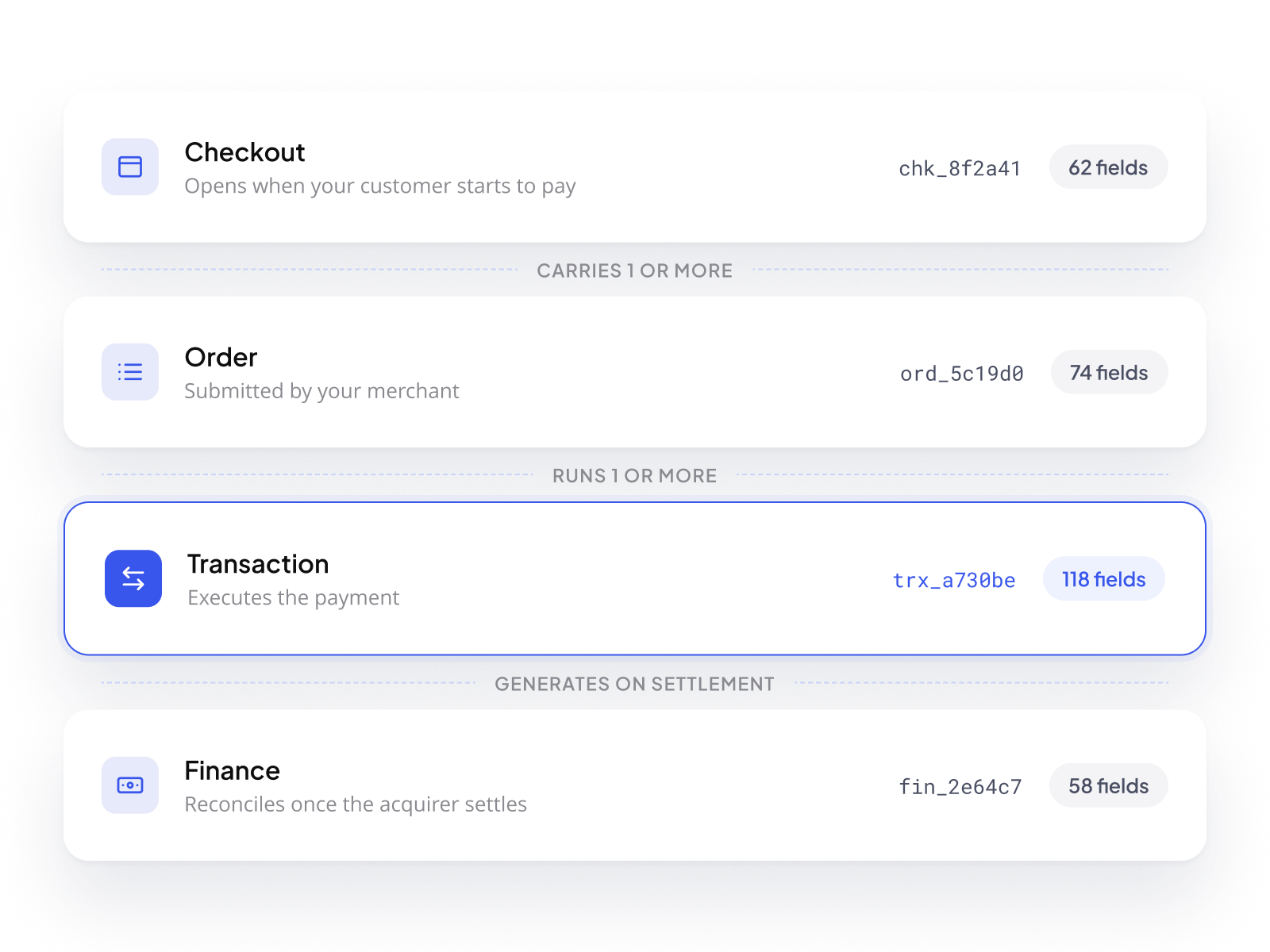
The four objects connect in sequence: a Checkout opens when a customer starts to pay, carries one or more Orders, and each Order runs through one or more Transactions that generate Finance records once the acquirer settles. Your merchants follow a payment end to end, or jump straight to the object they need.
One record, every team.
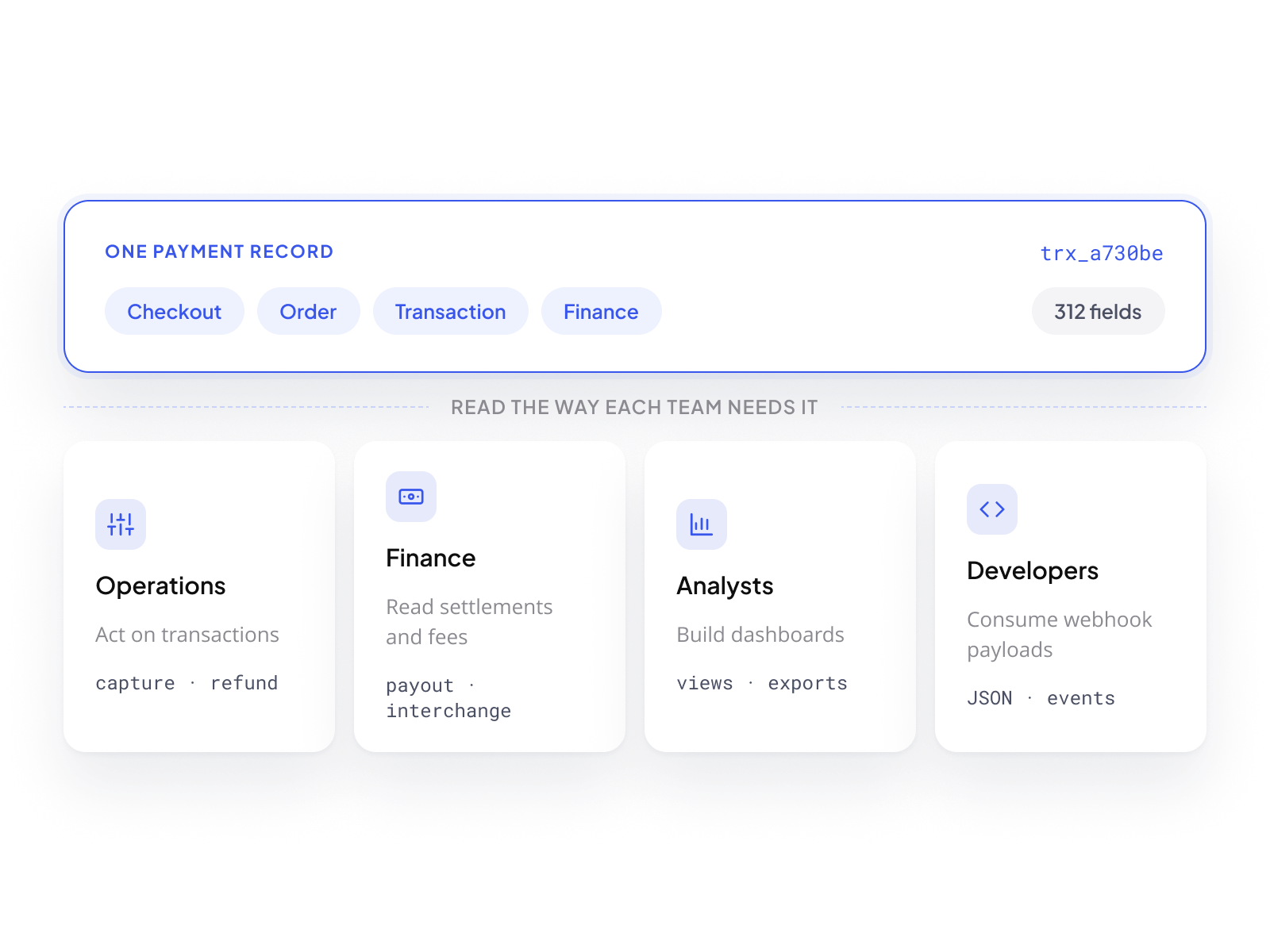
The same structured data serves every use: operations teams act on transactions, finance teams read settlements and fees, analysts build dashboards, developers consume webhook payloads. One record, read the way each team needs it.
One record. Every provider.
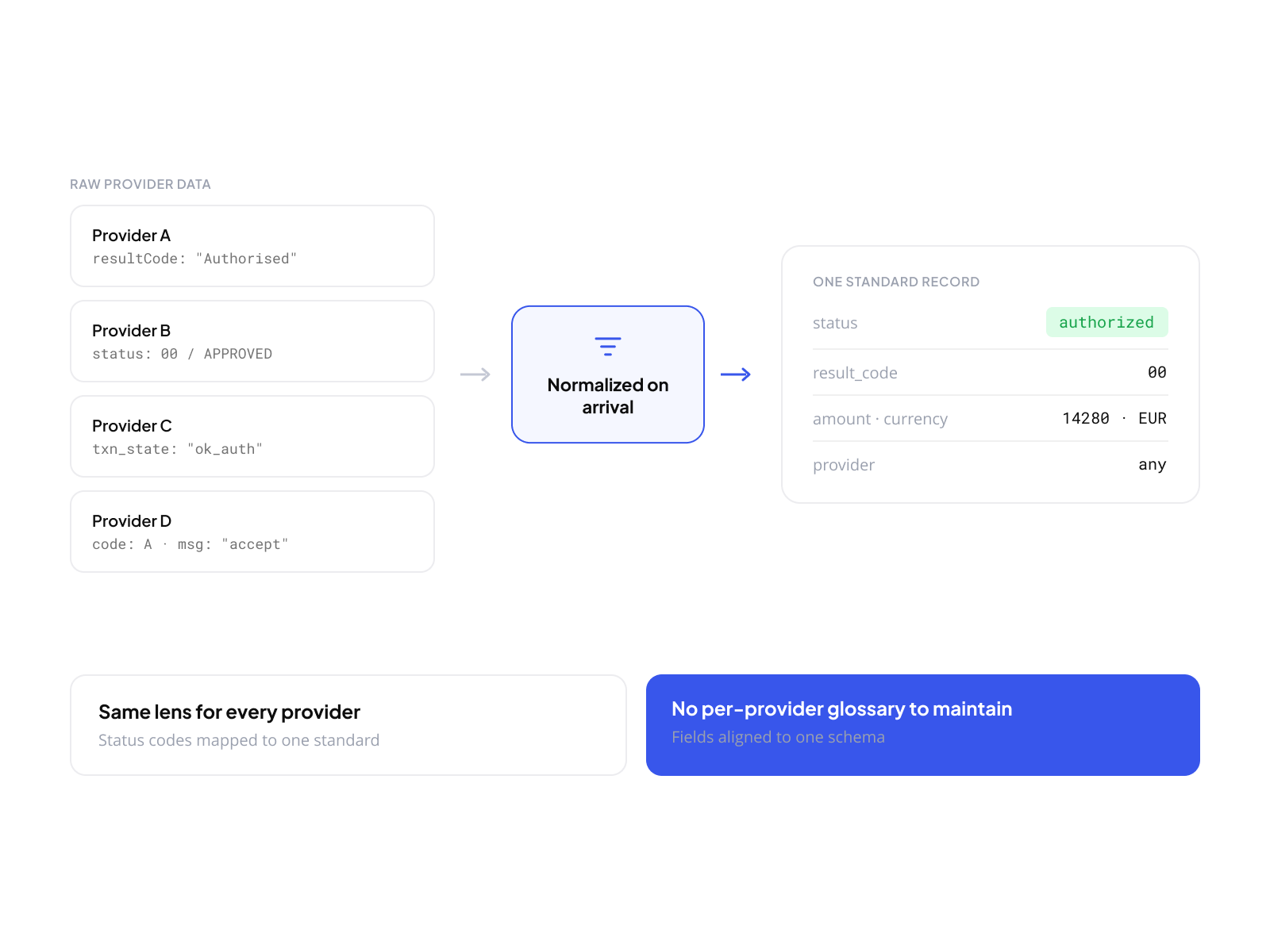
Each provider speaks its own language: its own status codes, its own field names, its own payload shape. On your platform, every transaction lands in one normalized schema, whatever the provider behind it. A Bancontact payment routed to one acquirer and a Visa payment routed to another read with the same fields, the same statuses, the same structure. Your merchants stop translating provider formats in their heads. One schema covers the whole network.
Normalized, not just collected. 
Raw provider data is normalized as it arrives: status codes mapped to one standard, fields aligned to one schema, results expressed in one vocabulary. Your merchants read every provider through the same lens, with no per-provider glossary to maintain.
Online and in-store, one stream.
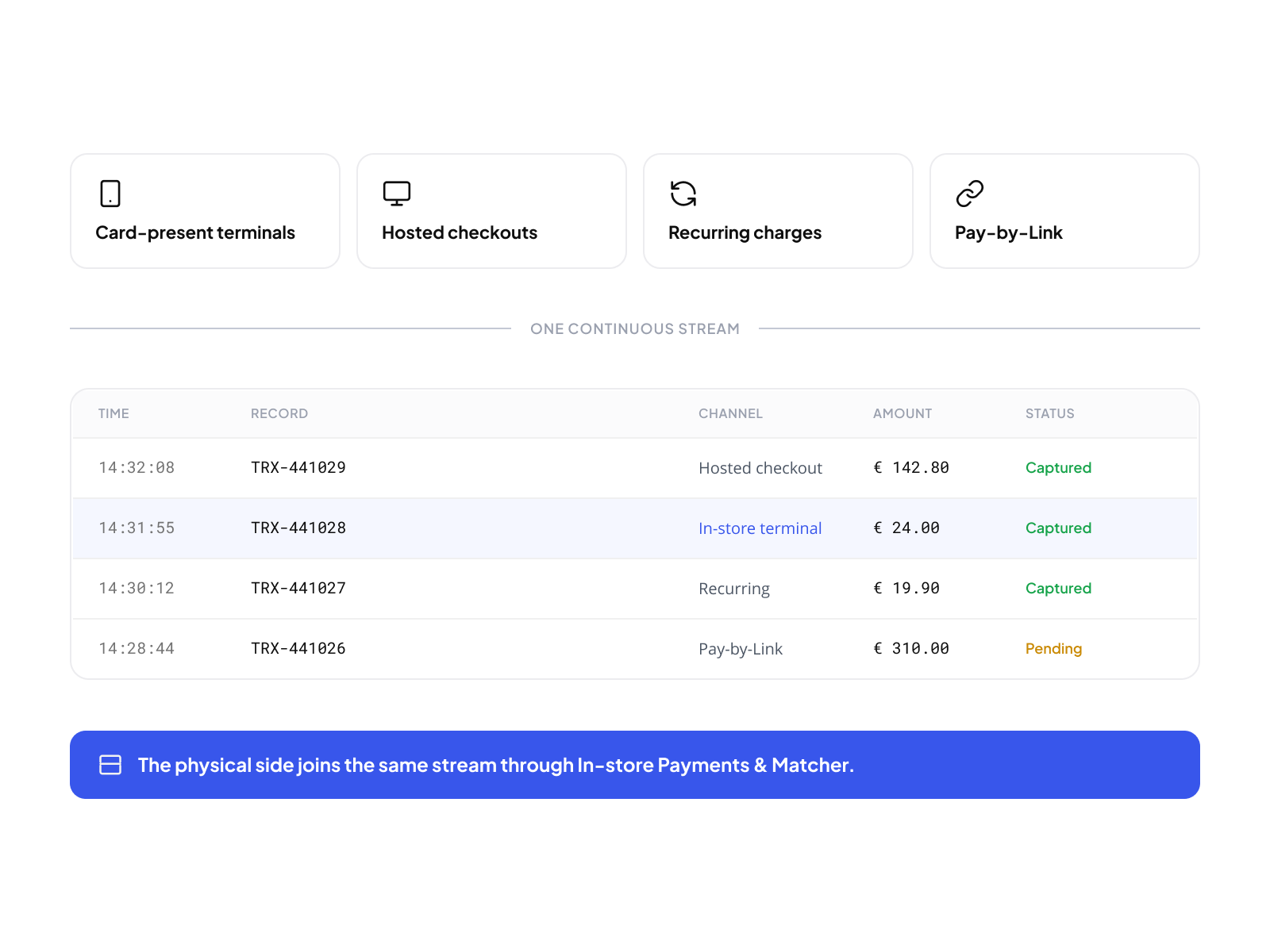
Card-present terminals, hosted checkouts, recurring charges, Pay-by-Link: every channel writes to the same record structure. Your merchants see one continuous stream of activity instead of disconnected silos. The physical side joins the same stream through In-store Payments & Matcher.
Every field is a filter.
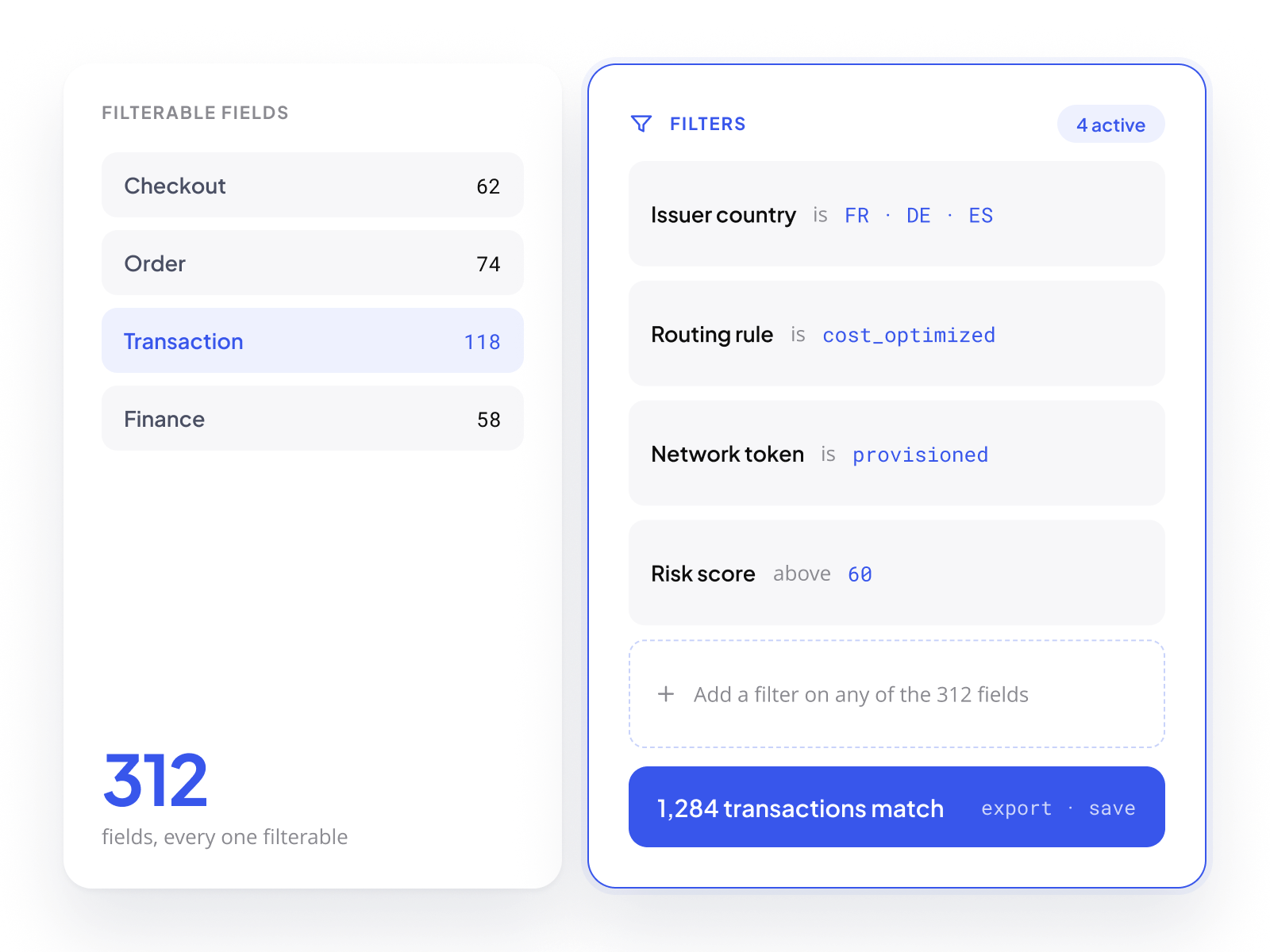
On your platform, every data field is also a filter. The 300+ fields that describe a payment are 300+ ways to segment, search, and build a view. Filter by issuer country, by routing rule, by network token status, by risk score, by card category, by store. Combine any of them. The granularity your merchants can reach is set by the data itself, never by a short list of preset filters.
300+ fields. 300+ filters.
Filtering reaches beyond a handful of common attributes. Every field on the Checkout, Order, Transaction, and Finance objects can filter a view, feed a saved search, or define an export. The depth your merchants can query matches the depth of the data captured.
Saved, shared, reused.
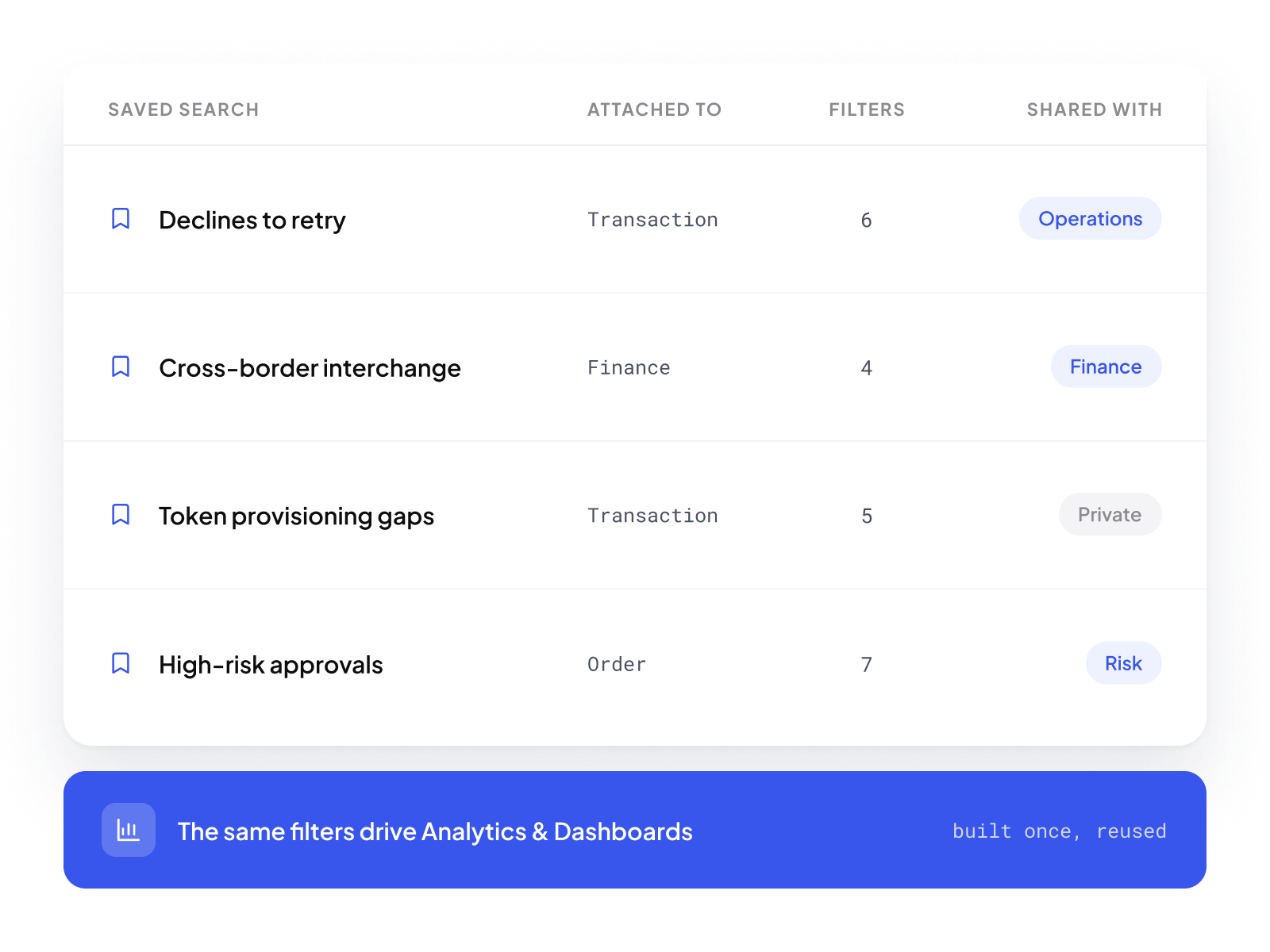
A filter combination your merchants rely on becomes a saved search, attached to the view where it belongs and shared with the right team. The query is built once and reused. The same filters drive your dashboards in Analytics & Dashboards.
Operate every payment from the Console.
Authorization is the start, not the end: after a payment is authorized, your merchants capture it, refund it, or cancel it, in full or in part, directly from the transaction detail. Each action lives on the transaction itself, with the current state always visible. No code. No ticket to your team.
Capture, full or partial.
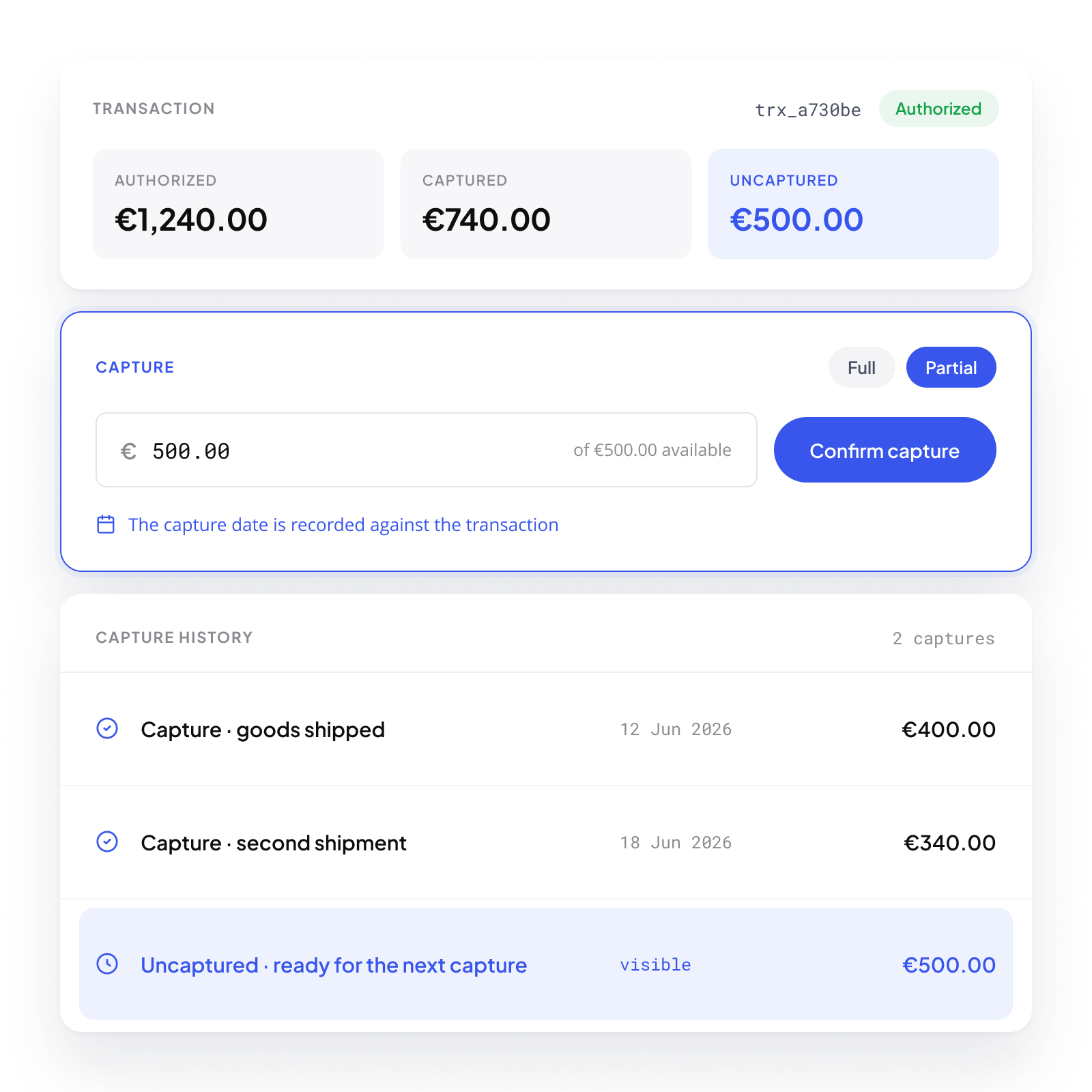
A captured payment can be settled in full, or in parts as goods ship. Your merchants set the amount, confirm, and the capture date is recorded against the transaction. What stays uncaptured stays visible, ready for the next capture.
Refund without losing history.
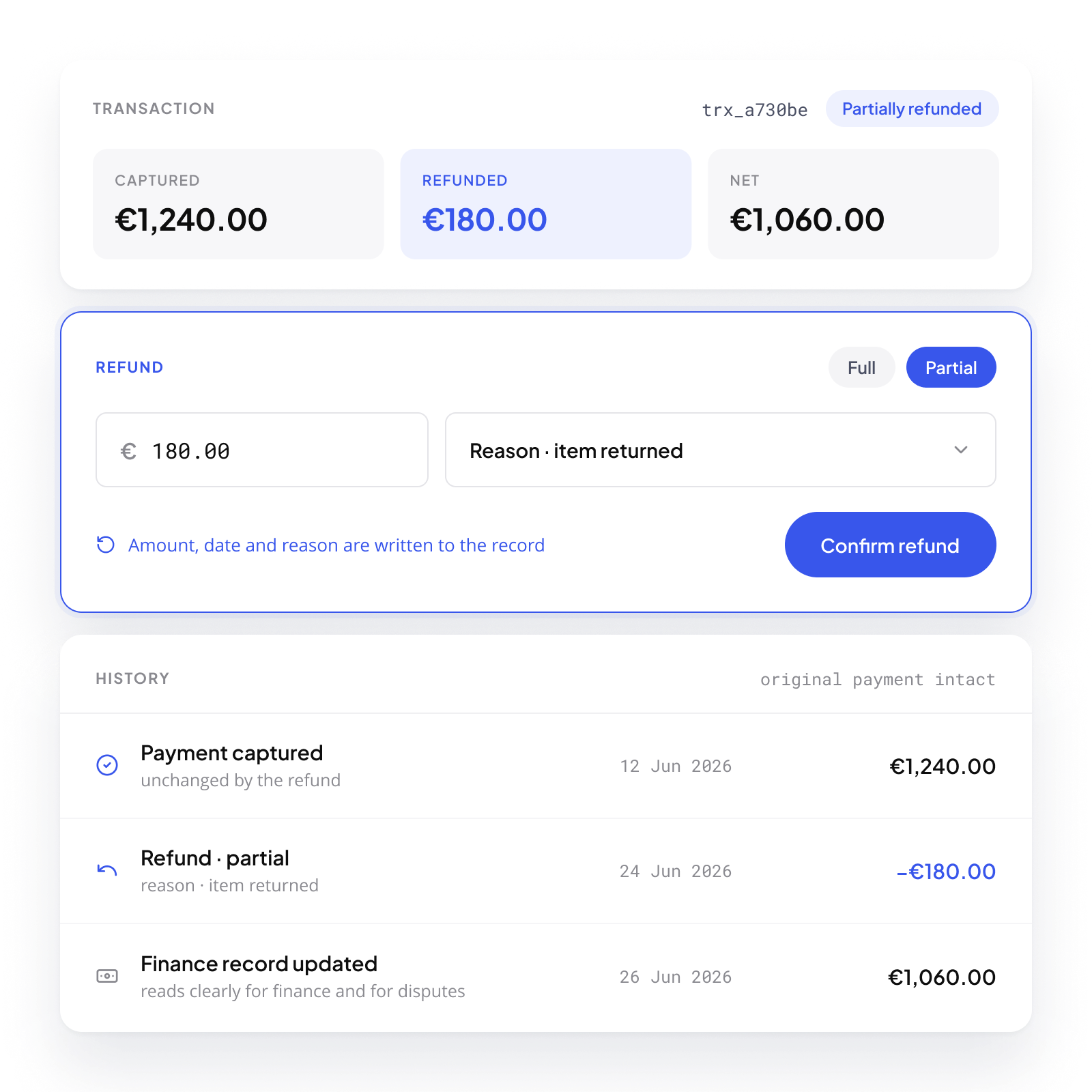
Refunds run in full or in part, with a reason attached. The refunded amount, the date, and the reason sit on the transaction record. The original payment stays intact, so the history reads clearly for finance and for disputes.
Cancel before capture.
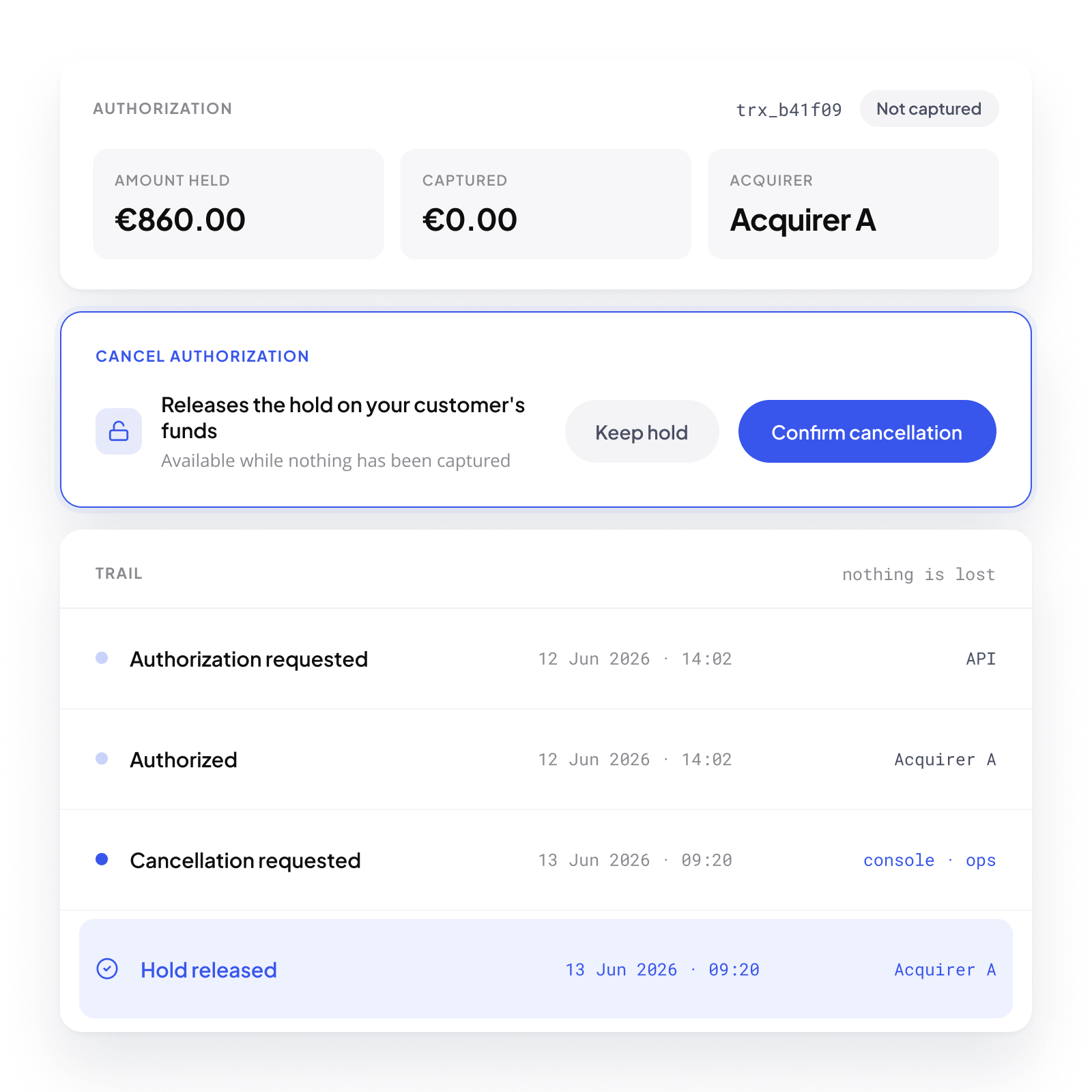
Before funds are captured, an authorization can be cancelled to release the hold. The transaction keeps its full trail: the request, the cancellation, the date, the actor. Nothing is lost.
Every level. Every scope.
Operations and data follow the same scope model as the rest of your platform, the hierarchy set out in the White-Label Platform. A Merchant Account sees its own transactions. A Program Manager sees its portfolio. A Meta Program Manager sees the full network. Every level acts and reads within its perimeter, on its own data.
One view across your network.
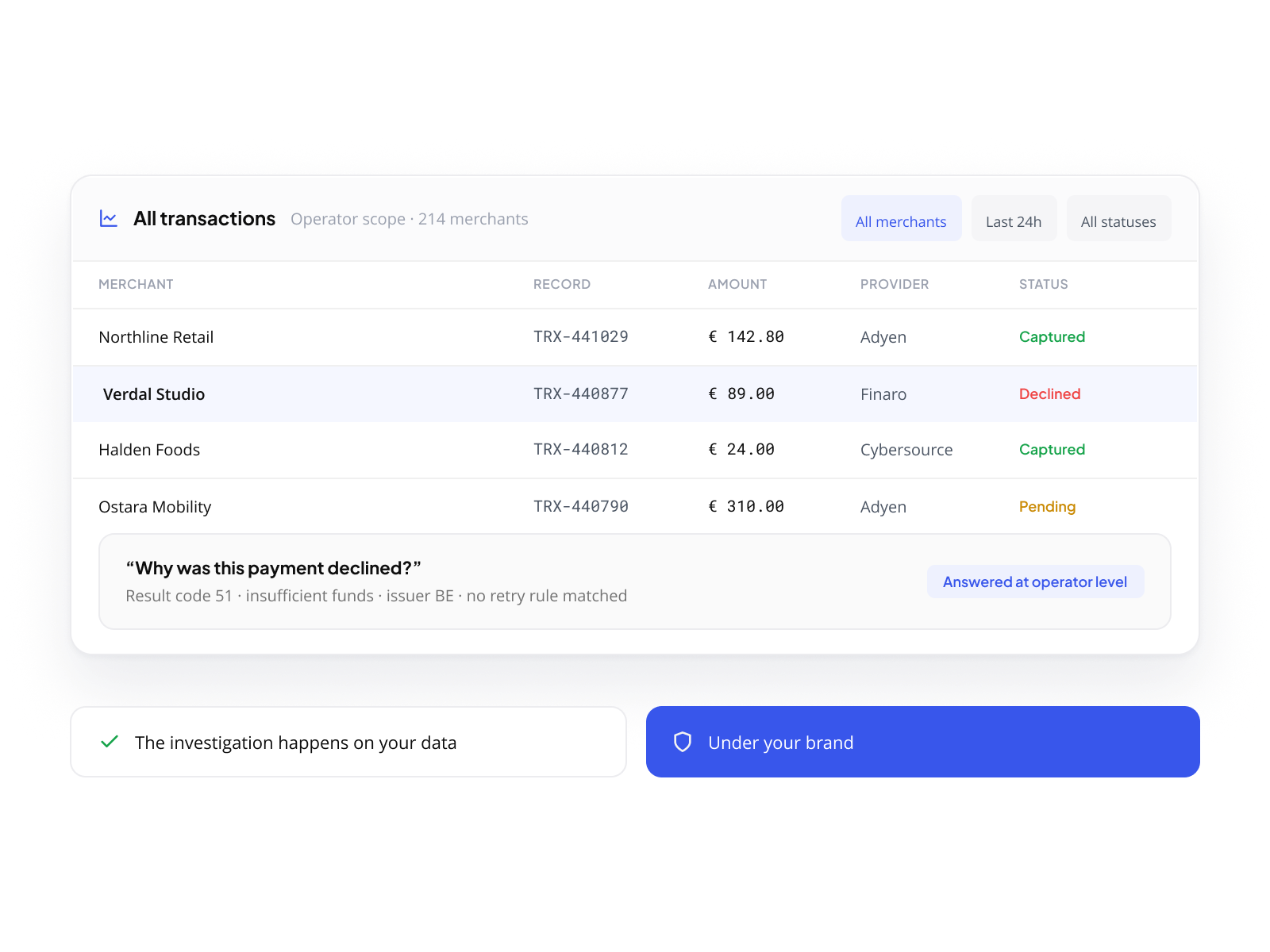
From your operator view, every transaction across your merchants sits in one place, under the same filters. When a merchant asks why a payment behaved a certain way, you open the record at your level and answer. The investigation happens on your data, under your brand.
Access you grant.
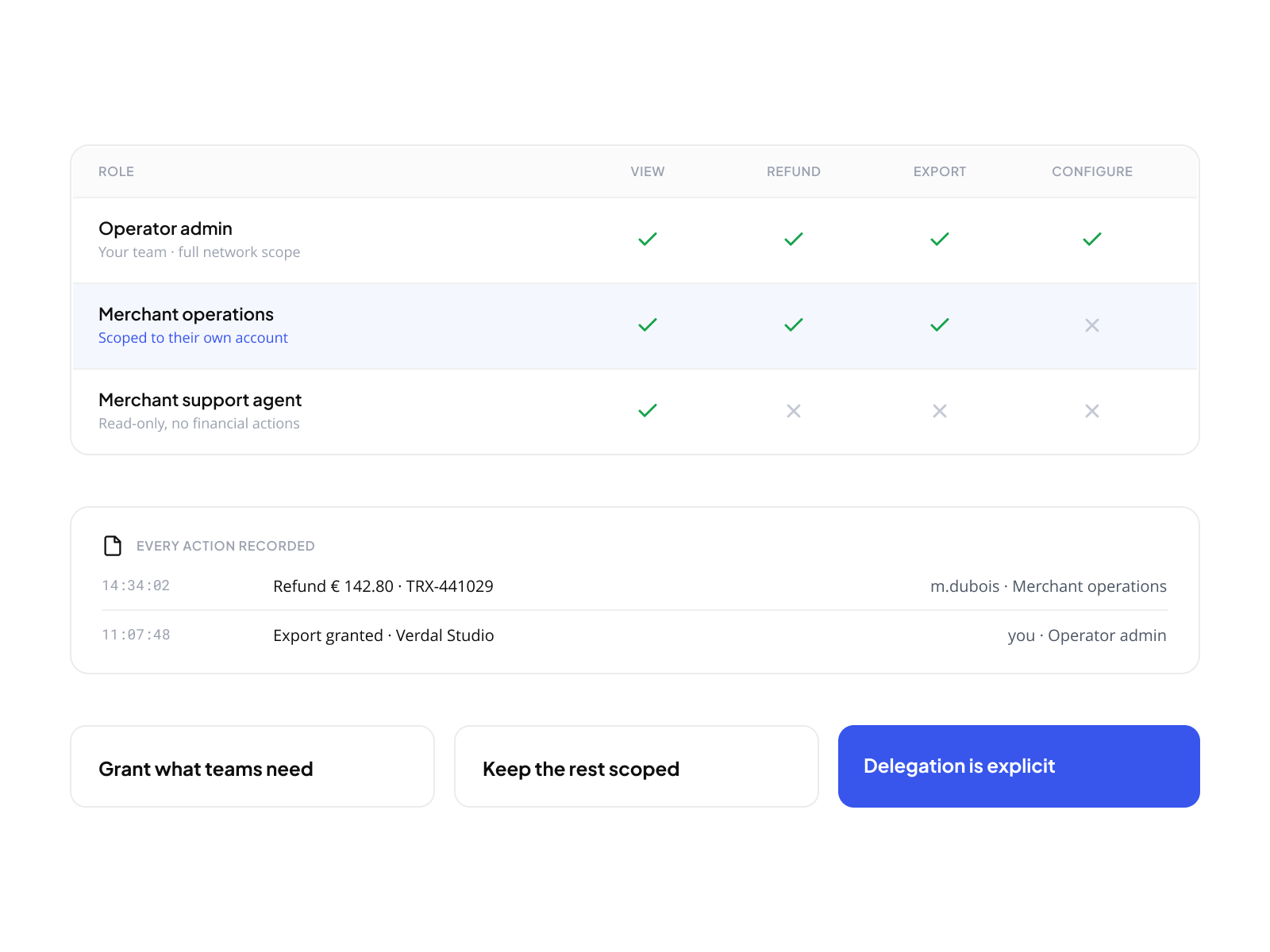
What each merchant sees and does follows the permissions you set. Grant operational rights to the teams that need them. Keep them scoped where they should stay. Delegation is explicit, and every action is recorded.

Every payment, unified and yours to operate.

One record, 300+ fields, every action and every filter in one place.

Book a demo