
The transition from cash to digital payments is uneven: Japan and Germany move gradually, Brazil leapfrogged through Pix, and Mexico is catching up through instant transfers. For PSPs, PayFacs and ISVs serving merchants in these markets, the practical answer is a hybrid stack that supports local payment methods and instant rails, with routing and reconciliation handling the complexity.
Cash is declining everywhere, but at very different speeds, and each market's path shapes what merchants need from their payment provider. This article, updated in October 2026 with the latest central bank and government data, looks at the global picture, then at Japan, Germany, Brazil and Mexico, and at what operators should build for markets where cash and digital payments coexist.
How much cash is still used worldwide?
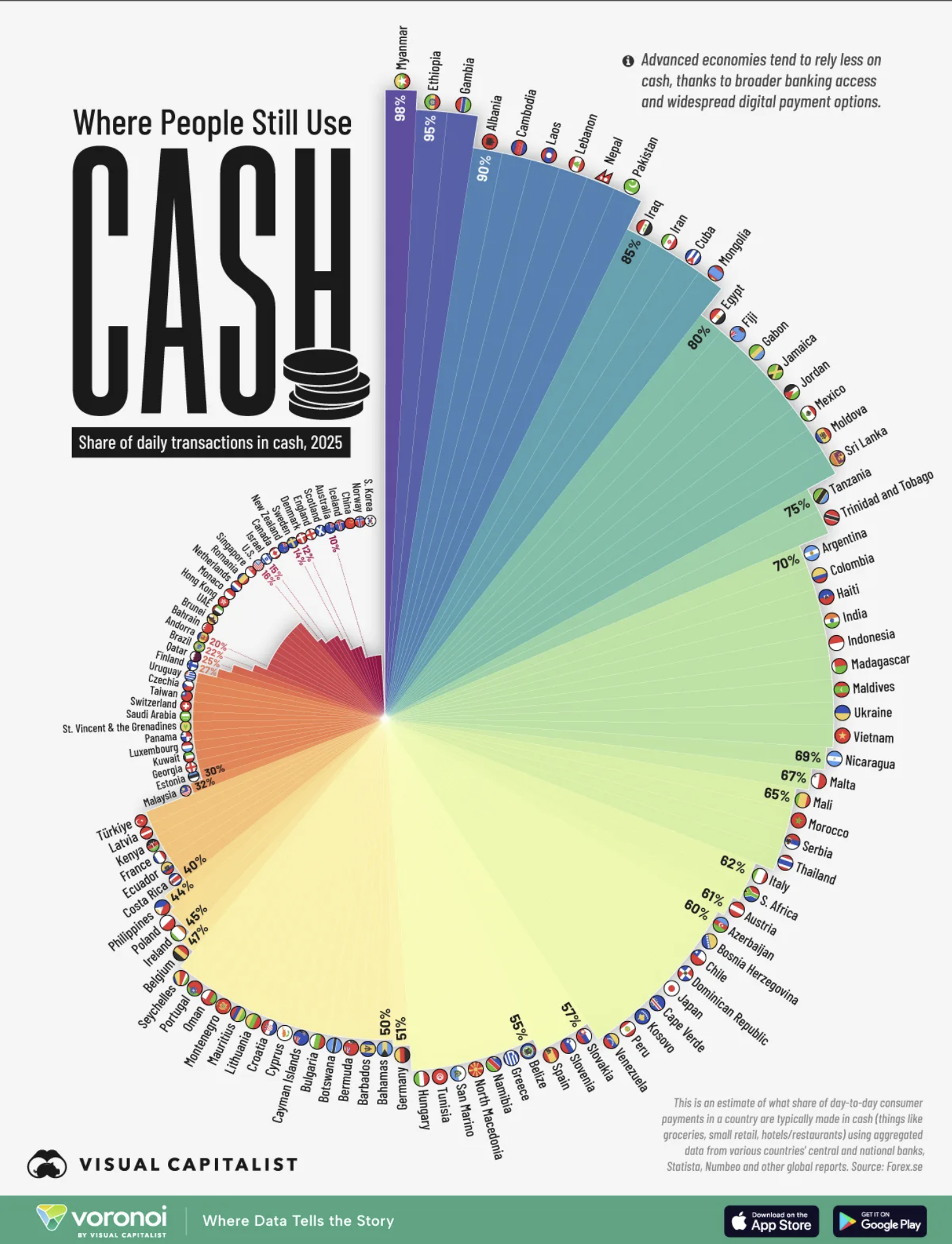
Still a lot, in some markets. Visual Capitalist's 2025 ranking shows countries where cash still covers the vast majority of daily transactions, up to about 98 percent in Myanmar. Even in digital-first economies, the Bank for International Settlements notes that demand for cash withdrawals has generally stabilized, a sign of the lasting role of cash.
For payment operators, the conclusion is the same everywhere: the shift is uneven by region, age group and channel, and the stack must support both new digital rails and merchants whose customers still pay in cash.
How far has Japan moved toward cashless payments?
Faster than expected. According to Japan's Ministry of Economy, Trade and Industry (March 2026), the cashless payment ratio reached 58.0 percent in 2025 on the domestic indicator, and the government now targets 65 percent by 2030 and 80 percent in the long term.
Cash persists among older consumers, small independent shops and vending machines. For a PayFac or PSP in Japan, the opportunities are digital onboarding of small merchants and acceptance of QR codes and mobile wallets such as PayPay alongside cards and JCB, with routing across methods.
Why does Germany keep a strong cash culture and what is changing?
Privacy concerns, habit and merchants' sensitivity to card fees long kept cash in first place. That has just changed: in the Bundesbank's payment behaviour study (June 2026), cash accounted for 45 percent of payments in 2025, six points less than in 2023, and cashless payments were used more often than cash for the first time.
For operators targeting Germany, the stack should cover girocard, international cards, Apple Pay and Google Pay, SEPA Instant transfers and Wero, presented as digital first with cash still accepted in store.
How did Pix make Brazil a blueprint for digital payments?
By making instant payments free for individuals, available 24/7 and accepted through QR codes at any merchant. Pix is now the most used payment method in the country: according to Banco Central do Brasil data reported in July 2026, it processed 36.3 billion transactions between January and May 2026, 26 percent more than a year earlier.
Cash remains for informal and low-connectivity segments, and card acceptance still matters for credit and installments. For operators serving Brazil, Pix must sit next to cards and Elo, with recurring Pix and refunds handled at platform level. The A2A payments article places Pix among other real-time systems.
What slows digital payments in Mexico and how do operators adapt?
A large unbanked population, informal commerce and limited merchant equipment in rural areas. Cash still represents roughly 62 percent of transactions, according to Mexico Business News (January 2026), citing Banxico data, while the SPEI instant transfer system already counts more than 73 million adult users.
For ISVs and PSPs in Mexico, the path runs through low-cost acceptance, transfers and cash vouchers for online purchases, and cards including the domestic Carnet scheme, covered in the card networks article.
What should PSPs and PayFacs build to serve hybrid cash-and-digital markets?
A stack that follows each market's pace rather than forcing one model:
- Local method coverage: cards and domestic schemes, wallets, instant transfers and voucher methods, activated per market from the global payment network.
- Routing and fallback across methods and providers, with routing rules per country.
- Reconciliation that brings card, instant and voucher payments into one view.
- Data to follow adoption, costs and approval rates as each market shifts.
For operators expanding into new markets, that is the difference between launching country by country and redesigning the stack each time.
Sources
- Ministry of Economy, Trade and Industry (Japan), cashless payment ratio 2025, March 31, 2026
- Deutsche Bundesbank, "Payment behaviour in Germany in 2025", June 17, 2026
- Sou Brasília, Pix figures for January to May 2026 based on Banco Central do Brasil data, July 7, 2026
- Mexico Business News, "Trends shaping the future of payments in Mexico in 2026", January 12, 2026
- Bank for International Settlements, payment statistics commentary
- Visual Capitalist, "Ranked: Countries That Use the Most Cash in 2025"