
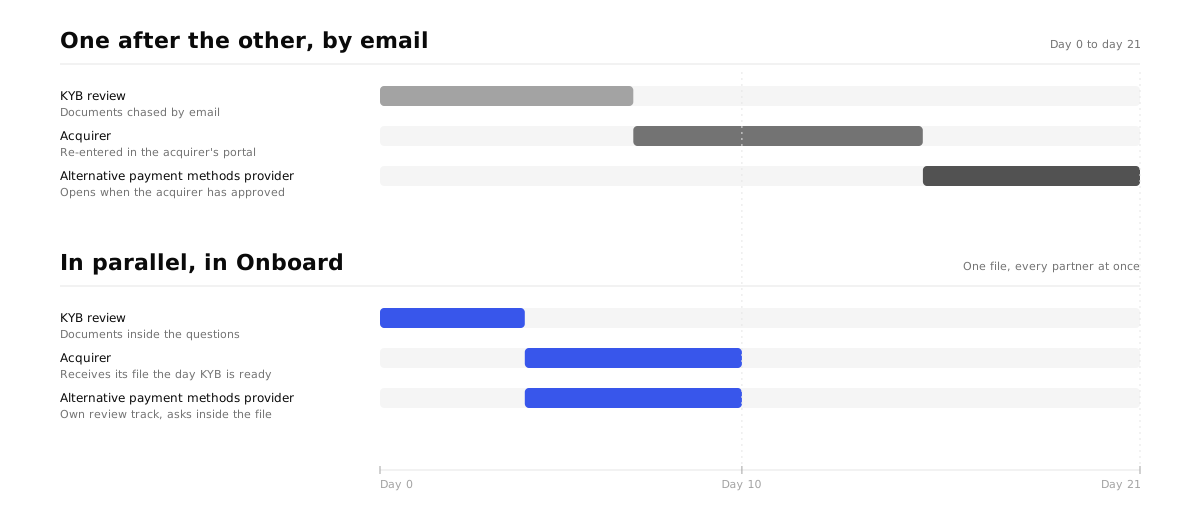
A merchant you invited on day 0 is still waiting on day 21. No single check was slow. The KYB review, the acquirer's questions and the second partner's questions simply ran one after the other.
That sequence comes from the tools, not from the regulation. Email, spreadsheets and partner portals each hold their own copy of the merchant file, so every partner starts from zero. NORBr Onboard replaces those copies with one file per merchant, under your brand, that every partner reviews at the same time and asks its questions inside. NORBr's CEO puts the effect simply: onboarding time divided by two, at a minimum.
Here is where the days actually go, why the regulatory calendar makes this urgent, and what changes when the file stops moving.
What does a slow merchant onboarding cost a payment operator?
Slow onboarding costs revenue twice. A merchant that goes live on day 21 instead of day 10 processes eleven fewer days of volume in its first year. And a merchant that is still waiting has time to sign with someone else, so part of the pipeline never processes at all.
Merchants price this in when they choose. In Mastercard's research on digital merchant onboarding, published in April 2024, 30 to 35 percent of small and medium merchants surveyed in Asia-Pacific said onboarding time and a simple onboarding process were key considerations when selecting an acquirer. The same study puts the cost of processing an application at 250 to 350 dollars for a traditional acquirer, against around 8 dollars for a payment facilitator with a digital flow. Those two figures describe the same gap from both sides: the merchant feels it as waiting, the operator pays for it as manual handling.
Why is merchant due diligence getting heavier, not lighter?
Three forces push the other way at once: the European Union is replacing its anti-money-laundering directives with a directly applicable regulation, that regulation puts a clock on how often merchant files must be refreshed, and card scheme rules keep the acquirer liable for everything its payment facilitators sign.
Regulation (EU) 2024/1624, the AMLR, applies from 10 July 2027. It replaces national transpositions with a single rulebook for obliged entities, which include payment institutions and e-money institutions. Two of its provisions land directly on merchant onboarding. The beneficial ownership threshold becomes ownership of 25 percent or more, where the fourth directive said more than 25 percent, so a holding of exactly 25 percent now has to be identified. And Article 26 requires customer information to be updated at an interval that depends on risk and may not exceed one year for higher-risk customers and five years for all others, with an event-driven review whenever a relevant fact about the customer changes. AMLA, the new EU authority, is due to publish guidelines on ongoing monitoring by 10 July 2026.
On the scheme side, nothing has loosened. Visa's description of the payment facilitator model, dated February 2024, states that acquirers are responsible for the acts of both payment facilitators and sponsored merchants, that the acquirer must ensure proper due diligence occurs when sponsored merchants are signed, and that the payment facilitator monitors sponsored merchant activity on an ongoing basis.
What is the difference between KYB and KYC when onboarding a merchant?
KYB, Know Your Business, verifies the legal entity: registration, legal form, registered address, ownership chain down to the beneficial owners, sanctions and adverse-media screening, and the business itself, meaning what it sells, through which website, under which merchant category code. KYC, Know Your Customer, verifies individuals: the directors, the authorized signatory and the beneficial owners identified during KYB, through identity documents and, where required, a liveness check.
In merchant onboarding the two are nested. A KYB file is not complete until the people it points to have passed KYC. For low-risk merchant types many operators run what the market calls light KYC, identity verification on the signatory and the main beneficial owner only, and reserve full KYC for higher-risk categories. The depth is a risk decision. The sequencing is a tooling decision, and that is where most of the time goes.
How does merchant onboarding work today for a PayFac, PSP or ISV?
In most operators the flow is the same. The merchant fills a form or receives a questionnaire by email. The onboarding team chases missing documents and tracks the file in a spreadsheet. Once the KYB file looks complete, the team opens an application with the first partner, typically the acquirer, in that partner's portal, re-entering data and re-uploading documents. The acquirer comes back with questions, the team relays them to the merchant and back. When the acquirer approves, the team opens the next application with the second provider, and the cycle restarts.
Each step is reasonable on its own. The acquirer is right to ask about the refund policy. The second provider is right to want the beneficial owner's passport. The merchant is right to expect to answer each question once.
Why do email and partner portals make every partner wait for the previous one?
Because each tool holds a separate copy of the file, and a copy cannot be reviewed by two parties at once without someone reconciling the versions. The operator's team becomes that someone, which is why reviews run in sequence: nobody can safely open application B while application A is still generating changes to the file.
Three structural limits follow. First, status lives in people's heads. The merchant does not know what is left, the partner does not know whether its question reached anyone, and the operator's team knows only what the last email said. Second, every partner question costs two hops, operator to merchant and back, with the file drifting a little on each hop. Third, the refresh cycle that Article 26 imposes has no home: a year after go-live, the file exists as attachments in four inboxes, and the operator rebuilds it to run the annual review.
Standalone KYB verification tools fix the first check and leave the rest untouched. They tell you whether a company exists and who owns it. They do not run three partner applications off one file, because they do not hold the file.
What changes when one KYB file feeds every partner at once?
The file stops moving. In NORBr Onboard, a dedicated onboarding console, separate from the NORBr Console that runs payments, each merchant has one file that lives in one place for the whole relationship. The merchant sees it under your brand, your team works in it, your referral partners follow their own merchants in it, and each payment partner you connect reviews it in the same place. You decide, question by question and document by document, what each partner sees, and whether the merchant sees that partner's name at all.
For the merchant, the questionnaire you built shows only the questions that apply, so a marketplace is asked about its sellers and a single-store retailer is not. Each document is uploaded inside the question it supports. Progress saves as it goes, missing fields are listed before submission, and a file started on Tuesday can be finished on Thursday from a phone without starting over.
For your team, every file has an owner, a risk level and a history of who did what. Your analyst, the merchant and each partner read the same status. When a document is wrong, the merchant is not rejected but challenged on that one document, and answers in a conversation attached to it. The console shows average decision time and approval rate over the last 30 days, overall and per partner, so you know where the days go across the portfolio and not only on the file someone complained about.
For your partners, one KYB feeds every application at once. The acquirer and the second provider receive their file on the same day, each reviews it against its own document requirements on its own review track, and each asks its questions on the exact question or document concerned, directly to the merchant or relayed by your team, as you choose. The merchant answers once. The timeline that ran KYB, then partner A, then partner B now runs KYB, then A and B together. That is the mechanism behind the halved onboarding time, and it is why the gain is structural rather than a matter of working faster.
After go-live, the file does not disperse. Every document, every earlier version and every exchange stays attached to the merchant, so when the review that Article 26 requires comes round, your team reopens a file instead of rebuilding one from four inboxes. The data is hosted in the European Union and sensitive answers are encrypted value by value.
NORBr Onboard does not make the underwriting decision. Your partners keep their requirements and your team keeps its risk policy. What changes is that the three of you read the same file at the same time.
The merchant that signed elsewhere on day 21 did not leave because the checks were strict. It left because they ran one after the other.
NORBr Onboard gives PayFacs, PSPs, ISOs and ISVs one white-label onboarding file per merchant, reviewed by every partner in parallel. Talk to us about running your merchant onboarding under your brand.