
Explained to kids!
Imagine a giant soccer game where every player wears the same color, but each one plays a different position. Some defend, some pass, some score. Now imagine trying to figure out who does what without knowing their roles.
That’s how payments work sometimes.
There are players like ISVs, ISOs, PayFacs, PSPs, and Acquirers. They all touch payments, but they play very different roles. This guide helps decode who does what and why it matters.
And detailed for specialists
Purpose of this document
The payments ecosystem is full of overlapping roles, confusing terms, and actors that seem similar but differ in function, responsibility, and regulation. This document clarifies the distinctions between the major actors:
- ISV (Independent Software Vendor)
- ISO (Independent Sales Organization)
- PayFac (Payment Facilitator)
- PSP (Payment Service Provider)
- Acquirer (Acquiring Bank)
We explain who they are, what they do, what regulatory status they hold, and how they interact with merchants, acquirers, and card schemes.
Key distinction: commercial vs legal vs technical roles
Many actors are defined by:
- Legal/regulatory status (e.g., licensed PSP, EMI, PI)
- Card scheme role (e.g., Visa-registered PayFac or ISO)
- Business model (e.g., SaaS platform, aggregator, integrator)
Understanding a company’s role requires looking at all three dimensions.
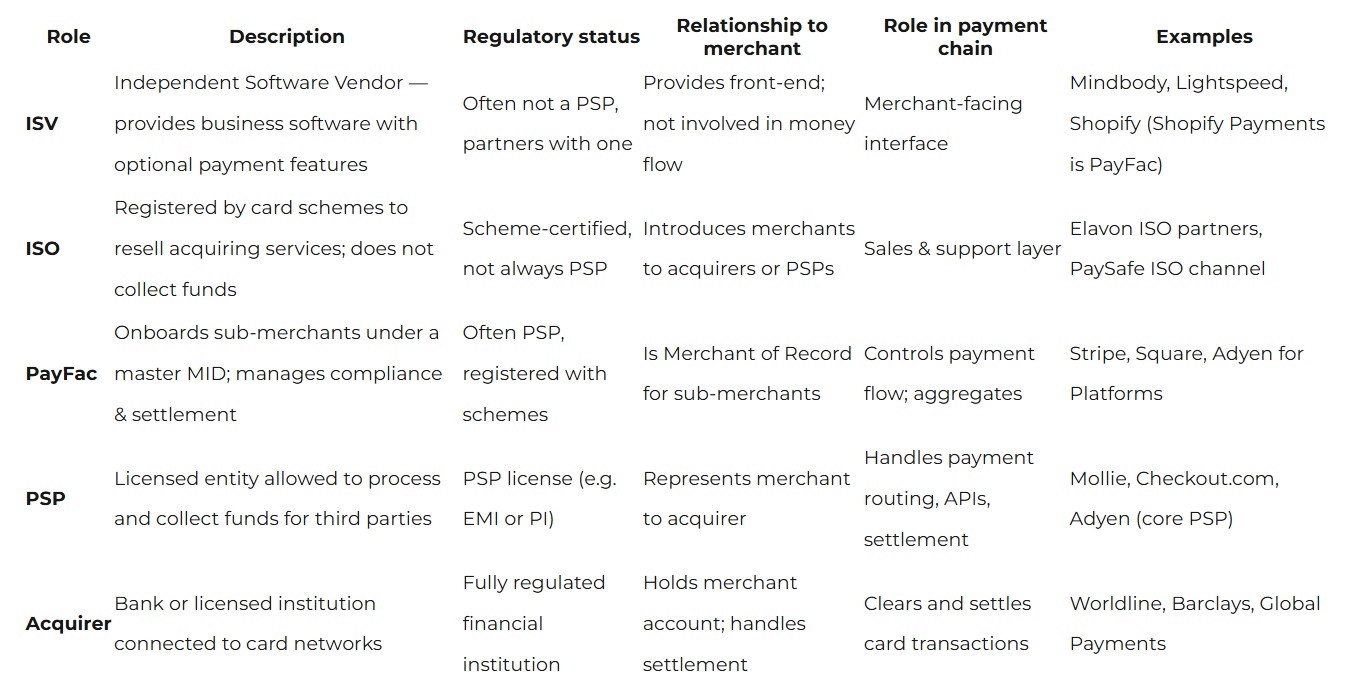
Glossary of Roles (with distinctions)
Nuances worth noting
- A PSP is a legal status, allowing an entity to collect funds for third parties (per PSD2 in Europe).
- A PayFac is a role defined by card schemes — often layered on top of a PSP license.
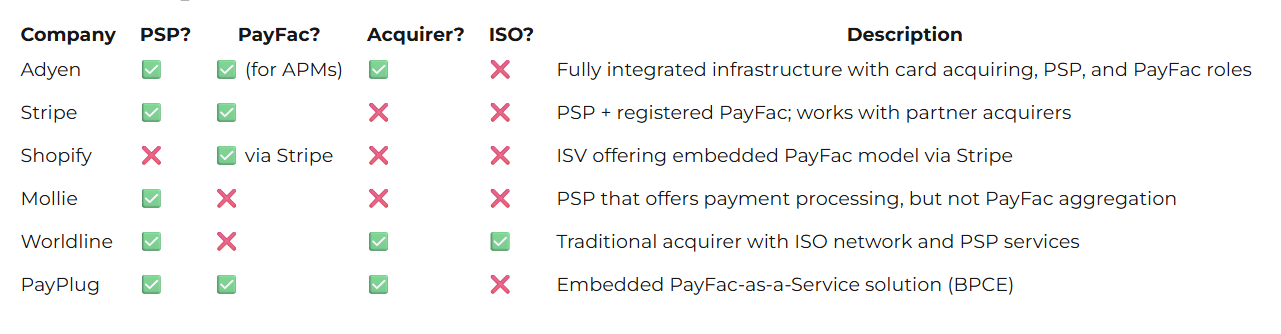
- An Acquirer is a settlement entity, but some modern players (e.g. Adyen) hold both roles (acquirer + PayFac).
- An ISV may embed payments but doesn't necessarily touch funds.
- An ISO does not process or collect funds — it is a commercial channel, not a regulated one.
Examples of combinations