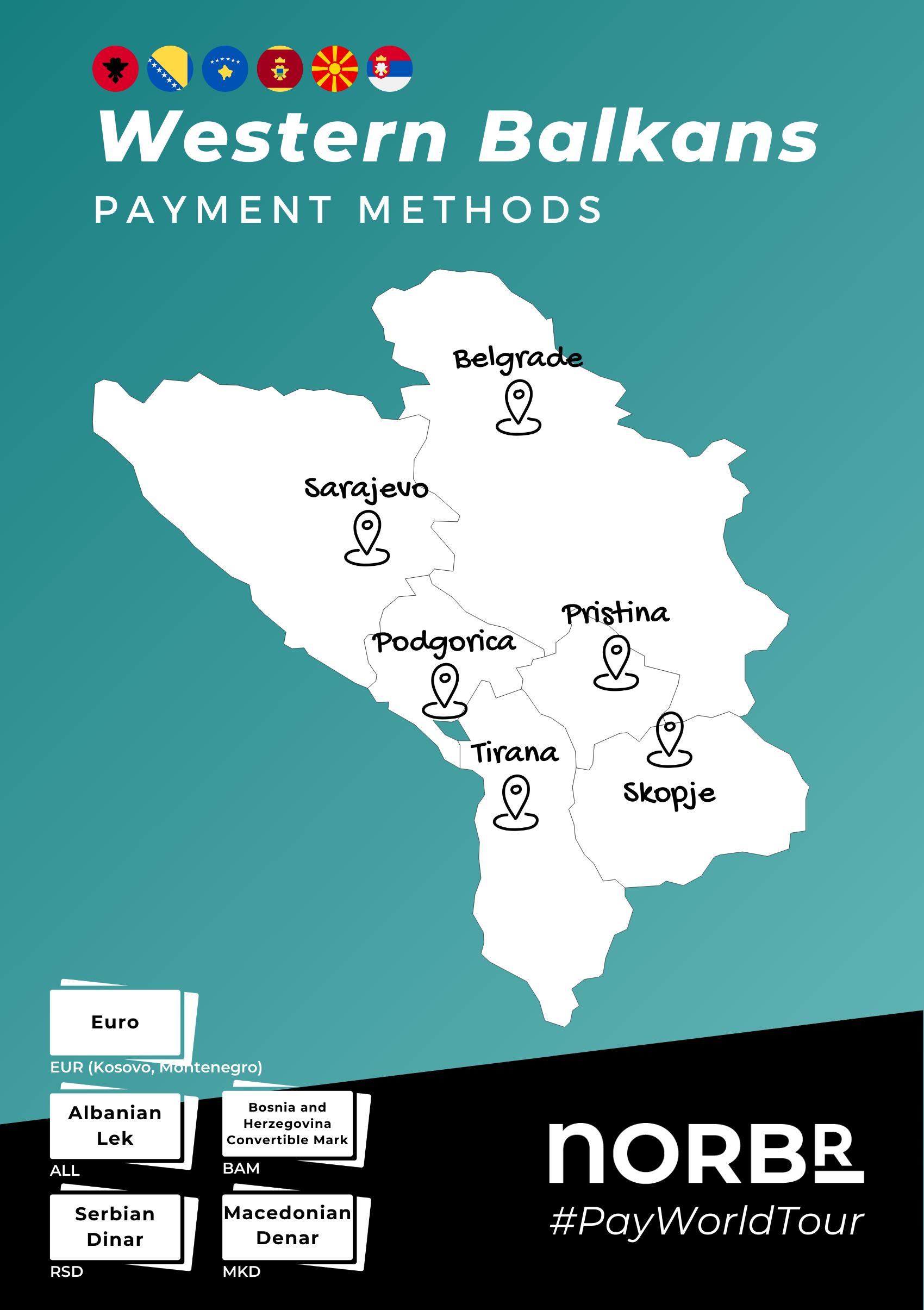
The Western Balkans region is witnessing a transformative shift in its payment landscape. Traditional cash payments remain significant but are gradually declining. Digital payment methods, including cards, bank transfers, e-wallets, and BNPL services, are gaining traction. This evolution reflects broader efforts to modernize infrastructure, align with European standards, and meet growing consumer demand for convenience and security. Each country in the region exhibits unique dynamics, shaped by local schemes and the presence of global players.
Payment by card in the Western Balkans
In the Western Balkans, encompassing Albania, Bosnia and Herzegovina, Kosovo, Montenegro, North Macedonia, and Serbia, card payments are increasingly prevalent in e-commerce. International card networks such as Visa and Mastercard dominate the market, with widespread acceptance among consumers and merchants. This trend is driven by growing trust in digital transactions and the expansion of online retail.
In Serbia, the domestic DinaCard system operates alongside international networks. Managed by the National Bank of Serbia, DinaCard serves the local market and is accepted by most Serbian online merchants. Some versions of DinaCard also support international use, enhancing its versatility.
Consumers across the region predominantly use debit cards for online purchases, while credit card usage is gradually increasing, especially among younger demographics and frequent online shoppers. In Bosnia and Herzegovina, and Montenegro, Visa and Mastercard maintain strong positions, with no significant local card schemes present. Banks in these countries issue cards from international networks, facilitating access to global e-commerce platforms.
North Macedonia exhibits similar patterns, with local banks primarily issuing international cards. Initiatives by financial authorities have promoted greater card adoption, leading to increased use for e-commerce, particularly in cross-border transactions.
Throughout the Western Balkans, financial institutions and e-commerce platforms are implementing 3D Secure protocols to enhance payment security. This measure addresses consumer concerns regarding privacy and fraud, and is becoming standard among card providers and merchants in the region.
Local actors: DinaCard

Payment by Cash in Western Balkans
In the Western Balkans, cash remains prevalent, though its use is declining. Serbia leads the region in cashless adoption. The country’s modernization efforts and wide adoption of DinaCard have driven digital payment growth (World Bank). Other countries, including Albania, Kosovo, Montenegro, North Macedonia, and Bosnia and Herzegovina, rely heavily on cash. These nations are gradually transitioning to cashless methods, but infrastructure and adoption challenges persist (World Bank, BIS).
For 72.5% of retailers, Cash on delivery (COD) remains the dominant payment method in e-commerce (ecommerce.mk). The reliance on COD presents challenges, including cash flow issues for e-retailers and logistical complexities. Despite these hurdles, there is a gradual shift towards digital payments as consumer confidence grows and infrastructure improves.
Payment by Bank Transfer
Bank transfers are a critical payment method in the Western Balkans, with countries implementing real-time gross settlement systems and instant payment solutions to improve efficiency. These systems facilitate large-value and urgent payments, supporting both domestic and cross-border transactions.
- Albania: The Albanian Interbank Payment System (AIPS) processes large-value payments, operating since 2004 under the Bank of Albania. AIPS EURO, launched in 2022, handles euro-denominated domestic payments, reducing reliance on correspondent banks abroad (Bank of Albania). In November 2024, Albania gained SEPA membership to facilitate euro transactions and cross-border interoperability (European Payments Council).
- Bosnia and Herzegovina: The Gyro Clearing System, managed by the Central Bank of Bosnia and Herzegovina (CBBH), is essential for interbank settlements and maintaining the smooth operation of financial transactions (CBBH). In January 2025, Bosnia joined a regional initiative with Italy to implement an instant payment system modeled on the Eurosystem’s TIPS (Bank of Italy).
- North Macedonia: The Macedonian Interbank Payment System (MIPS) supports large-value payments in Macedonian Denars. Operational since 2001, it aligns with ISO 20022 standards for interoperability and security (National Bank of North Macedonia). North Macedonia is also preparing for SEPA integration to modernize its payment landscape and improve cross-border transactions (European Payments Council).
- Montenegro: Montenegro became the first Western Balkans country to gain SEPA membership in November 2024. Its inclusion supports euro-denominated transactions and integration with EU standards (European Payments Council). Efforts to adopt instant payments are underway as part of regional cooperation with Italy (Bank of Italy).
- Kosovo: Kosovo participates in regional payment modernization initiatives, including plans for an instant payment system in collaboration with Italy. This system will enable real-time transactions in local currencies, enhancing financial efficiency (Bank of Italy).
- Serbia: Serbia has a well-established payment infrastructure and plans to adopt SEPA standards to align with EU practices. Its robust domestic systems include ongoing modernization to support instant and cross-border payments (World Bank).
These systems underline the region’s commitment to modernizing payment infrastructures. SEPA integration, combined with the rollout of instant payment systems, is expected to significantly influence the payment landscape by 2025.
Local actors: SEPA

Payment by installment and BNPL
BNPL (Buy Now, Pay Later) services are emerging in the Western Balkans, catering to younger consumers and online shoppers. Adoption is still limited, but global players like Klarna and local startups are beginning to explore opportunities in the region.
- Albania: BNPL remains niche but is gaining attention among urban consumers familiar with international BNPL solutions. NOA is a notable local BNPL provider, offering flexible payment options for Albanian consumers (NOA).
- Bosnia and Herzegovina: Limited BNPL options exist, though fintech companies are gradually introducing installment-based payment solutions for e-commerce (Metamorphosis).
- Kosovo: BNPL adoption is minimal, but startups are testing models to attract younger, tech-savvy shoppers. IBAS is a notable local BNPL provider, offering innovative payment solutions tailored for Kosovo’s market (IBAS).
- Montenegro: Awareness of BNPL is growing, particularly through online retailers offering installment plans (BIS).
- North Macedonia: Some retailers have started providing deferred payment options, responding to the increasing demand for BNPL services (World Bank).
- Serbia: BNPL adoption is higher compared to other countries in the region, driven by increasing e-commerce activity and younger consumers (National Bank of Serbia).
Challenges include regulatory hurdles, consumer awareness, and integration with local e-commerce platforms. However, the growing interest in flexible payment solutions indicates potential for future growth in the BNPL sector.
Local actors: NOA, IBAS


Payment by digital wallet and X-Pay
E-wallet adoption in the Western Balkans is steadily increasing, driven by growing smartphone penetration and consumer demand for digital convenience. However, the adoption varies across countries, and key players are beginning to emerge globally and locally.
- Albania: Leading e-wallet services include Raiffeisen Albania’s Raiffeisen ON and Paysera, which offer peer-to-peer transfers and payment options for utilities.
- Bosnia and Herzegovina: Popular options include UniCredit Mobile Wallet and BamCard, which facilitate local online payments and retail transactions.
- Kosovo: E-wallets like Moneta are gaining traction, focusing on remittances and small-scale online purchases.
- Montenegro: Erste Wallet and CKB GO Wallet lead in providing e-payment solutions for younger, urban consumers.
- North Macedonia: Halkbank’s HalkPay and NLB Pay dominate the local market, offering QR-based payments and mobile integrations.
- Serbia: The e-wallet landscape is competitive, with BanqUp by AIK Bank and Settle providing innovative digital payment solutions.
Despite regional differences, e-wallets are increasingly embraced as secure and convenient payment methods, with significant growth potential in both retail and peer-to-peer transactions.
Google Pay, Apple Pay, and Samsung Pay are available in Montenegro, North Macedonia, and Serbia, supported by partnerships with local banks. They remain unavailable in Albania, Bosnia and Herzegovina, and Kosovo.
PayPal is widely available in the region, providing reliable cross-border payment options for consumers and merchants.
Local actors: Raiffeisen ON, Paysera, UniCredit Mobile Wallet, BamCard, Moneta, Erste Wallet, CKB GO Wallet, HalkPay, NLB Pay, BanqUp, Settle








If the payment methods in the Western Balkans intrigue you, feel free to access the #PayWorldTour library for more insights.